









SCS Construction Management was founded on a simple premise: approach every project from the client’s perspective. Since its establishment in 2017, that principle has shaped the company’s development, guiding its expansion from construction management advisory services into a broader, multi-service operation across Massachusetts and the wider northeastern United States. Today, the company continues to position itself as a partner to its clients, focusing on transparency, efficiency, and long-term value.
From the outset, SCS concentrated on construction management advisory services, a model that allows the company to act on behalf of the client rather than simply delivering work.
This approach enables clients to remain focused on their core business while SCS manages the complexities of construction. By functioning as an extension of the owner’s team, SCS delivers constructability insights, schedule compression strategies, and cost certainty from day one. As Jeff Stevenson, president of SCS, explains, “We’re always going into a project, as if we’re the customer. We really focus on bringing the best value to the customer. So, consequently, most of our customers are repeat customers.” That emphasis on representation has proven effective in building lasting relationships, including with a medical device company that has remained in SCS’s portfolio since 2020, with continuous project work over that period.
While advisory services formed the foundation of the business, SCS has since expanded its capabilities significantly. Today, the company is involved across all phases of project delivery, with construction management advisory and owner’s project management now forming a smaller part of a broader service offering. Pre-construction services include site assessment, program development, cost analysis, permitting, and subcontractor qualification. During construction, the company provides project management and oversight, subcontractor onboarding, documentation, weekly coordination meetings, and quality control. Field operations include full-time supervision, inspections, and training related to equipment and utilities. Design-build services further integrate delivery, bringing collaboration earlier into the process and supporting fast-track project timelines.
A notable addition to the company’s capabilities is its use of robotic layout technology through HP SitePrint. This service, which can be offered independently or as part of a wider project, enables layout tasks to be completed with a reported 98% accuracy, significantly reducing the time required between design and construction phases. The integration of this technology reflects a broader investment in tools and systems designed to improve efficiency while reducing complexity for clients.
The expansion of services has been accompanied by growth in personnel and geographic reach. “About two years ago, we made a conscious decision to say, ‘We need to expand.’ And we started growing. We brought in office staff, we brought in field staff, and now we’re in multiple locations,” Stevenson said. Headquartered in Wilmington, Massachusetts, just north of Boston, SCS operates within a region characterized by high levels of construction activity and competition. Within that environment, the company differentiates itself through its client-focused approach.
“We’re always trying to bring the best value, and a lot more transparency,” Stevenson said. “We’re always advising the customer on, what are our options? What do we recommend? At every stage of the game. We are really focused on solving problems … sometimes it’s a timing issue. It’s a coordination issue. It’s a financial issue. Whatever the issue is, we’re always driving it towards a solution.” That process is supported by open communication, ensuring that clients are equipped to make informed decisions at each stage of a project.
“Whatever the issue is, we’re always driving it towards a solution.”
SCS primarily serves clients in the commercial and industrial high-technology sectors, including clean rooms, life sciences, science and technology facilities, and warehouse environments. These technically demanding environments require precision planning, utility coordination, and strict adherence to regulatory and operational requirements—an area where SCS excels.
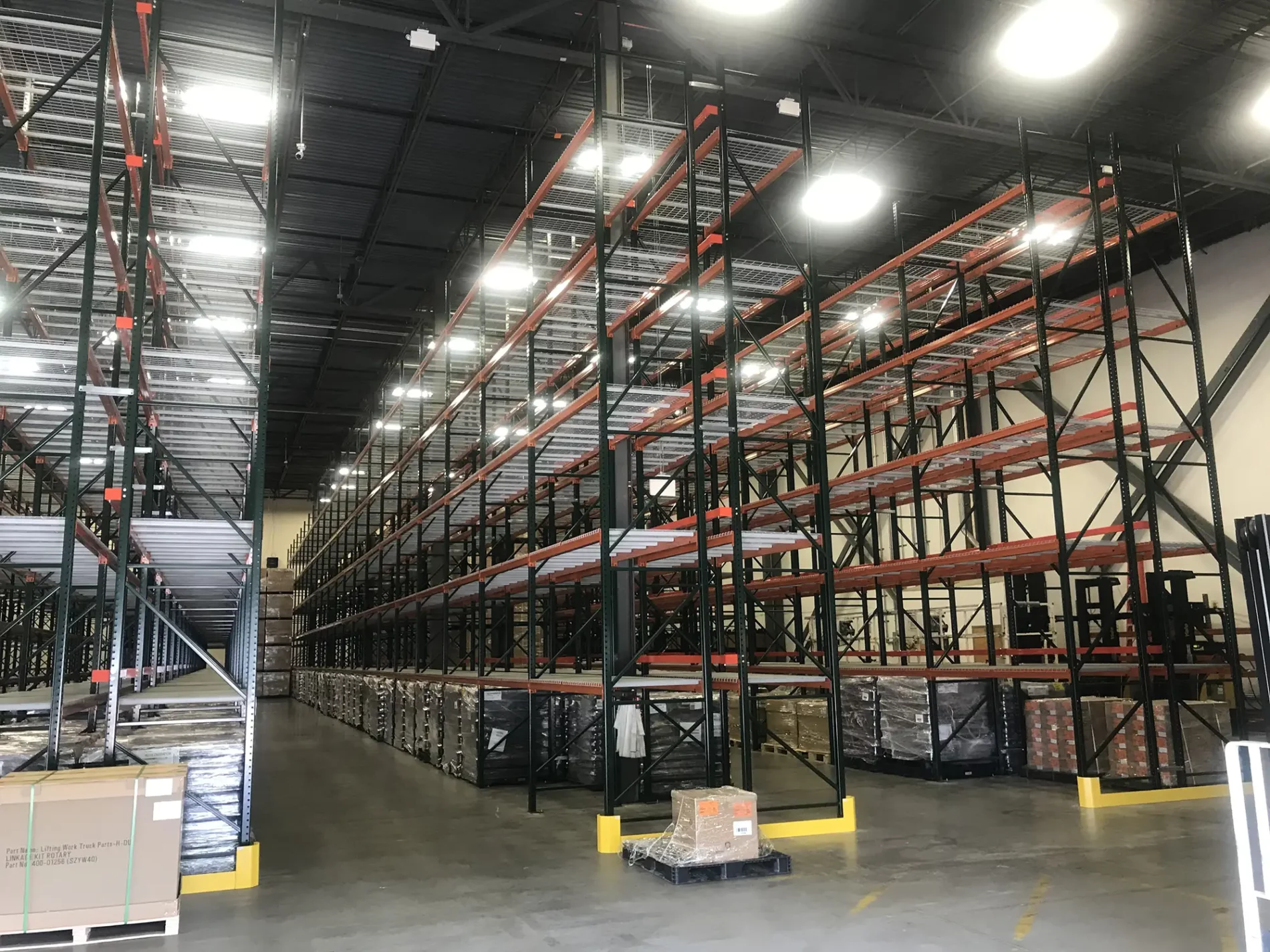
One project that illustrates this approach involved the conversion of a 110,000-square-foot warehouse into a distribution hub. This was the first project in which SCS deployed the HP SitePrint robotic layout system. The task involved laying out a detailed racking plan while coordinating with lighting, life safety systems, and wire guidance requirements. The layout also needed to be completed several months in advance of rack installation to allow other trades to proceed with their work. Traditionally, this process would require a team of seven people working for approximately 112 hours, including time to verify accuracy. Using the robotic system, the work was completed in a single eight-hour day by one operator, using a CAD-based layout that incorporated all required references. The outcome was significant enough that HP has since cited the project as a case study for the technology.
Another defining example comes from the company’s earliest days. SCS’s first project in 2017 involved the renovation of 12,000 square feet of office space. Stevenson recalls presenting an approach that would reduce costs for the client by 15%. “You’re going to pay me this, and you’re going to save all that,” he said, describing the initial pitch. The project ultimately exceeded expectations, finishing three weeks ahead of schedule and under budget. The client returned with additional work to test whether the outcome could be repeated. It could, and that engagement evolved into a long-term relationship, with SCS completing approximately $10 million of work annually for three consecutive years. In total, nearly $40 million in revenue was generated from that single client relationship. “The company was born out of that project,” Stevenson said.
As SCS approaches a decade in operation, the company is focused on scaling its business while maintaining the principles that have defined its growth. The target is to reach four times its current size within the next five years. Achieving that will involve continuing to attract repeat clients, expanding its presence and further investing in software and technology to support delivery.
“Our goal is to become a value resource,” Stevenson said, emphasizing that growth will not come at the expense of the company’s core identity. That identity is rooted in its role as a client advocate rather than a traditional contractor. “So long as we’re showing up as a partner to the clients, then that process works … we are not reliant on the architects and engineers to tell us what we need to do. Our approach is focused on the customer. We’re working on their project.”
As SCS Construction Management continues to expand across the northeastern United States, its development reflects a broader shift within the industry toward integrated services, technology adoption, and closer client collaboration. By maintaining its focus on representing the client’s interests while expanding its capabilities, the company is positioning itself for continued growth within a competitive and evolving construction market.