






Associations

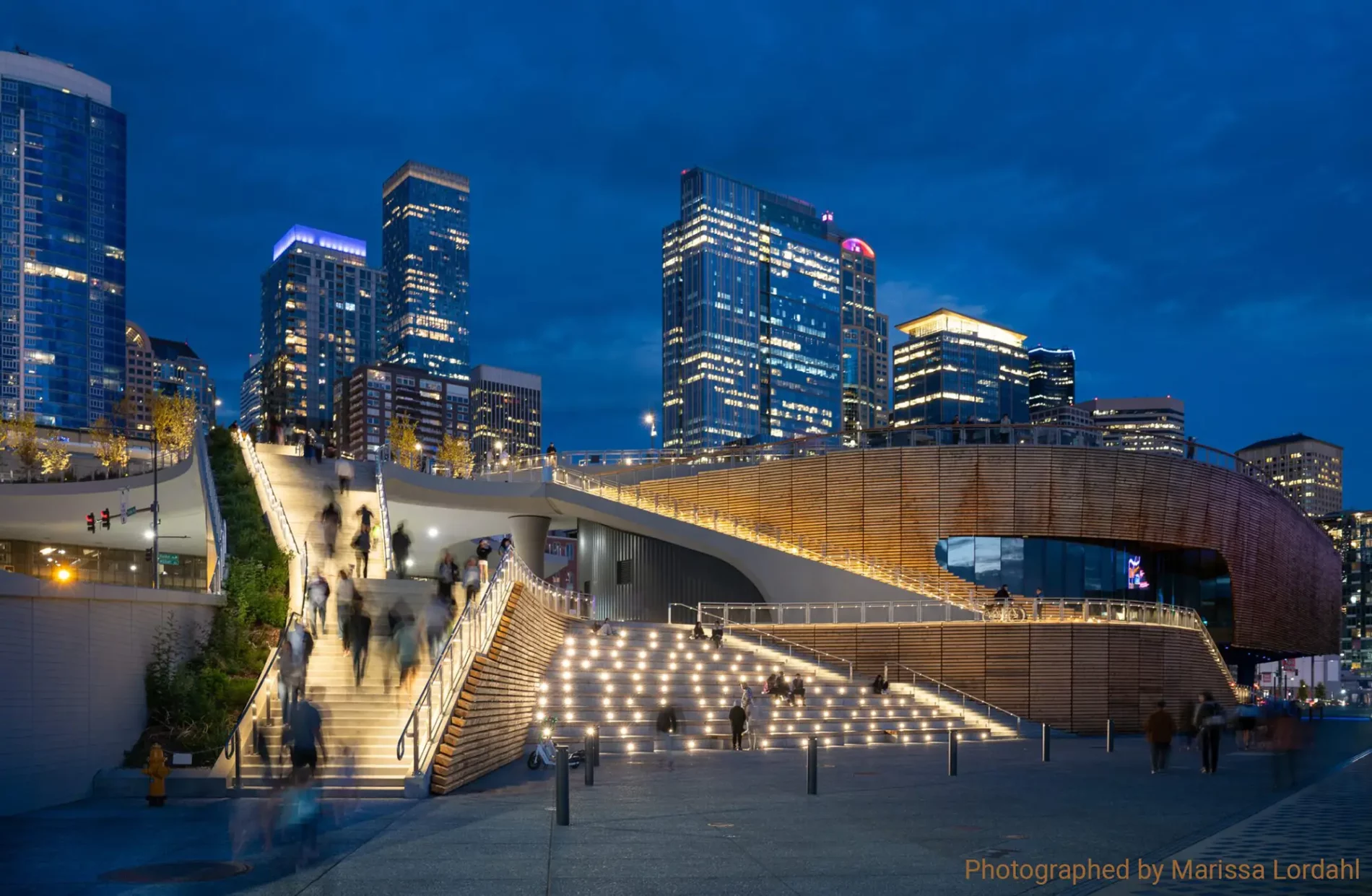
city ahead on a road at night

Civil Engineering & Infrastructure

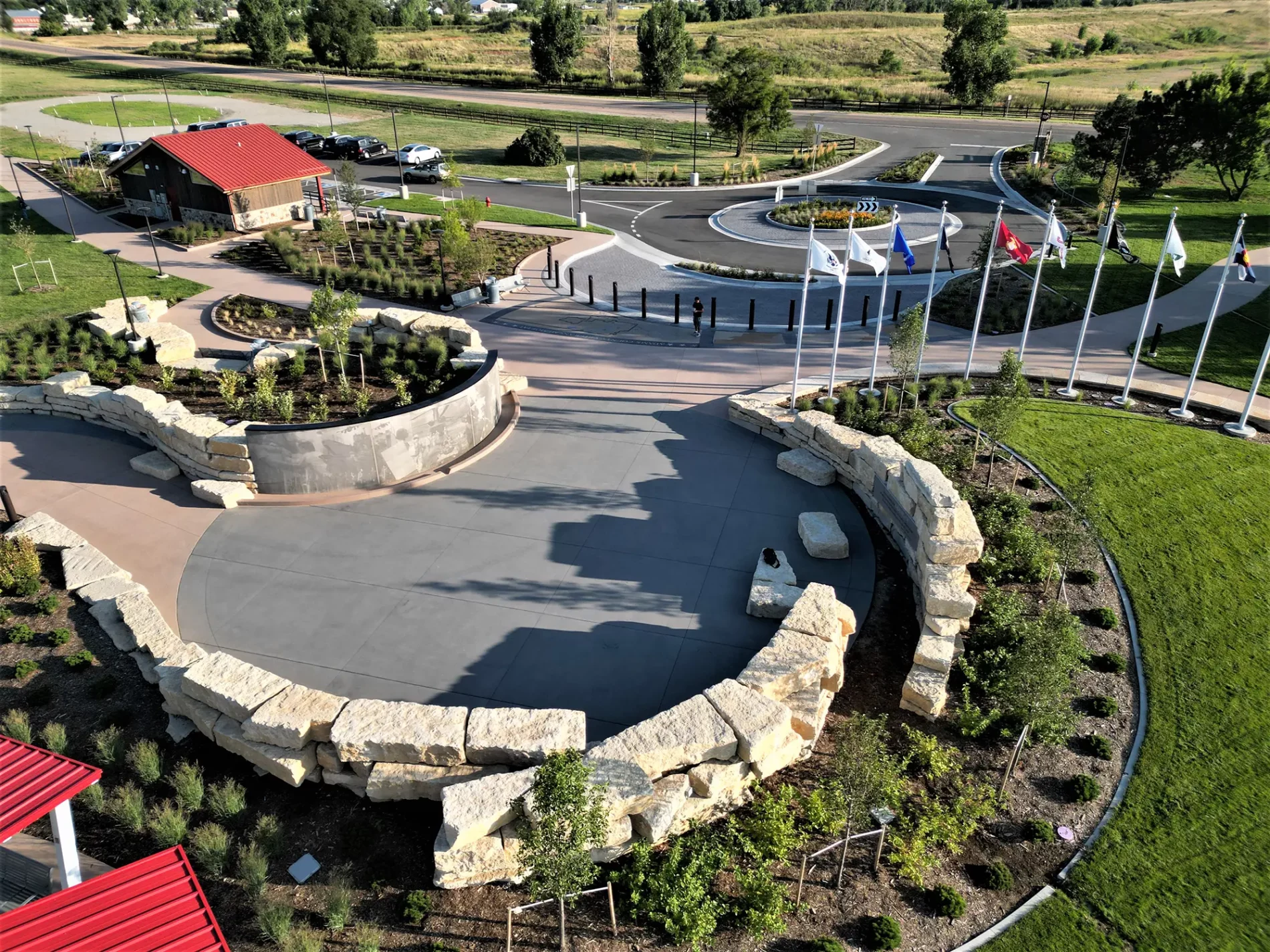
modern concrete structure

Concrete

design build drawing with construction tools

Design Build | CM | GC

multiple excavators parked in a row

Equipment

green tree outside office building

Green Building

thumbs up

Positive News

toolbelt construction tools

Specialty Contracting

Steel

Relationships Before Transactions – Design Build Success in the Midwest

View in E-mag

In construction, projects often start as simple, owner-developed sketches—rough, informal concepts drawn directly from the imagination. From these early ideas, preliminary designs begin to take shape. As the owner commissions the work, designs and details continue to evolve. The PBS team then initiates a thorough budgeting process. Once approved, the project progresses to final drawings, permitting, and construction. At every stage, PBS coordinates the process to ensure the outcome aligns seamlessly with the client’s vision.

THE PBS APPROACH

Professional Building Services (PBS) Inc. is a full-service planning, design, and construction firm based in the Midwest. With deep roots in the greater Chicago and Northwest Indiana area, PBS has been guiding construction projects from concept to completion for nearly four decades.

“We handle the process from beginning to end,” says PBS President Chad Charon. “Everything comes under one umbrella—planning, design, permitting, and construction—which streamlines and simplifies the construction process for our clients.” This integrated delivery system was the catalyst for the company’s early success and continues to drive its growth today.

While some owners still opt for the traditional bid-build method, Chad notes that approach often makes projects “far more transactional” than PBS prefers. At PBS, a “relationship over transaction” mindset is central to their approach. Listening to clients and building strong relationships lies at the heart of this award-winning design-build company.

As PBS moves into its 37th year, Chad and Founder Dale Reiser reflect on the milestones that have shaped the company and its roadmap for continued success. “When we formed the business, the concept of design and construction under a single responsibility and contract was our starting point,” Dale explains. “It allows our clients to work with a single, relational source, rather than navigating the traditional bid-build process.”

“When we formed the business, the concept of design and construction under a single responsibility and contract was our starting point.”

DESIGN BUILD VS. BID BUILD

Under the bid-build construction delivery system that Dale references, the client assumes significant responsibility. This includes hiring all design professionals and trying to communicate the project vision—often without input from or a relationship with the eventual builder. The process relies on bids from multiple contractors, after which the owner must decide who to hire. In this model, the owner bears substantial responsibility, trusting that the bids are complete, accurate, and fully account for all aspects of the project.

A RELATIONSHIP – FIRST PHILOSOPHY

PBS has found success through a more integrated, relationship-driven approach. For many years, the traditional design-bid-build method has been widely used across commercial, industrial, and municipal markets, largely based on the assumption that it delivers the best price for the owner.

However, this approach presents challenges. In many cases, the “low bidder” has no prior relationship with the owner and limited understanding of the project’s immediate and long-term goals. When discrepancies or oversights arise in a contractor’s pricing, disputes often follow—raising questions about responsibility and who will absorb the additional costs.

As a result, owners are frequently forced into the role of referee, resolving conflicts and, in many cases, covering unexpected expenses just to move the project forward. Engaging a single, accountable source for both design and construction help avoid these complications.

“The design-bid-build method is more transactional,” Chad explains, “and the preferred bidder is usually the lowest bidder. We take a more informed approach by understanding the owner’s objectives from the very beginning of the design process and from a builder’s perspective. From that initial concept sketch, we carry those goals all the way through completion. This creates a true relationship—often even a friendship—rather than just a business transaction. Many of our clients become friends, which is a benefit to both the owner and the builder.”

Dale reinforces this philosophy: “By design, we are not transactional—we are relational.” For more than 36 years, most of the company’s work has come through referrals from satisfied clients, a direct reflection of its relationship-first approach that has defined the company since its founding.

At the core of PBS’s approach is a clear vision: to simplify the construction process. As Chad describes it, simplification means having “one organization under a single umbrella responsible for planning, design, budgeting, permitting, and construction—all in one place.”

By contrast, the traditional model requires owners to separately hire architects and multiple engineers—civil, mechanical, structural, and electrical—before soliciting bids from general contractors who often had little or no involvement in the design phase. The result can be a fragmented and inefficient process.

PBS becomes the client’s single source of communication and responsibility—that’s how construction is simplified.

Having found success with this model, PBS is now focused on helping move the industry forward by advocating for the design-build approach through education and its own proven track record.

“We’re working to move the industry beyond the idea that soliciting multiple bids automatically leads to a better price. While that can sometimes be true, a low price is often not all-inclusive. When that happens, it becomes a difficult and frustrating process to unravel.”

In the traditional model, once a design is completed, owners send it out to general contractors for bidding. Those contractors then seek the lowest prices from numerous subcontractors and suppliers. Proposals are not always thoroughly vetted, key details can be overlooked, and ultimately the owner bears the consequences.

In these cases, the original contract amount rarely reflects the true total project cost. Frustration between all parties grows—the early appeal of a low price is quickly forgotten when faced with the realities that follow.”

DIVERSE PROJECT PORTFOLIO

In addition to its relationship-focused and simplified approach, PBS exemplifies what it means to be a truly diversified design-build company. This is reflected in both its service offerings and the breadth of its project portfolio.

“Design and construction have always been our core model,” Chad explains, “but there are times when owners come to us with independently completed drawings and ask us to serve as their Construction Manager (CM). In those cases, PBS is engaged to verify constructability and establish accurate project costs followed by complete construction management.

Under this delivery method, PBS also evaluates potential design adjustments that could generate cost savings for the owner. From there, the company manages and coordinates the entire construction process—from bidding and contract awards to payment coordination, construction and final occupancy permitting.

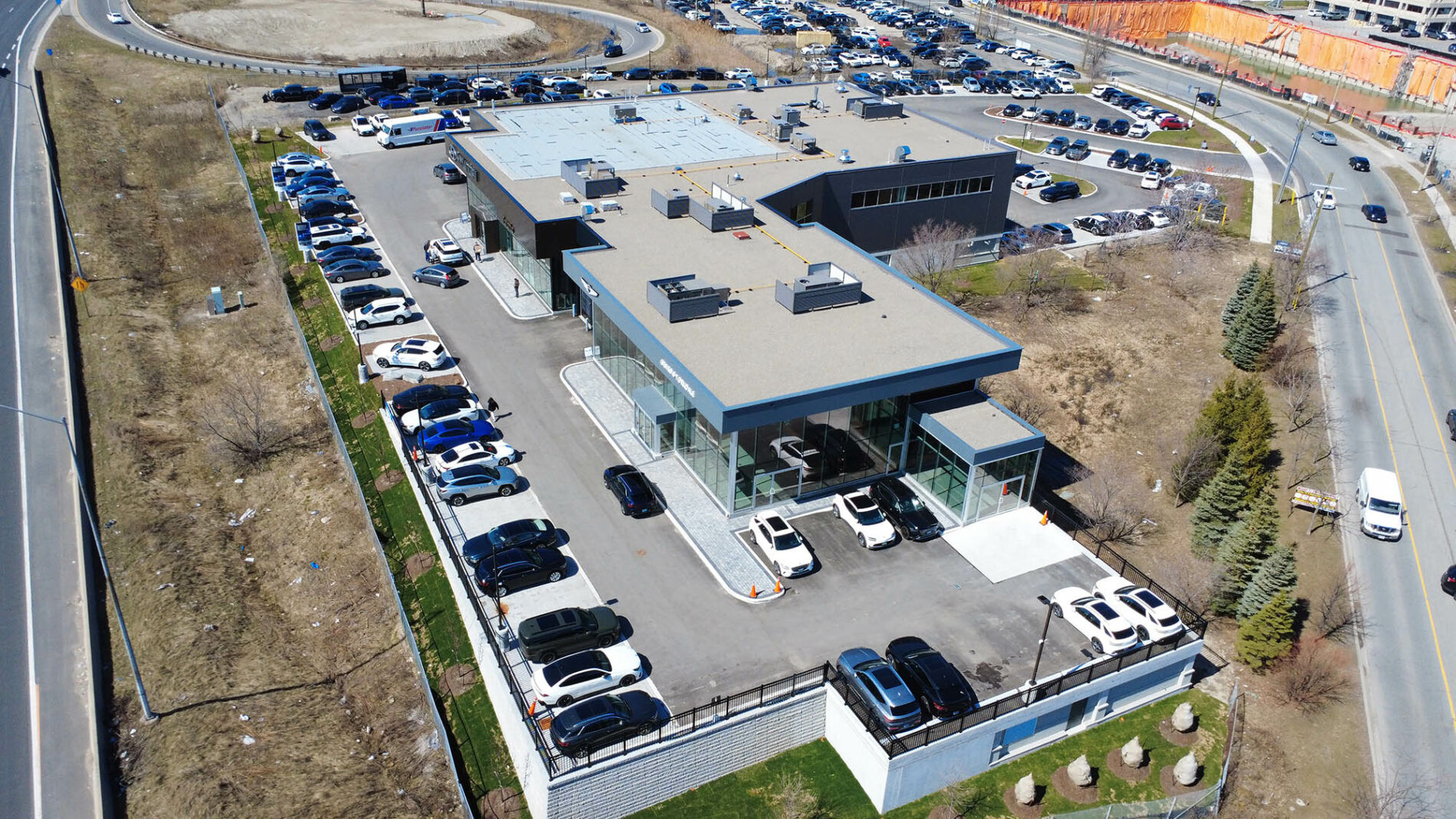
PBS’s commercial portfolio spans a wide range of sectors, including healthcare, hospitality, banking, automotive dealerships, transportation facilities, and cold storage, among others.

“Our work in the industrial sector includes manufacturing, production facilities, and industrial warehousing,” Chad adds. “In the municipal space, we’ve completed ESDA, EOC and fire stations, as well as recreational and public works projects. A significant portion of our work is also in faith-based projects, including worship centers, educational facilities, and multi-use spaces.”

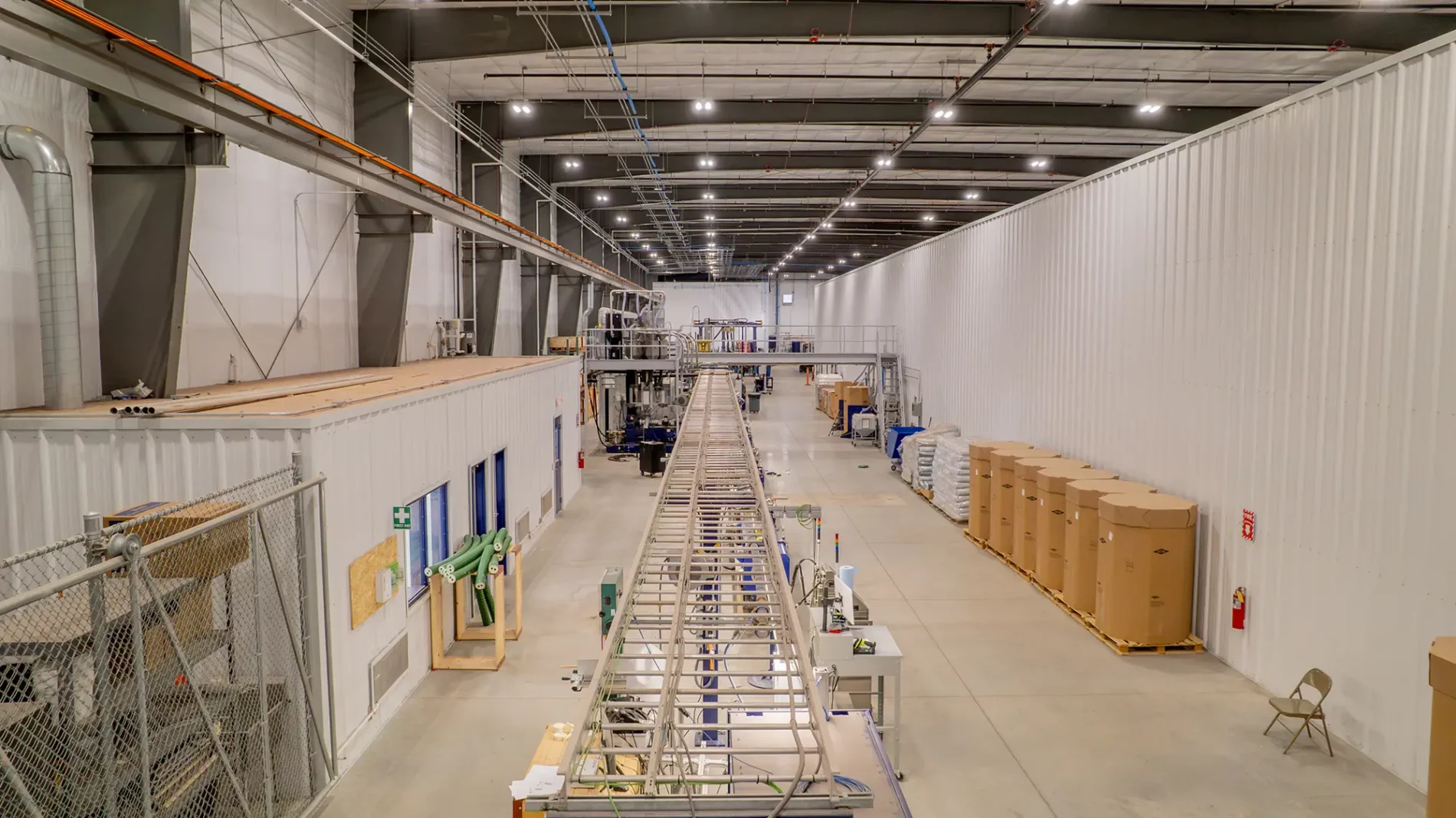
Recent projects highlight the breadth of PBS’s experience across multiple sectors. One example is Rovanco Piping Systems, an international joint venture focused on the manufacturing of piping systems, which showcases the company’s expertise in the industrial space.

“This was a 50,000-square-foot, ground-up development that included extensive site work and infrastructure expansion,” Chad explains. “It was a complex project involving large complex material handling systems, underground storage for fire sprinkler systems and significant electrical power requirements.”

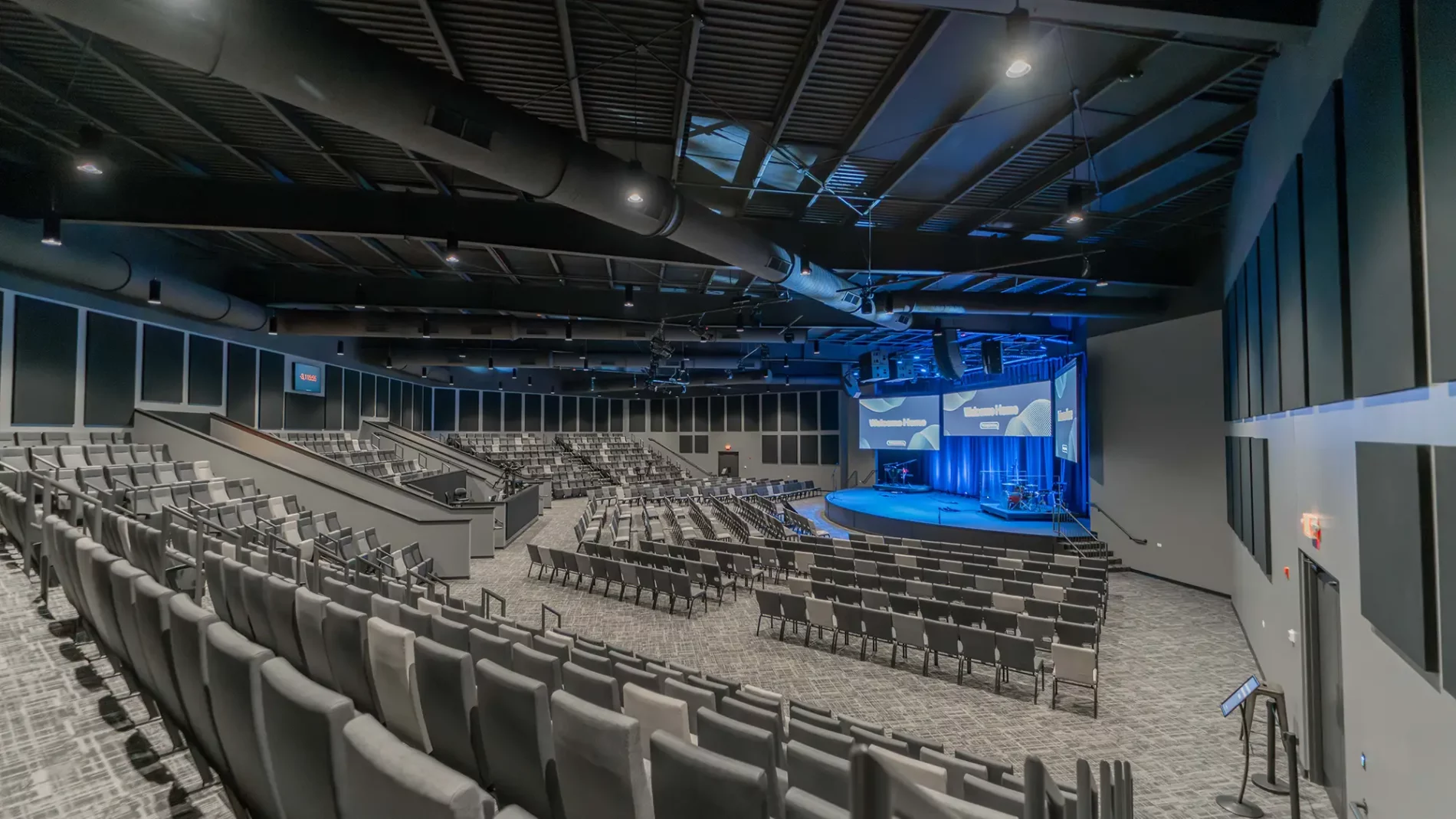
Reflecting PBS’s diversified approach, Chad points to a very different type of project: Heritage Church. “This project included a 1,000-seat worship auditorium along with renovations to the existing church building. It also required substantial site and infrastructure work to expand the overall footprint.”

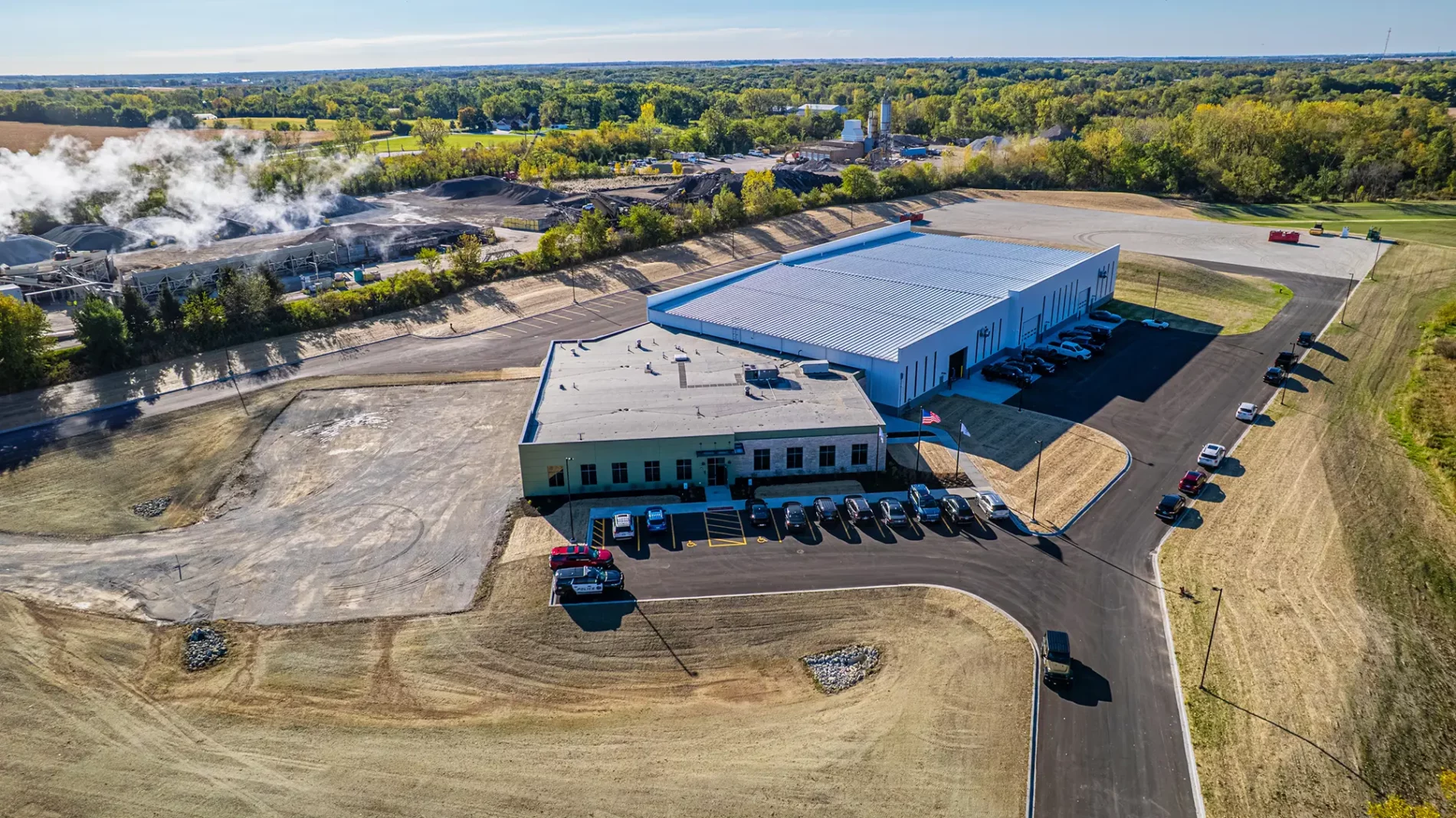
Another recent example is the construction of a significant public works facility for the Village of Monee. “This project encompassed 20 acres of site development and included staff offices, training spaces, and an apparatus storage building designed to accommodate large equipment.”

Through its site development services, PBS has the capability to transform raw land into fully functional building sites. “There was significant site development involved in both of those projects,” Chad says, referring to Heritage Church and the Village of Monee facility. This work included mitigating grade changes, designing and installing storm and sanitary sewer systems, addressing detention requirements, and completing site paving, curbing, and lighting, among other elements.

Another area of growth for PBS is tenant improvement projects. “We’re seeing increased demand in this space,” Dale explains, “which often involves renovating or building out existing facilities.” These projects span medical, dental, franchise, fitness, and retail environments. PBS’s design-build expertise provides valuable guidance to owners evaluating how best to adapt and optimize an existing space.

Looking back on the company’s evolution, Chad highlights Rhino Baseball, an indoor training facility, as an example of PBS’s diverse capabilities. “Multi-use indoor sports facilities are becoming increasingly popular,” he says. “These year-round environments require specialized design approaches. We utilize a range of systems, from steel structures that allow long, clear spans to air-supported dome systems. In fact, we’re one of the few companies in this region with experience designing and constructing air-supported dome structures—something that requires specialized expertise in our climate.”

For PBS, the goal is to strike a balance between broad capability and deep expertise. The company serves a wide range of sectors while also mastering the unique demands of each. “The church market is a great example,” Chad notes. “While some firms specialize exclusively in that space, we see our broader commercial experience as a significant advantage for our faith-based clients. We’re able to apply the latest construction techniques, materials, and supply chain insights to deliver added value to those projects.”

LOOKING AHEAD

In summary, PBS is a family-owned business with a strong team and a bright future. “We recognize that our market is evolving, Chad says. “An inherent benefit of working with PBS is our longevity, solid reputation, and the incredible relationships we’ve built. These attributes have sustained us, but we remain vigilant—not complacent. We are continually exploring new ways to serve our clients more efficiently and cost-effectively, including understanding the impact of AI in our evolving industry.”

For nearly four decades, PBS has strived to learn, adapt, and find opportunities in new challenges. “Dale is our founder, and he continues to encourage our team in our vision for the future,” Chad continues. He adds that being part of the PBS journey and serving together in family leadership of the company “has truly been a blessing to be a part of.”

By leveraging its experience across multiple sectors, prioritizing relationships over transactions, and simplifying the construction process through the design-build model, PBS positions itself as a catalyst for positive change in a traditionally stubborn industry. For the company, this approach defines a clear path forward toward many more years of success in the Midwest construction market.

Hitting the Ground Running – A Design Build Success Story

View in E-mag

Pivotal Construction is a medium-sized general contractor operating in the Puget Sound area, specializing in industrial, medical, and commercial tenant improvements, as well as ground-up construction for retail, office, restaurant, and professional service spaces. Whatever the scope, Pivotal approaches it’s projects with a client-centric, relationship-driven, and team-focused mindset. “We primarily serve the industrial concrete tilt up industry,” says Chief Executive Officer, Matt Terlau. “We do a lot of big box retail, restaurants, hospitality, breweries, medical, dental, veterinarian and general tenant improvement.” Operating out of Kirkland, Washington, Pivotal Construction has found success in the design-build method which allows the client to have one point of contact for the whole project. “We ultimately manage the design element from architectural to structural to all the MEPs,” Matt says. “Ultimately it just makes it a lot easier on the client, and there’s less communication breakdown.” The design-build method eliminates the ‘lost in translation’ risk that comes with the client communicating with multiple design disciplines and contractors. This streamlined communication structure helps keep the project on track by maintaining alignment between client expectations and contractor delivery. The result, when done right, is a finished project that is true to the clients original vision, and one that both the client and design-build contractor can take ownership of and pride in.

Most companies start small, but not this one. In just over six years, Pivotal Construction has established itself as a leading medium-sized design-build contractor, breaking the $40 million annual turnover mark last year and on track to continue this upward trajectory. Pivotal Construction was built to operate at scale from the beginning, with large projects quickly becoming the standard. “Our very first job was a $12 million job,” Matt says. “Within the first 3 years of business, we were building a $30 million project. Breaking $40 million annually for us was a pretty big milestone.” The high-profile clients Pivotal has built for – like Chick-Fil-A and Floor & Décor – is another indicator of the company’s fast success in the commercial and industrial space. “Considering the financial qualifications and project experience that a lot of those clients require – it’s a pretty big deal for a company as young as us. It happens, but I don’t think it happens often.” When I point out that Pivotal Construction must be doing something right when it comes to delivering large-scale construction projects for high-profile clients, Matt says that they are doing their best to figure it out as they go. “We’re probably doing a whole lot wrong too,” he says, “but that’s alright.” It’s a refreshing mindset in an inherently imperfect industry, where experience – and the ability to problem-solve and navigate inevitable challenges – matters far more than the pursuit of unattainable perfection.

“It’s a refreshing mindset in an inherently imperfect industry, where experience – and the ability to problem-solve and navigate inevitable challenges – matters far more than the pursuit of unattainable perfection.”

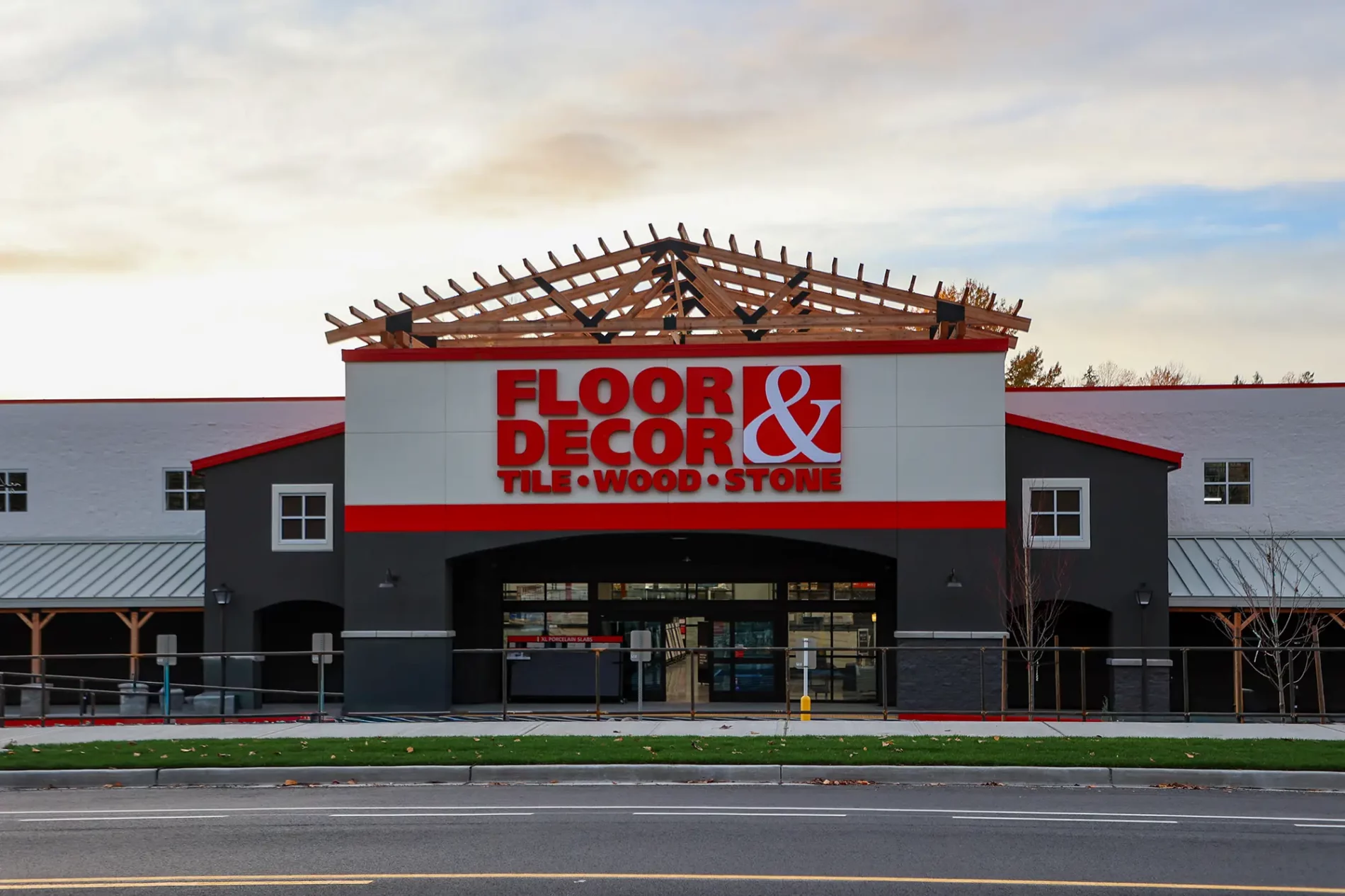
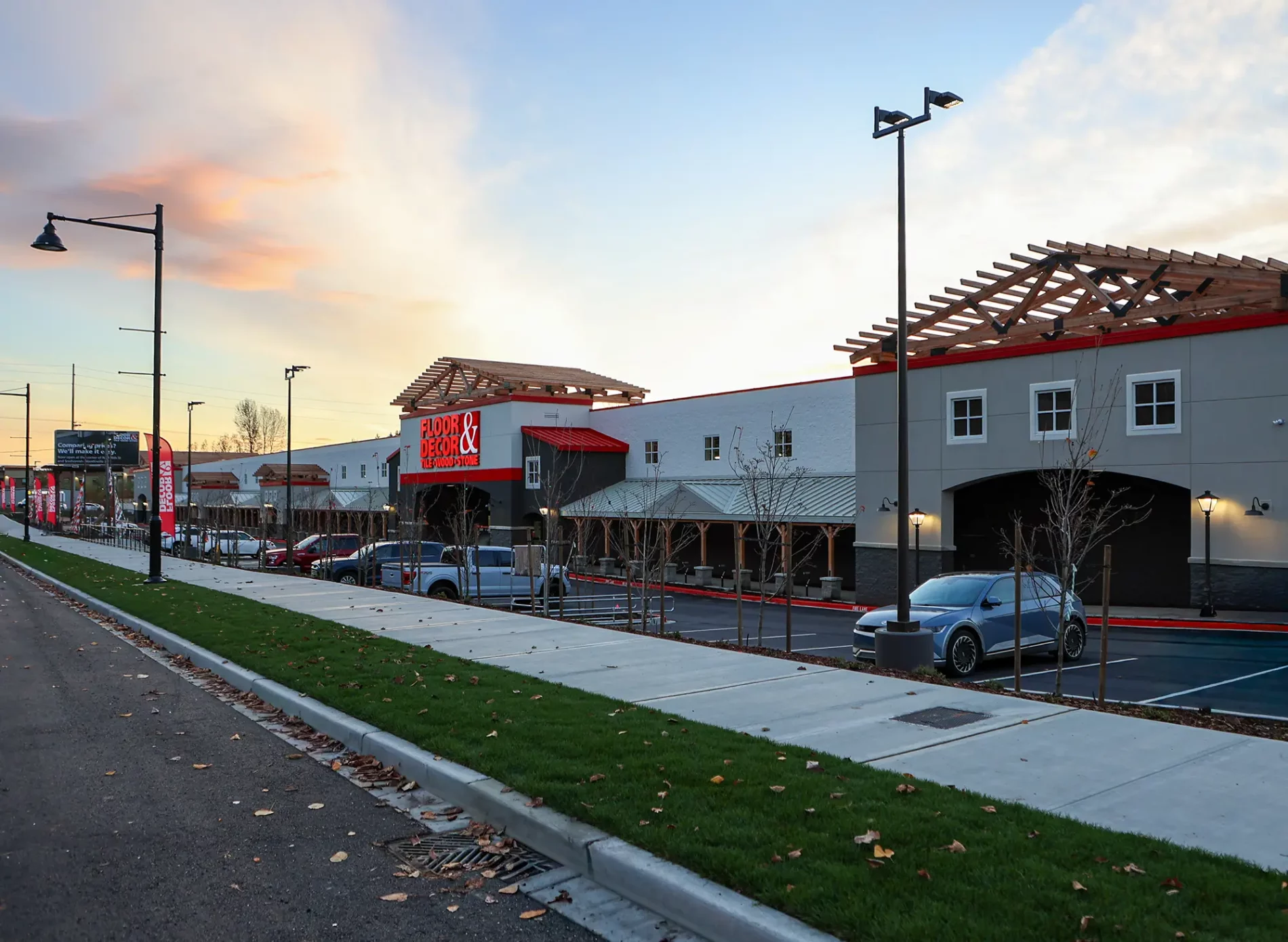
“Floor and Décor was a 78,000 square foot big box retail store on a little less than five acres,” says Matt of a recent high-profile project for the leading flooring and tile retailer in Woodinville, WA. The project included full ground-up construction with a Concrete Masonry Unit (CMU), structural steel roof framing, wood trellises and canopies, and a complete interior buildout. “It had a concrete detention vault that was 14 feet deep and larger than a football field. It was 310 feet long by about 90 feet wide. The project has over $1.3 million just in decorative mass timber.” An already aggressive timeline of eight months became even more so when Pivotal received the building pad seven weeks later than originally planned. “Their steel supplier held us up two months,” Matt says, “and then their permitting held us up another month. They stole almost three months from us, and we still built that project in almost the same time frame, which is pretty incredible.” Despite navigating several challenges along the way, Pivotal were able to push forward with the tight program and bring this unit to life for a well-respected client who it now considers a partner.

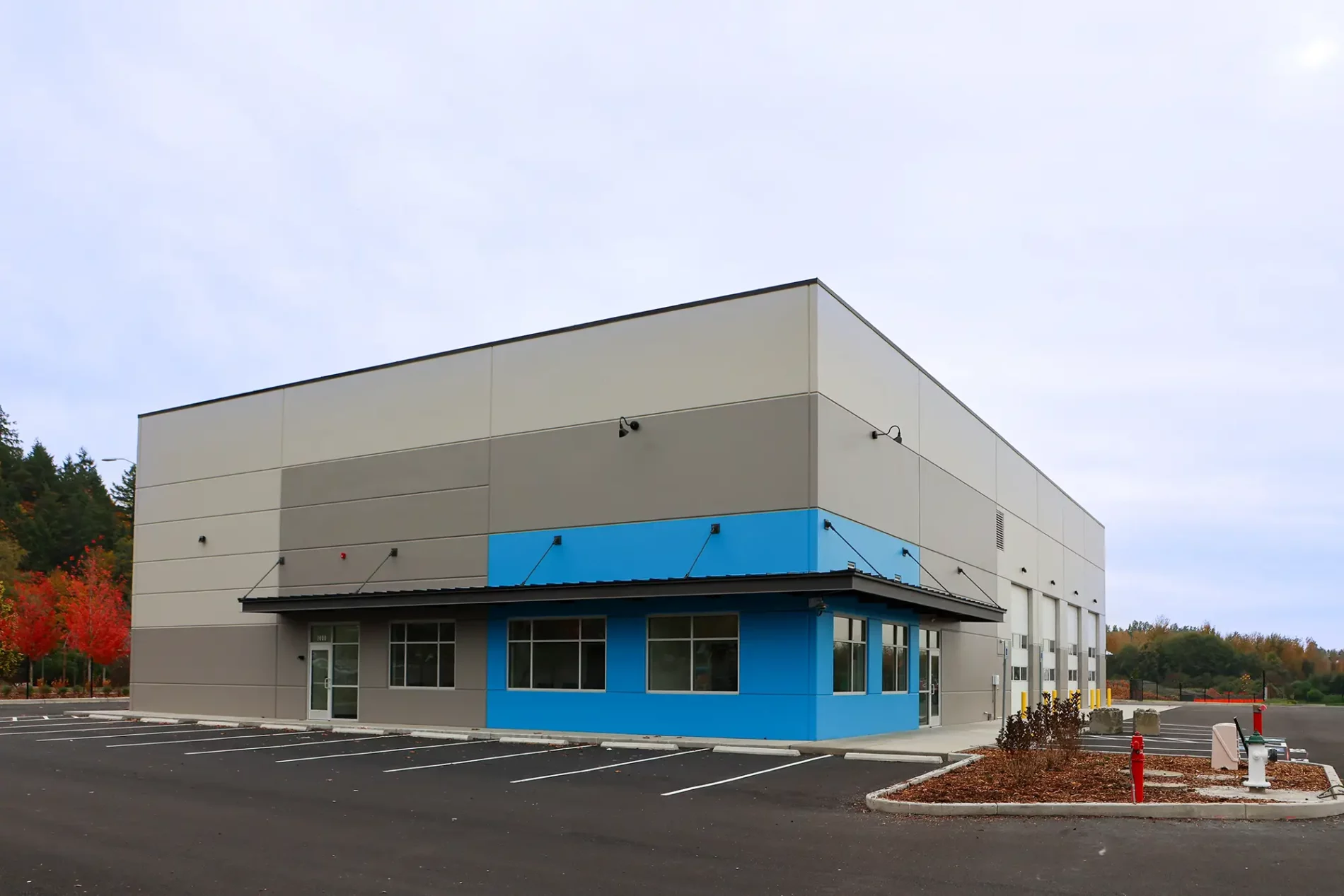
“SMARTCAP DC North was an industrial development built in the winter of 2021, going into 2022,” Matt says of a notable Distribution Centre project in Marysville, WA. “It was the wettest winter ever on record in Washington State. Every other contractor gave up because it was just too much, but we continued on, and we finished it on time.” The development included Building A and Building B which were built concurrently, with a total square footage of almost 300,000. This approach provided the developer better economics over two projects and ensured that both projects were built with the highest degree of quality.

A notable project that showcases Pivotal’s experience in the Tenant Improvement (TI) space is Bellevue Brewing, a new flagship commercial restaurant and brewery located in downtown Bellevue’s Spring Street District. “It’s about 9,000 square feet with a full brewery inside, and a restaurant and a patio area,” says Matt. “The cool part is, over the bar, there are five big copper sub storage tanks. The beer gets brewed in the back and there’s a clear garage door with glass all the way around, so you can see inside this brewery, and the beer gets ran up to those cool copper tanks overhead which you can see when you sit at the bar. It was thousands of feet of hand TIG welded stainless steel and copper lines. A really cool build, and at around $5.4 million, expensive for a TI restaurant.” Unlike many projects, those open to the public – particularly those in the hospitality sector – give contractors the chance to return and engage with the finished space. This was true for the Pivotal team and the Bellevue Brewing project, particularly given the strong rapport Matt established with the client. “We built another custom restaurant for that same client in Bothell,” Matt says. “And we’re starting another one for him in Mulvey. He’s a tough client, a super wealthy guy, and now a business partner and a really good friend of mine.”

Reflecting on Pivotal Constructions’ early days – when it officially launched in September of 2019 – it would be remiss not to acknowledge the global pandemic that shaped the years that followed. Yet, this unprecedented challenge from the outset did not define the company’s trajectory. With almost seven years of impressive growth behind it, the question now is what lies ahead for this commercial and industrial design-build powerhouse. “The goal is 250 million a year in the next seven to eight years,” Matt says. Part of Pivotal’s strategy for achieving this growth is to become a multi-state service provider, moving into at least 10 states in that seven-to-eight-year timeframe. “We’re pushing our way into civil construction and have started our civil division, so we’ll be doing our own dirt work and site development.” Knowing where its strengths are and with a growing book of clients, the plan is to “continue to hyper-focus on big box retail, the industrial sector, and restaurants.” Equipped with six and a half years of industrial and commercial project experience, a client-centric approach and a clear vision for growth – and now strengthened by the addition of a civil division – Pivotal Construction shows no signs of slowing down as it enters its next phase of design-build excellence. The trajectory, as it has been from the outset, is firmly upward.

Raising the Volume

View in E-mag
View Brochure

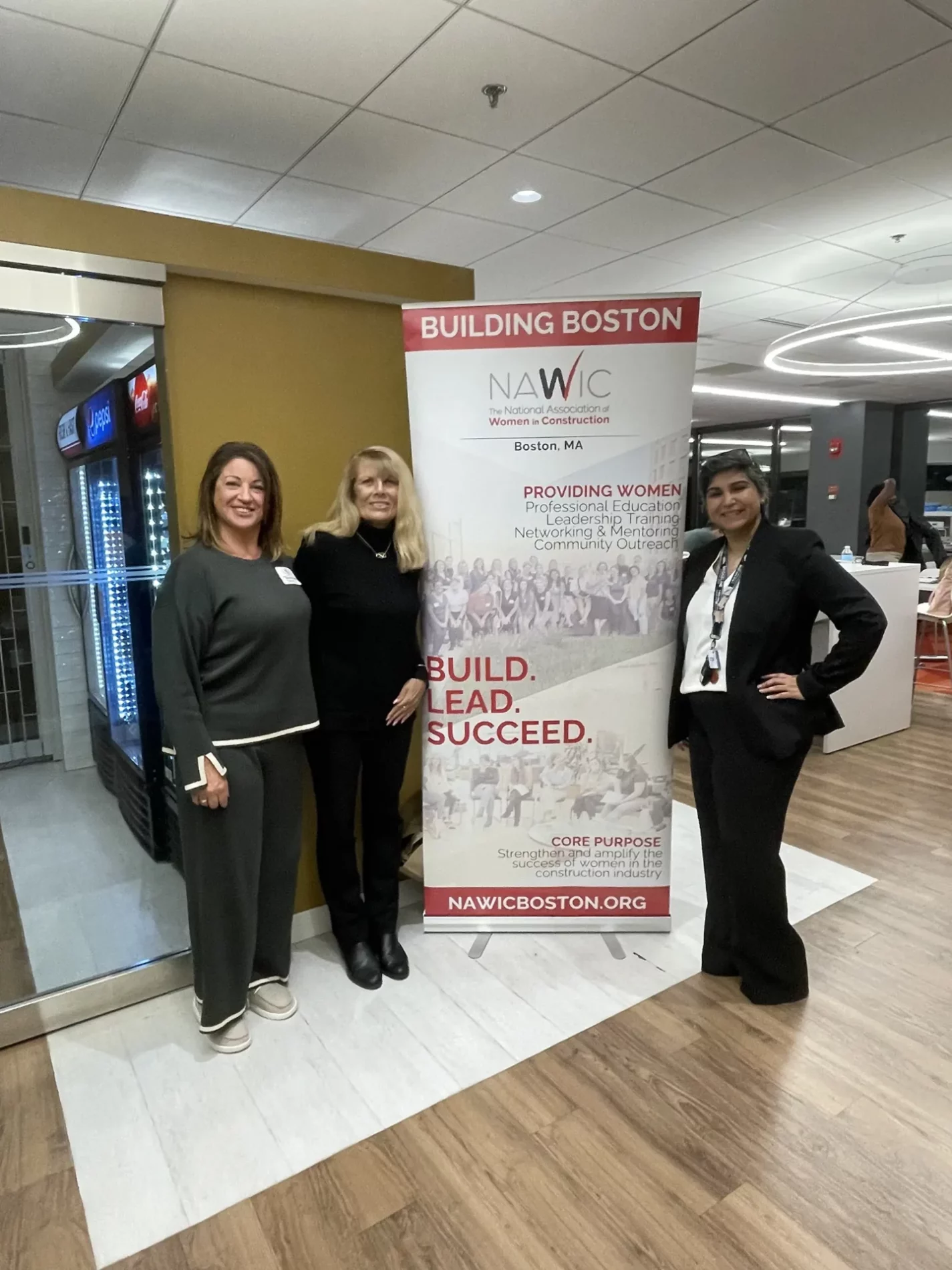
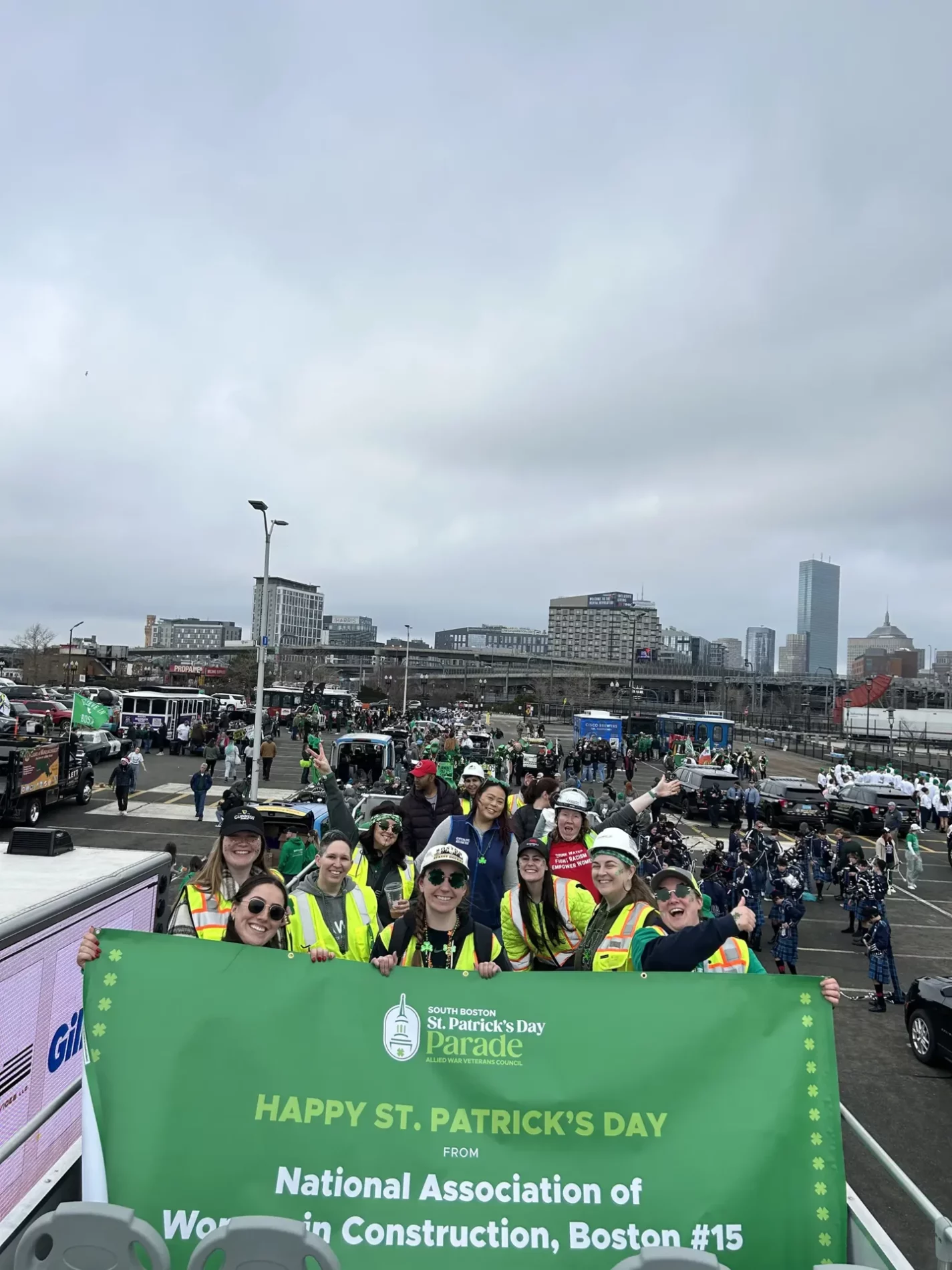
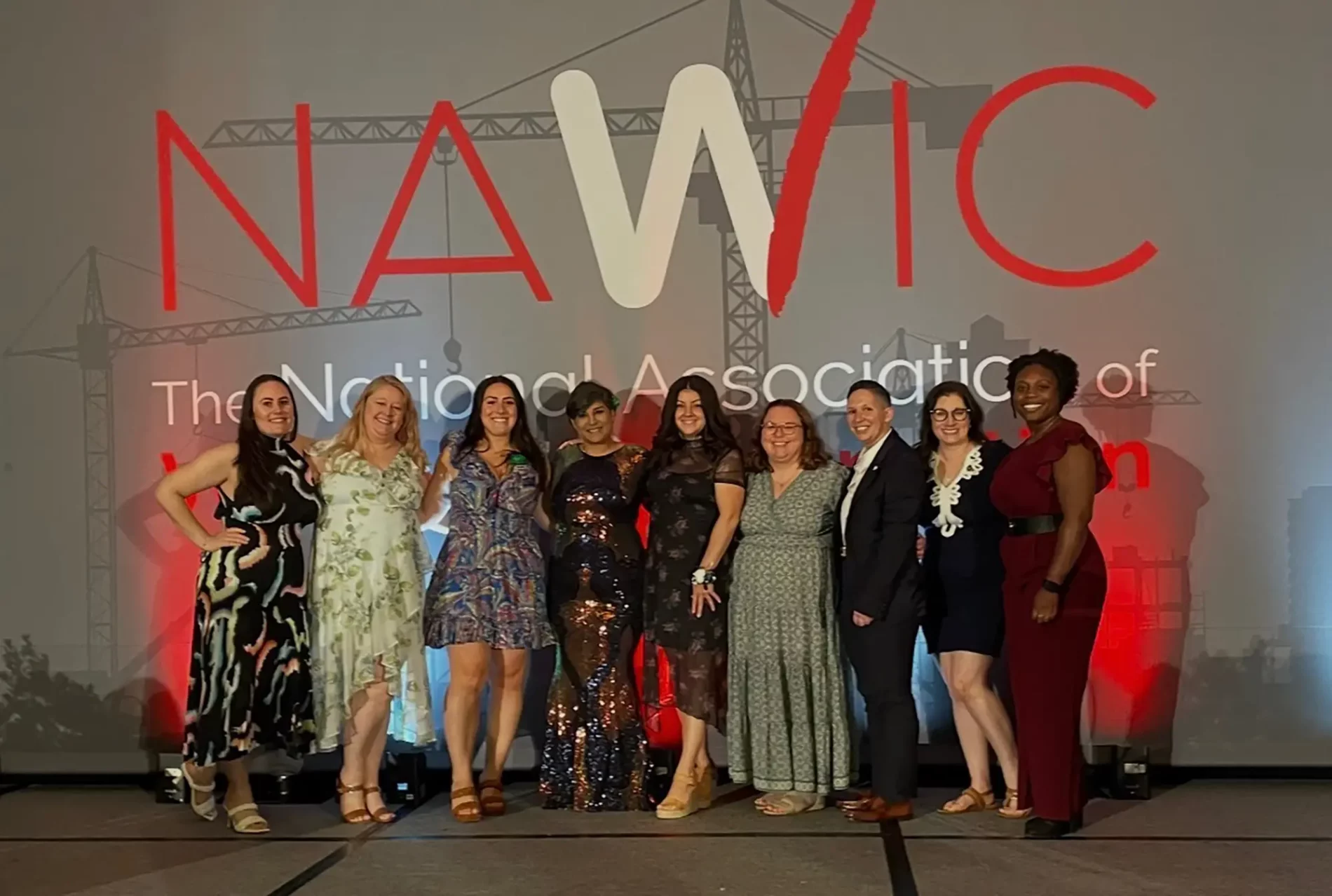
Every March, women and their advocates across North America and beyond gather to celebrate Women in Construction (WIC) Week, a nationwide initiative led by the National Association of Women in Construction (NAWIC). The initiative was started by NAWIC Nationals in 1960 and has since become a significant part of the organization’s impact on the construction industry. Under the tenacious leadership of Rita Brown, current NAWIC National President, NAWIC continues to encourage the AEC industry to “Level Up, Build Strong.”

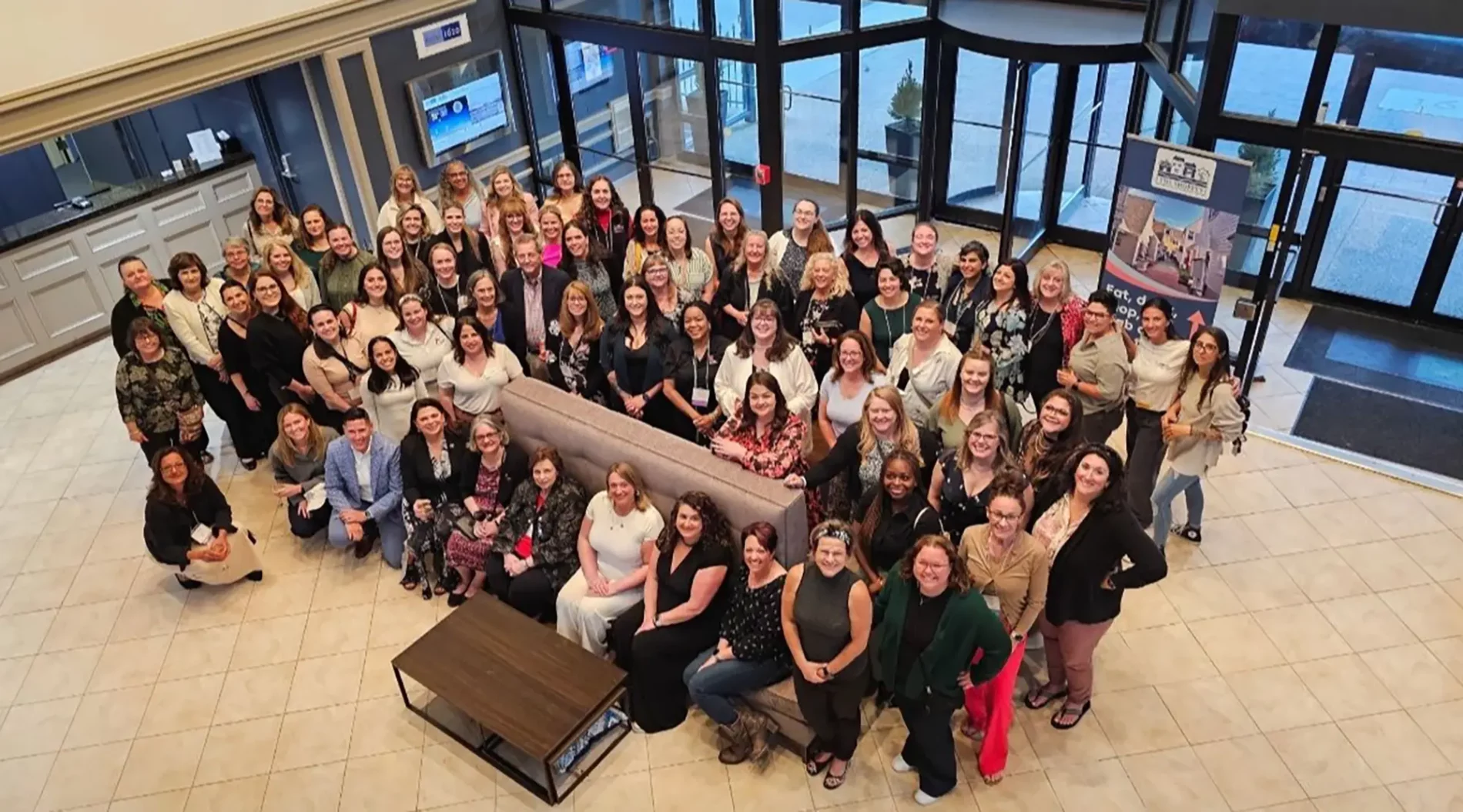
But WIC Week is just one of the many ways NAWIC amplifies the voices of women in construction. Alongside it are scholarship programs, fundraising events, educational courses and certifications, networking events and conferences, and community outreach. Driving each of these initiatives is the same vision: to transform how women experience the architectural, engineering, and construction industry. I’m joined by several of the women behind NAWIC Boston Chapter #15, each bringing their own roles and insights in pursuit of that vision.

The President of NAWIC Boston Chapter #15, one of the first chapters in the country, is Andrea Rizzo. For Andrea, the work NAWIC does is multifaceted. It represents women in the AEC industry while also creating meaningful opportunities for growth and connection.

Devin Henry, Vice President of the Boston Chapter and Chair of the Safety Committee, as well as a 2025 National Member Strong Award Winner, has been part of NAWIC since 2022 and, in her words, “it’s been fantastic.”

Rachana Karaj, Board Member of NAWIC Boston, Chair of the Diversity, Equity and Inclusion Committee, and both NAWIC Nationals Member of the Year and Member Strong Award Winner for 2025, brings deep insight into the organization’s nationwide impact.

Under the leadership of Regional Director Jillian Penkin, alongside Board Members Jen DeAmicis, Rachel Finney, Kara Champagne, Lenna Sweeney, Geselle Valenti, Leah Hoffman, and Ching Ling, the chapter has not only prepared an empowering WIC Week but also built a year focused on growth, support, education, and meaningful networking — harnessing “The Power in the Room,” this year’s regional motto. Once introductions are complete, the tone of the conversation is clear: enthusiasm and genuine passion for NAWIC, its mission, and the year ahead.

“Our main mission is to strengthen and amplify women’s voices in the construction industry,” Andrea says. NAWIC Boston offers not just camaraderie, but mentorship, support, and a shared vision — creating a community that promotes a safe space for women and their advocates.

“Our main mission is to strengthen and amplify women’s voices in the construction industry.”

When asked what the organization means to them, Devin and Rachana echo Andrea’s point. “In the United States, women make up only 11% of the construction industry,” Devin says, “and out of that 11% only 2 to 3% are women in the field.”

NAWIC Boston aims to bring more women into the trades while also expanding awareness among those in non-field roles about the education and growth opportunities available within the industry. NAWIC is structured nationally, regionally, and then by local chapters. Chapters such as Boston represent specific areas — in this case, the Northeast — which collectively form part of the national body.

In its effort to reach tradeswomen, a National Trades Women Committee was formed by NAWIC Nationals to help regions and local chapters strengthen this focus. “It’s about diversifying the pipeline and reaching people who may not have any exposure to this industry and letting them know what the possibilities are,” Andrea says. “There are so many different avenues for people to become a part of this industry, and one of the roadblocks we’re constantly trying to break down is how to expose people — especially at a young age — to this industry and all of its potential.”

Digging deeper into the current state of the industry and the driving force behind NAWIC’s mission, Rachana shares further context. “When it comes down to the construction industry, if we don’t tap into resources and people who are different than the norm, the old school generations are all going to age out. Women make up half the population on the planet and NAWIC aims to expose the architecture, engineering and construction space to as many of them as they can.”

Rachana adds, “A part of what NAWIC does is reach out to the younger generation, like our STEM Program or Block Kids, where we run contests that are STEM oriented.”

Through involvement in these initiatives, as well as Junior Achievers, Girls in Trades, YouthBuild Boston, and AGC MA’s STEM and education programs, NAWIC Boston is committed to guiding the next generation into the AEC industry. Devin adds: “What we like to communicate, especially to the younger generations, is that yes, we do need more skilled tradespeople, but also when you’re involved in construction you don’t have to be the person swinging the hammer.”

With a vast range of career paths available, the AEC industry offers opportunities for people with many different passions — from accounting and legal services to HVAC installation, electrical engineering, construction material sales and manufacturing, and the logistics professionals who transport materials across cities, states, and countries.

NAWIC Boston not only provides valuable experiences, but actively builds opportunity. To date, the Boston Chapter has awarded 171 scholarships worth over $230,000 to students in construction-related programs.

“Within the larger organization, NAWIC has a National Education Fund that some chapters participate in,” Andrea says, “but we also have our own funds that we award scholarships through. Every year we invite anyone who is pursuing a higher education degree in architecture, engineering, or construction, or anyone pursuing a trade program. We’re supporting people enrolled full time in both trades and college programs, and they’re eligible to apply for a scholarship.”

By hosting a wide range of events throughout the year, NAWIC Boston raises funds to continue amplifying its community. Through outreach efforts, the chapter strengthens connections and reinforces the growing presence of women in construction. With at least one event per month — sometimes up to four — and a dedicated scholarship committee, participation in the scholarship program continues to grow.

“It’s a really great way to provide people with opportunities to pay for their education, and then hopefully down the line they’ll want to join NAWIC as a member. Once students are in their programs, we also have a fund established to sponsor students so that they don’t have to pay for a student membership,” Andrea says.

Kara Champagne, NAWIC Boston’s Membership Chair, has developed a plan to keep members engaged, welcome new student members, and ensure the broader community continues to benefit from what NAWIC Boston offers — including recognizing members who have been with the chapter for five, ten, twenty, and even thirty-plus years.

Members of NAWIC Boston benefit not only from scholarship programs and industry engagement, but also from a variety of annual events hosted by the chapter, which they can attend free of charge.

“This is a huge value add for our members,” Andrea says. “The events are intended to bring people together, educate them, and sometimes provide them with certifications. We try to provide a wide variety of events based on people’s interests, and we get different groups for each one. It’s always a really great environment.”

As Chair of the Safety Committee, Devin oversees the rollout of a monthly newsletter that advises companies on compliance standards and required administrative practices.

“We distribute that to all of our members so that they are able to go back from these events with something tangible to their employer,” Devin says. “When you can hand them something and say I’m giving you some OSHA standards or DoT standards, or other topics like hazard communication, fall protection and roadway safety, that tangible piece of paper absolutely helps.”

Linking companies with the NAWIC membership community is central to the Boston Chapter’s approach. Rachana states, “We cannot be the only person in the room — those around us have to be involved and join this conversation. Our companies and advocates are truly important to making the industry successful for all.”

As the Boston Chapter prepares for this year’s Women in Construction (WIC) Week, excitement is building.

“We focus on events and initiatives that bring women together, give them space to voice their opinions, hear one another, and showcase women in the industry,” Rachana says. “WIC Week shines a light on how much our industry needs a future generation of women.”

One of NAWIC Boston’s largest collaborative events, held alongside sister chapters NAWIC Worcester and NAWIC Rhode Island, is the WIC Week Kickoff Event — a gathering of 200 to 300 industry professionals.

“We play some virtual golf, we bowl, we eat, we socialize and we come together to kick off the start of the week,” Rachana says. “That’s a big way of showcasing our chapter, showcasing all of our members and giving back to our community. It’s a networking opportunity — an opportunity to find someone their next job opportunity, a new connection in their chapter or region who can help build their career.”

This year’s WIC Week Kickoff Event is February 24th at Howl at the Moon at Patriot Place in Foxboro. NAWIC is the official starter of WIC Week, and this event, like so many others, reflects the commitment of the women who lead it.

Continuing the Northeast’s theme of “Power in the Room,” NAWIC hosts not only local events but also regional and national conferences to broaden its reach.

“Our next regional conference is in Lake George in May, bringing 19 chapters together to learn, socialize, network, and explore different topics. Those types of events are really exciting for the DEI committee,” Rachana says. “We created a three-year strategic plan for what we call Voices of Change, which starts with hearing the voices in our community — how they got started, their struggles, and their happy and aha moments.”

NAWIC Boston has created a safe and supportive space where members can speak openly about their experiences and work together to tackle challenges.

“Because our industry is very small, feeling safe and supported, especially as a woman, is very important. We use that DEI series, Voices of Change, to push the conversation from one level to the next.”

The program encourages open dialogue on topics such as financial responsibility, innovation, hiring, and recruiting.

“We’re involving people like the AGC and members like Holly Folan who come in and talk about GRIT, which is Girls Rising in Trades, an organization she founded. It’s a great opportunity for people to level up their experience and build a strong foundation for their companies and themselves.”

NAWIC is invested in the long-term success of its members and the wider WIC community, creating opportunities that not only open doors but support sustained growth within the industry.

“Our Chapter has won the ACT. ACHIEVE. INSPIRE. Award, which has given us thousands of dollars to keep this messaging and this programming alive,” Rachana says. “The National Association feels that this is a very strong program and one that everybody can learn from, not just locally but regionally and nationally as well. We try to make things as valuable and accessible to our community and our advocates as possible.”

Ultimately, NAWIC’s goal is to ensure that, within the construction industry, everyone is part of the conversation. That dialogue begins within NAWIC but extends far beyond it — ensuring women’s voices are amplified and their futures within the North American construction industry continue to strengthen.

The Art of Transformation

View in E-mag
View Brochure

Reidy Contracting Group (RCG) was started in 2010 by Pat and Lorraine Reidy, a synergy of construction experience, strategic leadership, and financial insight. Their shared vision was clear from the start: to drive long-term industry success built on collaboration, trust, and integrity. The RCG of 2010 – which made its name doing small construction jobs like painting walls and changing door hardware – is much different to the industry-leading NYC construction company we see today. The company in its evolved from leads ambitious projects throughout New York including high-end renovations, ground-up construction, infrastructure upgrades and intricate refurbishments. Still at the helm of the company is Pat and Lorraine, ensuring every project big and small upholds the high standards for which Reidy has become known. Not long after RCG was established, Daniel Monteiro joined the company as Chief Operating Officer, having previously worked alongside Pat for another employer. “We started off with three or four people in the office,” Monteiro says of those early days. “I remember going after work in the sub cellar, painting walls, and changing door hardware, before landing our biggest job at the time about a year later. We did an internal staircase and full floor build out for a Hedge Fund, and from there we just grew through repeat client referrals. We have a hand in every sector now, our bread and butter being commercial interiors, and then hospitality, higher education, and infrastructure projects.”

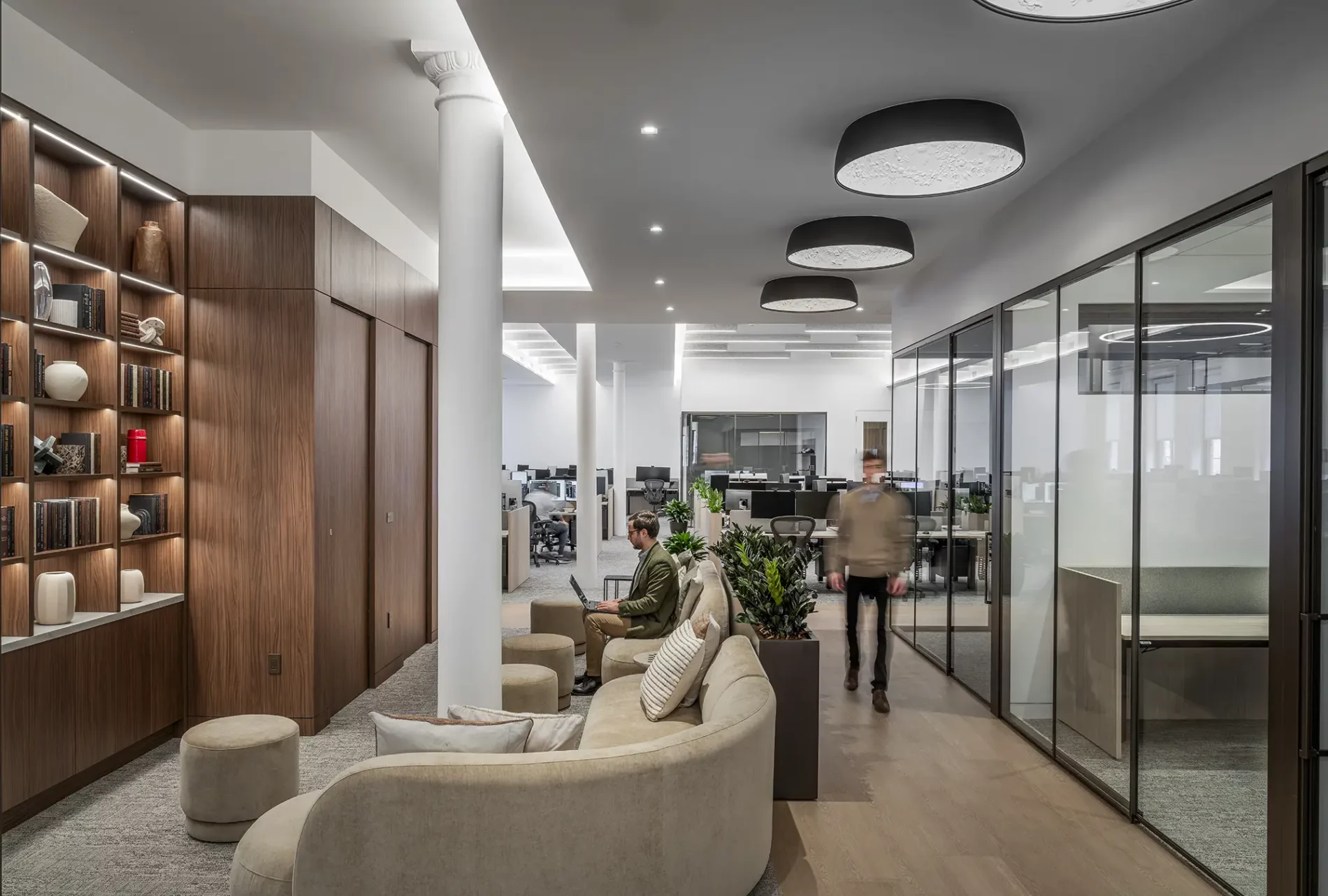
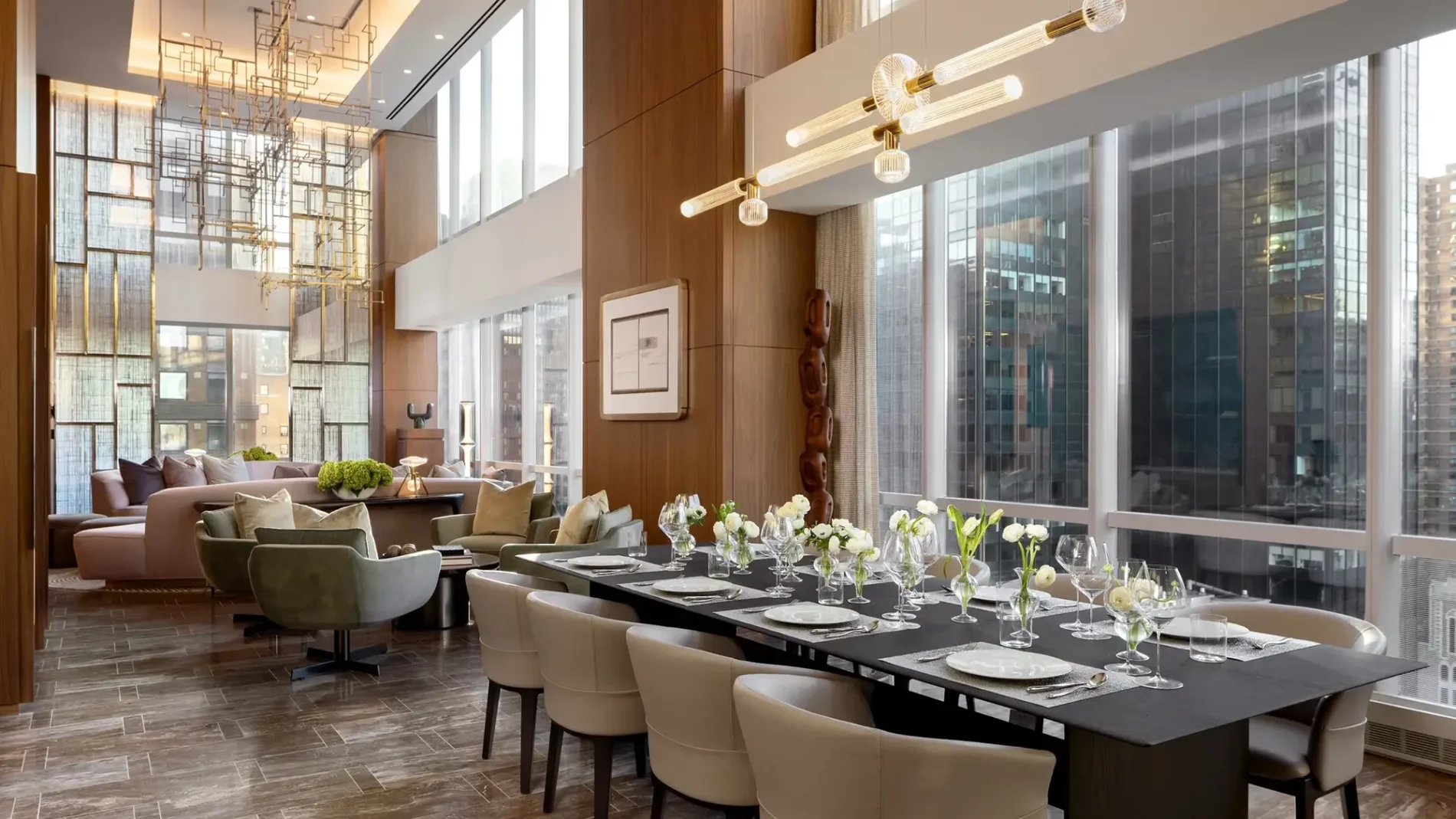
Being in the high-end interiors space, Reidy Contracting Group naturally leans towards the hospitality and commercial sectors where elevated budgets and bold design visions often call for higher quality finishes. Fauchon, a Parisan-style boutique and restaurant with its flagship store in NYC, is a project that exemplifies RCG’s high-end service offering. “Fauchon was a great because it’s right across the street from our offices in Bryant Park,” says Monteiro, “so it was always nice to be able to see the transformation happening in real time and being able to get over there pretty quickly.” As a renovation and refurbishment company, it is this passion for transformation that drives RCG. Every project starts with a vision; where others see dated old buildings at the end of their lifecycle, Reidy Group sees an opportunity to reimagine, renew, and build something better. The RCG team is equipped with the experience, tools and know-how to do just that, and this has led it towards notable clients and projects that make for a decorated portfolio of work.

Monteiro reflects on some of the milestone projects that came after the company’s first big win, like the George Soros office space at 250 West 55th Street. “That was our biggest multi-floor project at the time. As part of the deign we introduced an art piece by lighting designer James Terrell. It had a lot of publicity throughout the city and even globally.” Another milestone project was Discovery’s 13-floor headquarter building at 230 Park Ave South, which was completed during the COVID pandemic, and more recently, Major League Soccer’s Headquarters at 2 Pennsylvania Plaza. RCG recently completed the National Urban League (NUL) Headquarters in Harlem, an adaptive reuse project featuring 88,000 square feet with terrazzo flooring and a civil rights museum. “We did some donations with the Harlem Chamber of Commerce and helped them out with some minor upgrades within their office space headquarters, and that got us introduced to the ownership over at National Urban League (NUL),” Monteiro says of how this prestigious project came about. “They have a great cause there, and being part of something that’s giving back to the community was very important to us. The project in itself was a beautiful space. We did two floors for them in an entry level lobby. One floor had a full amenity space for conferencing centres, a theatre section, and a pantry area. The third floor was for their office spaces, and then a lobby with turnstiles and security entrances. It was a great project and in Harlem, so it was a nice to see that area building up and being part of that.”

“My phone’s always on, Pat’s phone is always on, so being able to reach out to ownership I think is very important for our clients and where we start to separate ourselves from our competitors in the market.”

Reidy Contracting Group understands that the success of a project starts long before construction does. The company excels in early engagement with the client and consultant on design, budgeting, and logistics, all of which play an important role in driving the project towards success. RCG’s services include preconstruction, construction management, financial and administrative management, sustainability and compliance, and project execution, allowing them to play an active role in achieving client objectives from the outset. “We come in early on in the design phase with the client and help with budgeting, help the consultants navigate through some construction items, and the logistics, which are just as important as the schedule and lead times. That’s one of the primary services that we bring to the table, whether it be an office space that has a ridiculous schedule where we have to worry about ordering lights at a certain time, or releasing custom millwork in a certain time, or a multi floor project where there’s logistics for stair openings or structural upgrades and things of that nature.” Reidy Contracting Group lives and breathes ‘attention to detail’, both in the quality of its work and the service it provides. The company’s Special Projects Division, which takes care of smaller upgrade and maintenance type jobs, was born out of this detailed approach. “That division opened up a couple of years ago and takes care of what we call ‘day two’ items,” says Monteiro. “For instance, if we build out a space and then the client has some painting touch ups or new walls or offices they want to build within the space, our special projects division takes care of that with the same attention we would give on a larger scale.” By staying with its clients long-term on smaller-scale maintenance and upgrade jobs, RCG fosters lasting relationships and trusted partnerships.

Monteiro believes that this ability to cultivate relationships with clients and consultants is at the very root of RCG’s growth and success. “Our mantra here is manage expectations,” he says. “It’s as simple as that. Communication is key. Our goal has always been – let us come in and change your door hardware, paint a few offices, and show you what we can do for you. And then ideally you give us the bigger jobs as we grow as a company. We try to position ourselves as a competitor with some of the bigger names in the city and show that we can do jobs if not just as good, but better than them and more attentive on the ownership side.” Reflecting on the New York construction industry as a whole, Monteiro recognises that it’s a busy time and not without challenges. “The numbers are very, very tight, which has its own complications and forces you at times to maybe go for a lower tier sub, where you have to either sacrifice quality or schedule.” This presents challenges for a companies like RCG who see high-quality as a non-negotiable. “But we do it day in and day out,” Monteiro says of upholding high standards and maintaining a reputation for construction excellence. “The market is looking for trustworthy contractors that are going to have their back, not only from an execution perspective, but also from the fiduciary responsibility. My phone’s always on, Pat’s phone is always on, so being able to reach out to ownership I think is very important for our clients and where we start to separate ourselves from our competitors in the market.”

While RCG has done some work in the tri-state area, it’s primary focus has been in Manhattan, New York, and the five boroughs. Plans are now in motion to expand this reach by opening office space in New Jersey and Connecticut. “There’s a tremendous amount of diversity there with consultants that already do work with us here in the city,” Monteiro says, “and we also have clients and connections in those areas as well. So for us to diversify in those markets, I think it’s going to be key to our success.” RCG aims not only to expand its geographical reach across the wider New York area but also to pursue projects of a larger scale. “We’re going after a lot of the bigger projects, and by bigger I mean two floor projects, not necessarily the six and seven floor projects that some of the other bigger contractors are going after. I think there’s enough competition in that market that they can all fight for themselves there!” RCG’s growth mindset is realistic, calculated, and always underpinned by an unwavering commitment to quality. As the company continues toward its goals, it is strengthened by its status as a Women-Owned Business Enterprise (WBE), bringing a unique perspective to every project it undertakes. This drive and ambition is balanced by a commitment to diversity and inclusion, as well as safety and sustainability, resulting in a well-respected and people-first company with a clear understanding of what truly matters.

The Modular Construction Evolution

View in E-mag
View Brochure

When modular construction first came about it was often seen as a compromise rather than a choice. The term brought to mind temporary structures and trailer park-style homes that were built fast and to lower quality standards. But this opinion of modular construction is an outdated one, contradicted by the application of the method in recent years to new sectors including high-end apartments and luxury hotels. As the market has faced challenges with housing and labor shortages, modern methods of construction have grown in demand, and today modular construction means not just faster build time but also tighter quality control, reduced waste, improved energy efficiency, and often even higher precision than site-built developments. Tasu Construction of Squamish, British Columbia, were early adopters to modular building solutions. The company has evolved in tandem with the industry itself, applying the modern construction method to housing, education, and commercial environments. “We specialize in modular and offsite construction solutions,” says Callum Norrish, the company’s Vice President. I’m joined by Callum and Director of Business Development Jamie Hutton, who take me through Tasu Construction’s history in the modular construction space and the outlook for the wider industry as it continues to grow and evolve.

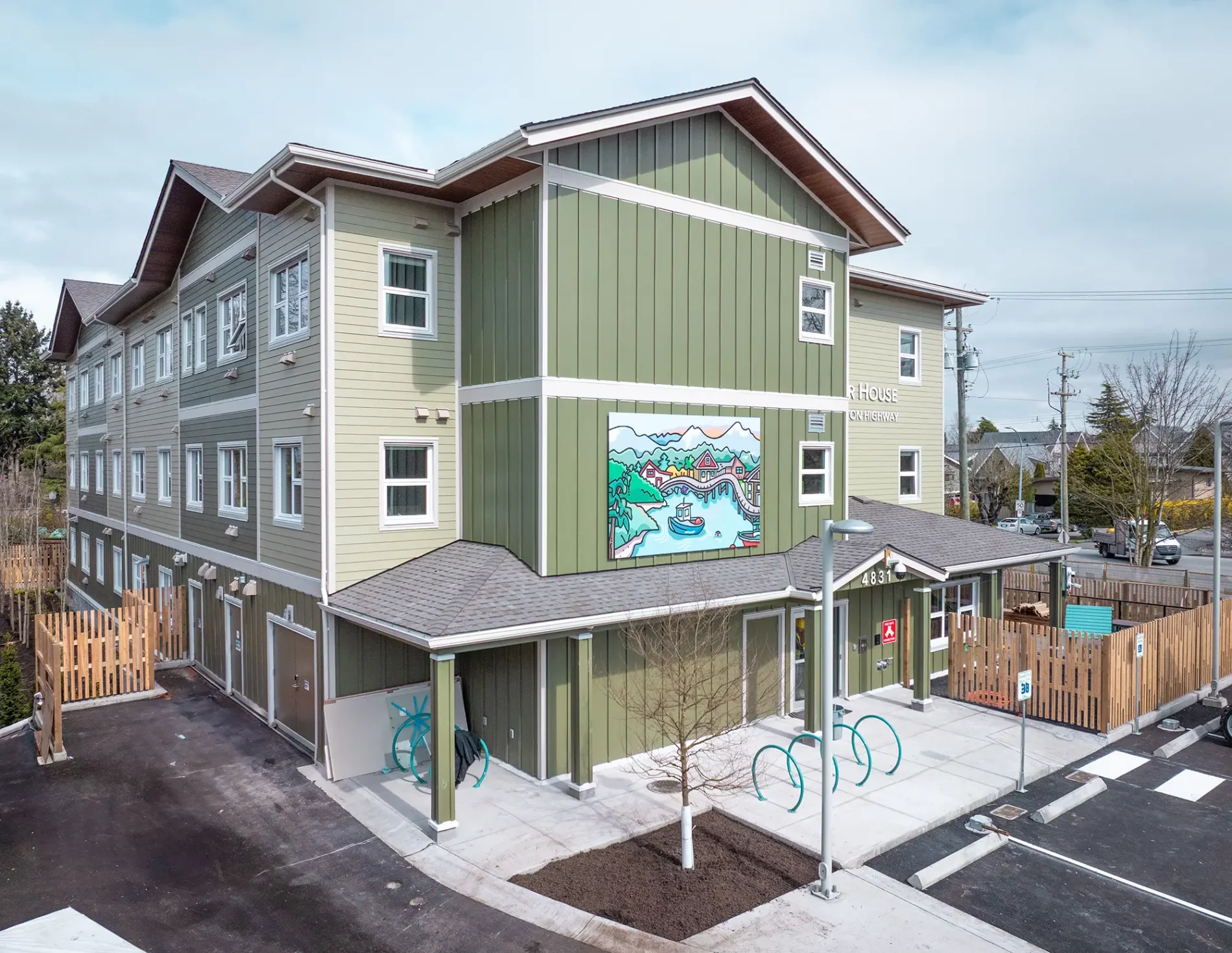
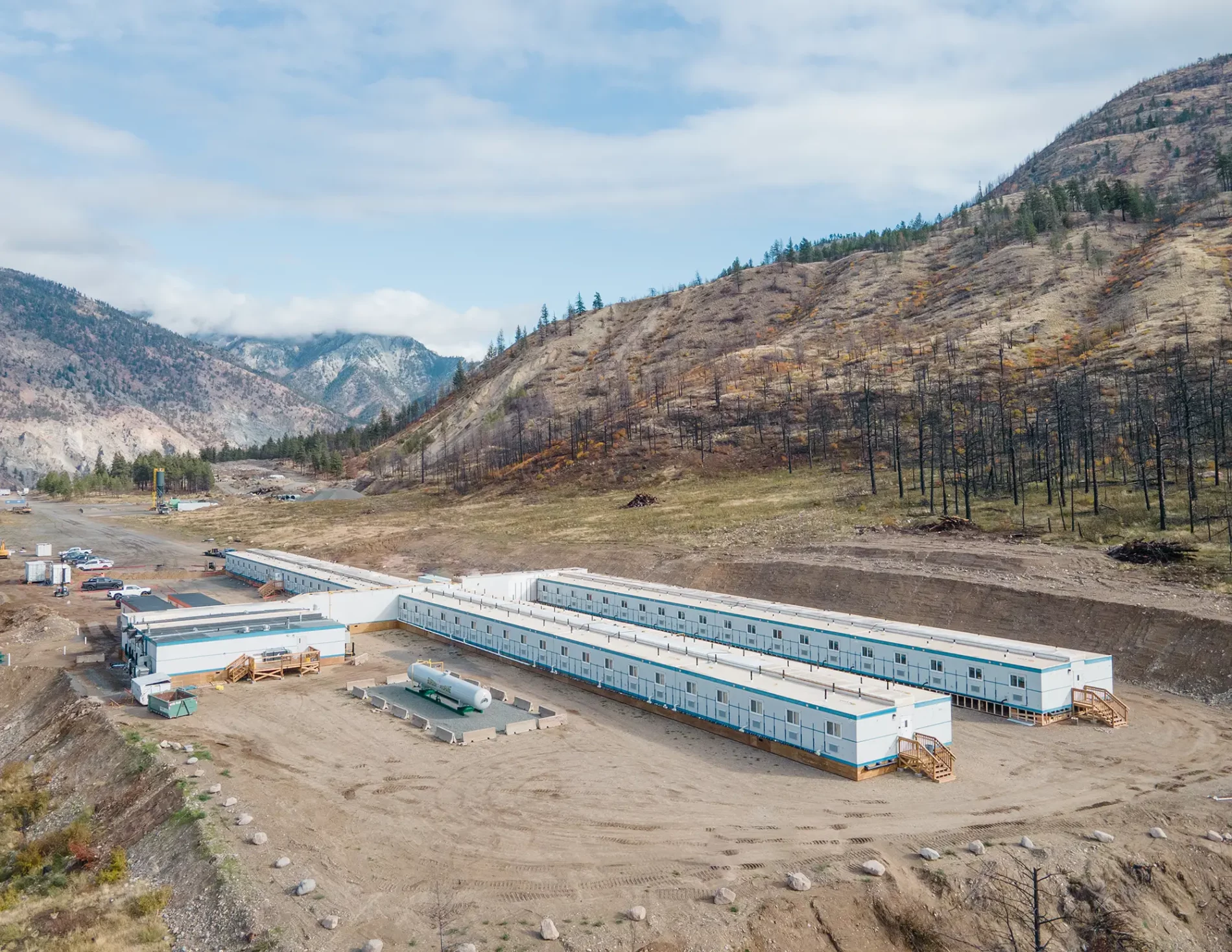
“The company originally started back in 2010 with a focus on remote workforce camps,” Callum continues, “so that’s camps for logging, mining, oil, gas, and energy infrastructure, often in the middle of nowhere where accommodations weren’t available. Modular construction really lends itself to that industry because it’s faster and you can build a lot off site.” The company, which operated then as Landsea Camp Services and Landsea Construction Ltd, laid down roots in the remote workforce accommodation space, which remained a large part of its portfolio in the decade that followed. “Flash forward to 2022 – the camp operations division of the company was sold. The buyer didn’t want a construction division, so a name change was initiated, and a new construction company was formed under the Tasu brand in late 2022.” As Tasu Construction evolved from camps, it continued to apply that same skill set to regional and urban environments. “That started with utilizing modular buildings for temporary emergency shelters, and then taking it to the next step to build permanent multi-story, multifamily supportive housing solutions. That experience has led us down other avenues with modular schools, childcare facilities, offices, and commercial buildings. We did our first BC supportive housing project in 2019, our first multifamily project in 2021, our first school in 2025 and our first six-story modular building in 2025.”

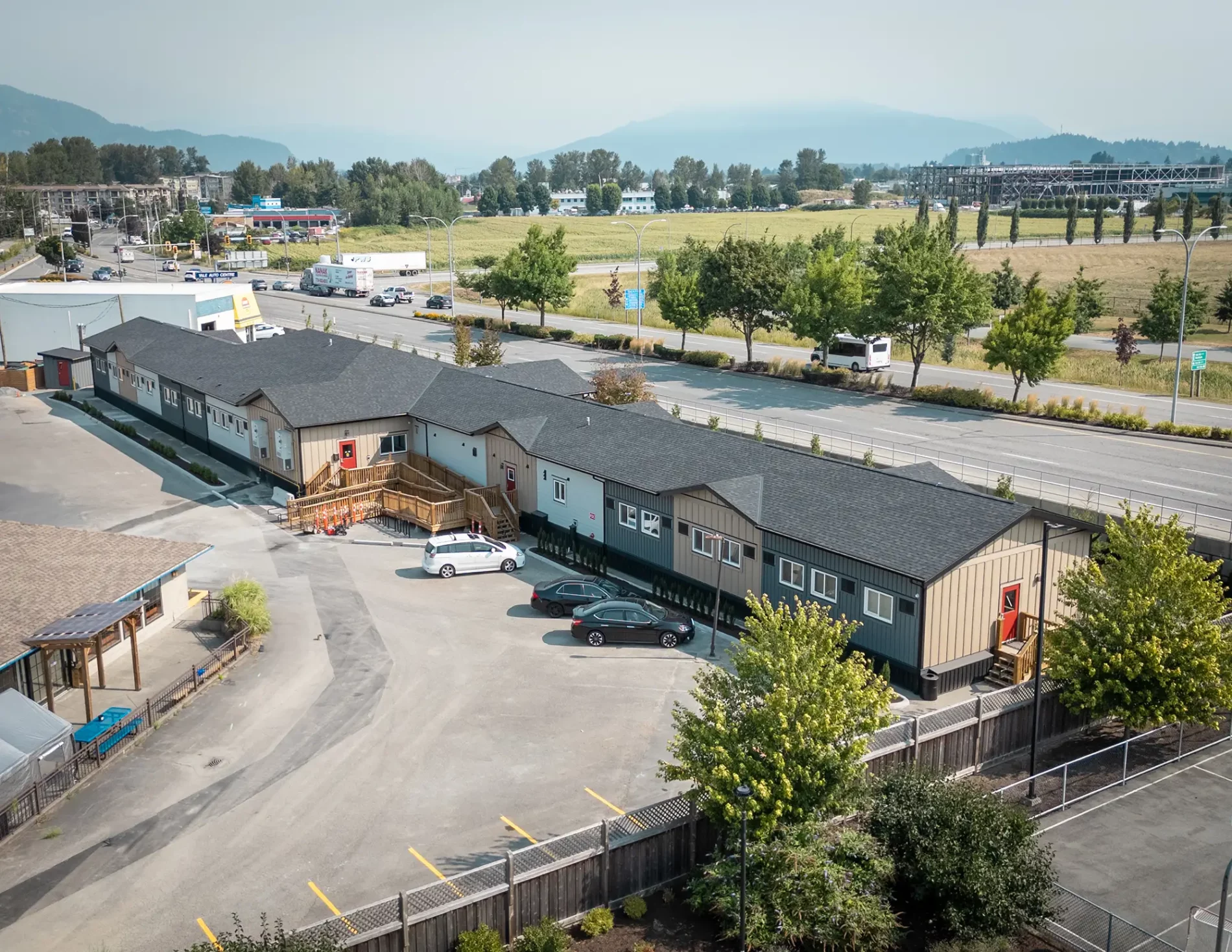
That brings us to the current day, where we see Tasu Construction operate as Western Canada’s most adaptable modular construction and installation company. “What people don’t know from the outset,” Jamie says, “is that Tasu Construction is not a manufacturer. Rather, we are a modular construction and installation company working in partnership or in conjunction with a network of specialized manufacturers. In the marketplace, there’s very few companies that have the depth of experience in volumetric modular like what Tasu does. Our work spans the entire project life cycle, everything from early planning and design coordination, coordination of off-site fabrication, transport, logistics, utilities, and final commissioning. So, we can do everything; the full scope from end to end on a project, or we can slot in as a specialty subcontractor, depending on what the requirements are.” Tasu Construction’s early experience delivering remote workforce camp accommodation for the industrial markets played a formative role in shaping its capabilities. Often challenging and demanding, these projects established a strong foundation and skill set, allowing the company to adapt and extend its craft into new sectors over time. “We originally built our reputation delivering complex remote workforce camp projects, that background has very much shaped what we do today,” Jamie adds. “We have delivered projects in extremely remote and challenging environments, whether that be rural northern settings or complex urban settings. Today our services have moved well beyond just those remote camps, and we now have experience across supportive housing, single family housing, multifamily and multistorey projects. We do that with our own in-house trades, and that portion of our business is growing. We have a dedicated team of red seal plumbers, carpenters, and laborers, and we can coordinate full utilities installation with our project management and project development teams. We have a huge range of capability in house that makes us a lot more efficient, because we’re not relying as much on subcontractors.”

“We originally built our reputation delivering complex remote workforce camp projects, that background has very much shaped what we do today.”

Tasu Construction’s growth reflects a broader shift in the market as prefabricated construction becomes increasingly mainstream. “While volumetric modular remains our core specialty, the language around modular has evolved alongside the industry itself. Historically, the term carried outdated perceptions often associated with mobile homes or temporary structures. Today, prefabricated construction represents a far wider spectrum of modern building methods, including hybrid systems, panelized construction, and mass timber. We are seeing more projects that integrate different prefabrication methods, and as that’s happening, the market is starting to become more and more switched on to off-site as a viable option. For us, we’re really well positioned to capture a big swing in a market trend here.”

Surrey Rapid Housing Initiative is Tasu’s largest multifamily project, and one that represents both the company’s and the market’s evolution in the residential space. “It’s six storeys, which is the tallest you can go with wood framed modular construction,” Callum says. “Structurally, no one’s been able to take it higher than that.” The project, which offers supportive housing for low-income people in Surrey, is made up of studio suites and common areas with amenities on the ground floor. “We worked as a specialty subcontractor for a large general contractor who have had a few challenges which have slowed down the project. Otherwise, we would be in and out of there in six months. But it’s been a really good project for us, and we hope to do more of that type and scale in the future.”

Another sector that lends itself well to modular construction where buildings are occupied and the holiday’s offer only short windows of time for construction works, is the school sector. “Another project we completed last year is called the Nicomekl School expansion,” Callum says of an eight-classroom addition to an existing school in Langley, made up of sixteen modules and accommodating up to 200 students. This marked the company’s first modular school project, and one that they hope will lead to many more of a similar nature in the education sector. “It was designed and fabricated with a manufacturing partner,” Callum continues, “the same manufacturer that we worked with in Surrey. We did full craning, service connections, the roofing finished as much as possible, and then the general contractor did foundations and siding.” This project saw Tasu Construction showcase its skillset not just in modular construction and installation, but also in project management, logistics, utilities and interior finishings.

Tasu is committed to building long-term relationships with First Nation Communities across Western Canada. Taking into account Indigenous values and the cultural importance of such communities, Tasu leads these projects with transparency and sensitivity to build trust-based partnerships. Speaking of this commitment, Callum highlights a recent project for Esk’etemc, just South of Williams Lake. “In 2024 we did phase one, which was ten single family homes on reserve in community. We were the general contractor and did turnkey from start to finish – design, permitting, manufacturing, installation, and commissioning.” Off the back of a job well done, Tasu Construction was called back the following year to deliver a further eight homes for the community. “We handed that over in early summer 2025,” Callum says of the single-family homes built on sustainability and environmental responsibility. “Obviously the client was happy since they called us back to deliver more housing. It’s for a First Nation community in need, and it went really well for us. We’re really proud of it.”

Tasu Construction’s future outlook is in line with the overall outlook for the modular construction industry. Opportunity, innovation, and evolution are what leads the way towards continued growth and success. “We see a lot of market opportunity out there,” Jamie says. “We’re really focused on very disciplined and controlled growth, and a deeper specialization in what we do. We’re going to continue to build on our strengths in complex volumetric modular delivery, especially in our core markets and First Nation remote community projects. At the same time, we’re going to continue to expand on our permanent modular and multistorey projects. Demand in those areas is quite strong and we see it increasing, particularly in light of provincial and federally funded programs that are specifically aimed at driving prefabricated housing delivery. We’re quite well positioned currently with everything that’s going on there, and there’s a lot of external drivers in the marketplace that really make prefabricated a very attractive solution.” While some opportunity comes from the evolution of modular construction and the wider perception of it as an attractive construction method, some comes from socio-economic issues that demand a new way of doing things. “In Canada we have a housing affordability crisis, a housing shortage, and the ability to get housing units to market faster is key,” Callum says. “That’s why we’re seeing these funding programs from different levels of government.” The ongoing skilled labor shortage presents a further market challenge for most construction companies but an opportunity for Tasu, as prefabricated construction becomes a viable option to replace more traditional and labor-intensive building practices.

“Our goal is to continue to position our brand as a trusted partner in the marketplace while continuing to develop relationships with development firms, architects, and large general contractors,” Jamie says. “We have a very specific skill set and project experience that’s hard to find in the marketplace, and a lot of opportunity out there for us to capitalize on.” For Tasu, a job done fast does not mean a rushed job or a low quality one. At the core of modern construction methods such as volumetric modular construction is efficiency, and not just in program delivery but also in cost control, quality standards and waste reduction. As more and more companies in Western Canada and beyond continue to embrace modular construction and all its benefits, its Tasu Construction, backed by years of experience, leading the charge.

Building Better for Boston

View in E-mag
View Brochure

It was right after the Great Recession of 2008 when Haycon Building came on the Massachusetts construction scene, at the time doing small multi-family existing buildings and historic rehabilitation projects. Both Architects by trade, founders Patrick Haydon and David Bemiss naturally leaned towards the design build method of construction in the company’s early days, which saw them handle both the design and construction of projects. “That evolved around 2011 into doing new construction, mostly development projects, and then we started doing service construction which we are still doing now,” says Patrick. Within the markets it serves, Haycon offers preconstruction, construction management, design-assist and general contracting services. The multi-unit residential sector has become its leading pipeline of work, and within that, high-performing and Passive House buildings has become its specialty. “Most of our work is as a general contractor on a contract basis. We’re doing new construction on mid-market multi-family projects, Passive House buildings, as well as Deep Energy Retrofits.”

Though Haycon has moved on from predominantly design build work, Patrick and David still lead the team with an architect mindset, which is particularly useful in projects that champion performance and sustainability. “As the projects got bigger we kind of stepped away from the architectural aspect of things,” David says. “But being architects, building owners and developers, we have a pre-construction mentality that’s a little different than just a general contractor, and I think that’s a huge benefit to our service offerings.”

That’s Haycon’s “then and now” summed up nicely by Patrick, but there’s a lot more in the journey of this award-winning company to unpack. In 2018, when there were talks of a climate crisis but it was not yet declared an emergency, Haycon had the foresight to understand the impact it would have on the construction industry – which is responsible for over 30% of global carbon emissions – and with that, its power to make an impactful difference. “We made the decision in 2018 to focus on sustainability, Passive House, decarbonization and reducing embodied carbon. By becoming specialized in that, we got pulled into Affordable Housing which was the front runner of Passive House projects. This was very helpful because Affordable Housing is the primary construction market these days.” Deep Energy Retrofits – which are relatively new on the construction scene and something that some companies are still wrapping their heads around, – are commonplace for the forward-thinking Haycon. “It’s pretty simple,” Patrick says. “Essentially you’re putting a sweater over a building. You take the existing building, and if it’s a standard wood frame building, you peel off the exterior and put on a new exterior which includes a pretty robust insulation package. You do all you can to get air tightness achieved, which is a big Passive House box to check, and then put in high performance windows. And as we’re doing that we’re decarbonizing, we’re changing the heating, cooling, and hot water over to electric sources. The deep energy retrofit reduces the heating and cooling load drastically, which reduces energy consumption and decarbonizes.”

 “We’re employing strategies that minimize the impact to the residents and reduce if there is any time off site. That’s a big part of that work.”

While the process is, to experts like Haycon at least – simple, the execution can be challenging in the multi-family residential housing market when buildings are occupied. Contractors are not just working on a building, but within someone’s personal living space. “Most of the work is on the outside, but the mechanical changeover is on the inside – the heating, cooling and hot water,” Patrick says. “Issues such as noise, dust, safety, privacy and continuity of services become much more complex to manage in occupied residential buildings. There is a risk of extended project timelines and limited access to critical areas of the home, and so careful phasing, communication, and professional services is important. “We’re employing strategies that minimize the impact to the residents and reduce if there is any time off site. That’s a big part of that work.”

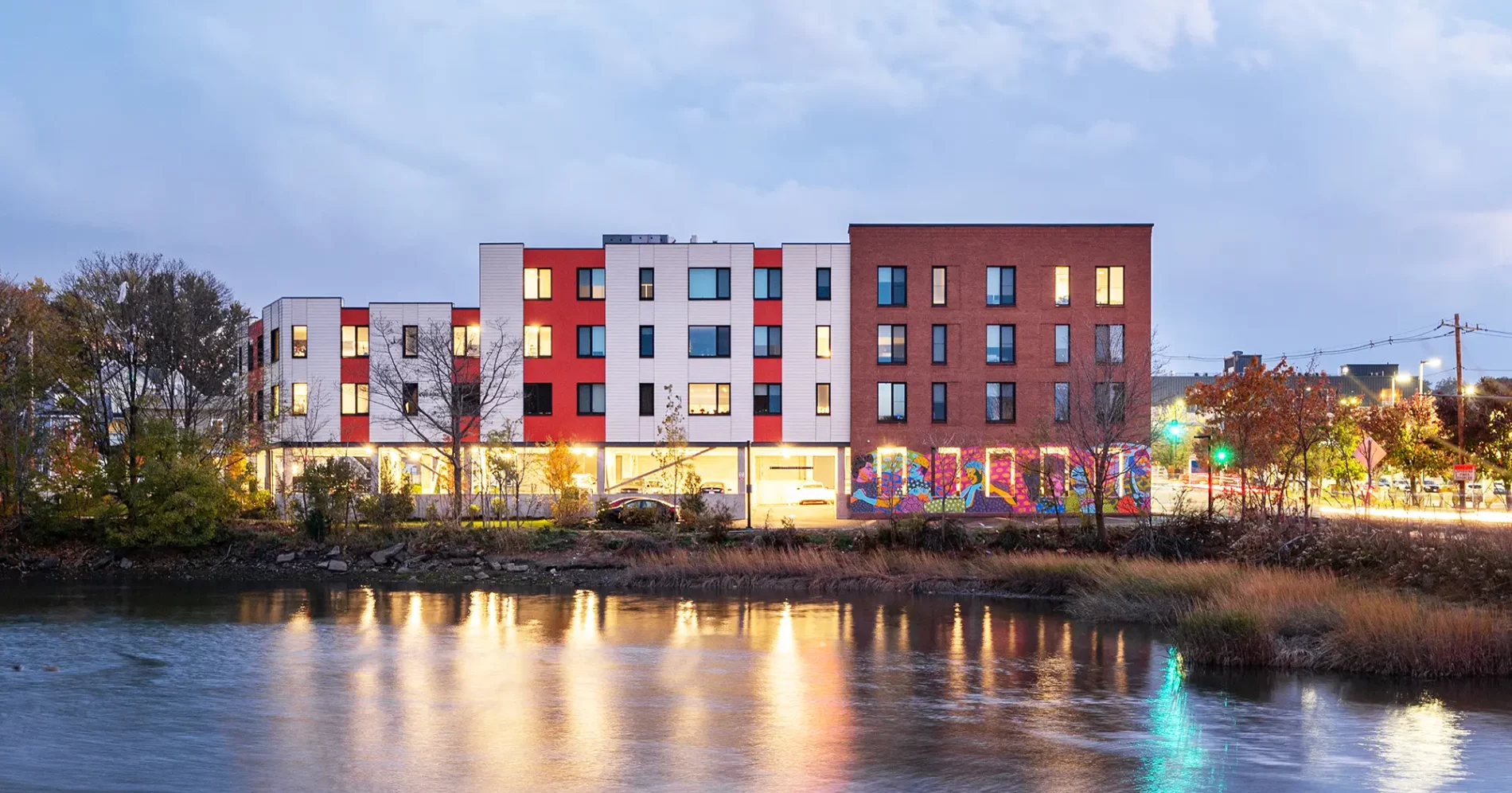
One such project is Hano Homes in Allston, which saw the deep energy retrofit of a 20-unit income-restricted community to significantly reduce its carbon footprint. As General Contractors on the project, Haycon provided energy-efficient solutions such as high-performance building envelope, triple glazed windows, and rooftop solar, moving the property closer to net-zero performance. These complex works were carried out while tenants remained in place, with careful consideration given to minimizing disruption. The result is a healthy living environment with a projected 70% reduction in energy use, and a benchmark for sustainable and affordable housing in Boston.

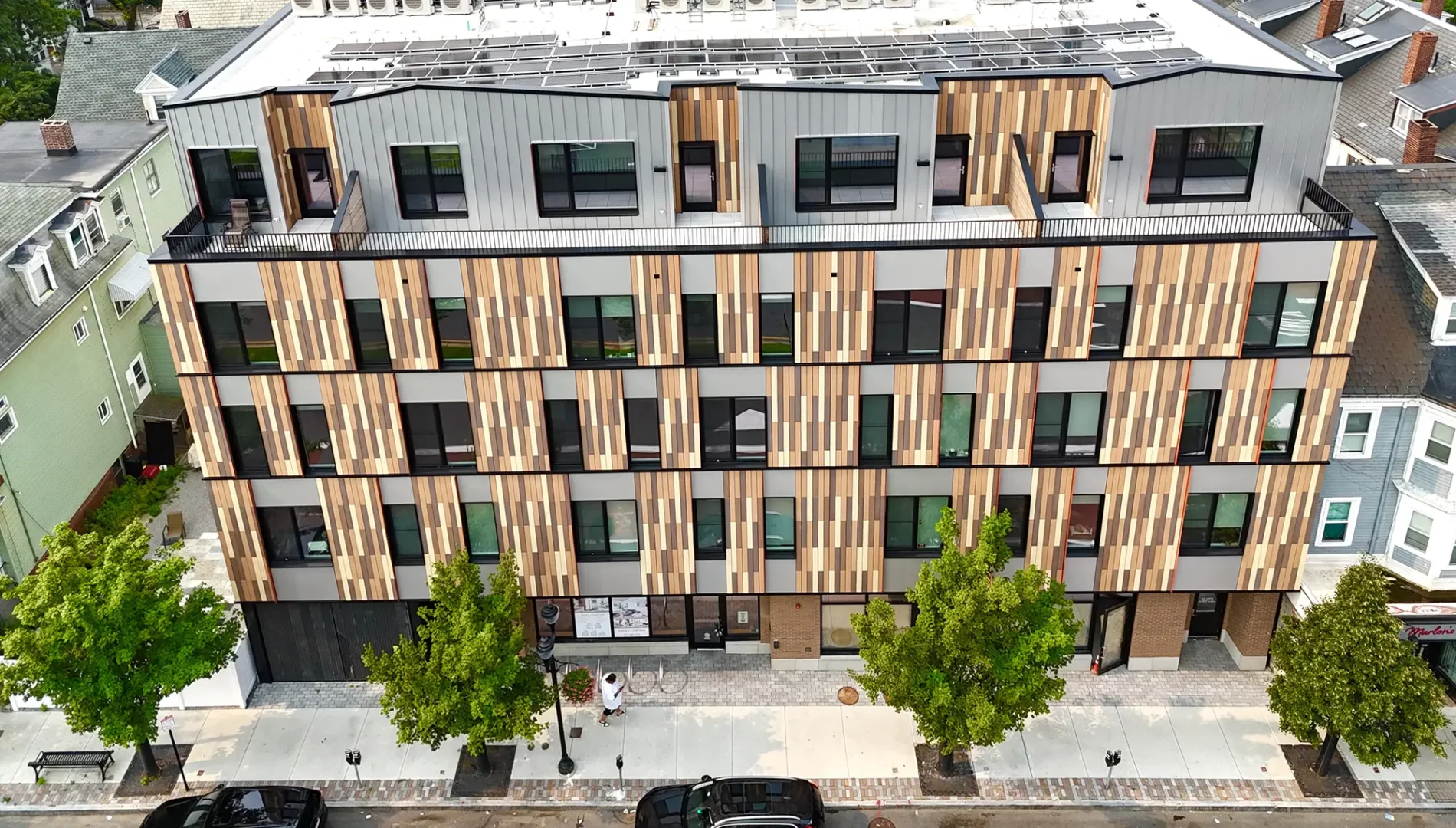
Another project that stands out to Patrick is 11 East Lenox, a mixed-use multi-family development and the first and only Mass Timber Passive House residential building in New England. The project, which received full Passive House accreditation, was built on the innovation and sustainability that Haycon has become known for. It features energy-efficient technology such as PV arrays, a VRF system, energy recovery ventilation and high-performance windows, all of which reduce the overall carbon footprint. Haycon’s scope included a Life Cycle Analysis (LCA) which compared the environmental impacts of the as-built Mass Timber building to an equivalent steel building, taking into account embodied carbon and highlighting the benefits of mass timber as a construction material. 1005 Broadway, a 38-unit affordable housing development in Chelsea featuring an all-electric HVAC system and rooftop solar panels, has also received full Passive house accreditation.

A project that aptly represents the forward-thinking mindset of Haycon and it’s collaborators is Jamaica Plain’s Brookley Flats at 10 Stonely. The development was built to Passive House Standards with sustainability embedded into every aspect, from the structural execution to the modern finishes. The coordination of air-sealing, insulation, and high-efficiency systems demanded an attention to detail that only an experienced company like Haycon could master, and this detail is evident in the finished project – a forward-thinking housing development with unmatched energy performance, and a model for affordable and sustainable housing in Boston.

Today, Haycon finds itself in a position where it has both the skill and the demand to scale up, but at the same time enjoys the close-knit culture it has fostered over the years. “We have a family style culture here where everybody works together and gets things done,” Patrick says. “There’s good collaboration, and it’s not very corporate. We’re only 30 people and that’s eight to ten Project Management, several people in the office, and a number of people out in the field, so we’re not a huge company but an extremely efficient one. I would like to maintain the size of our company and do the six or eight projects that we’re currently doing, but at some stage you have to make the transition to be more corporate, because you have an evolving staff, dollar volume and a significant workload. We’d like to stay where we are at roughly, but it’s hard because you get opportunities and you get lost opportunities, and timing is very difficult with construction because it’s really all about when. That’s the big question that we’re always tracking.”

Patrick looks at construction companies as a tool chest of different resources, each contributing to how the company carries itself in the industry. “The way I’ve looked at construction is, what’s your tool chest?” he says. “How can you tool yourself as a construction company to be able to execute development and construction projects most effectively.” Just some of the tools in Haycon’s chest are a central nearby facility and construction yard, internal virtual design coordination, state-of-the-art AI and Project Management software, and a staff of Certified Passive House Builders. “We have a yard in Boston where we can stage stuff, we can do our own excavation, and sometimes we can do our own building enclosures. So we’re nimble in that regard.”

Haycon has a solid team, valuable resources, and the industry know-how to deliver a streamlined experience for its clients. It’s location in Roxbury is in close proximity to its coverage area, offering further convenience and agility when it comes to serving sites more efficiently. Taking a wider look at the Boston construction scene and the outlook for the future, Patrick says that “the Affordable Housing market is starting to become saturated on the development and the construction side, because the market rate development is very hard to make financeable. Hopefully all that corrects itself in the near future, and there’s a balance of affordable and market rate housing getting built. We seem to have a great brand in the Affordable Housing world, and are doing good by our plans, so hopefully we stay strong.” With an established name in the Affordable Housing market, a tool chest of valuable resources, and a push for a more sustainable built environment through Passive House and Deep Energy Retrofits, Haycon are on the path towards continued success in the Boston construction industry.

Keeping it Real, Keeping it Elite

View in E-mag
View Brochure

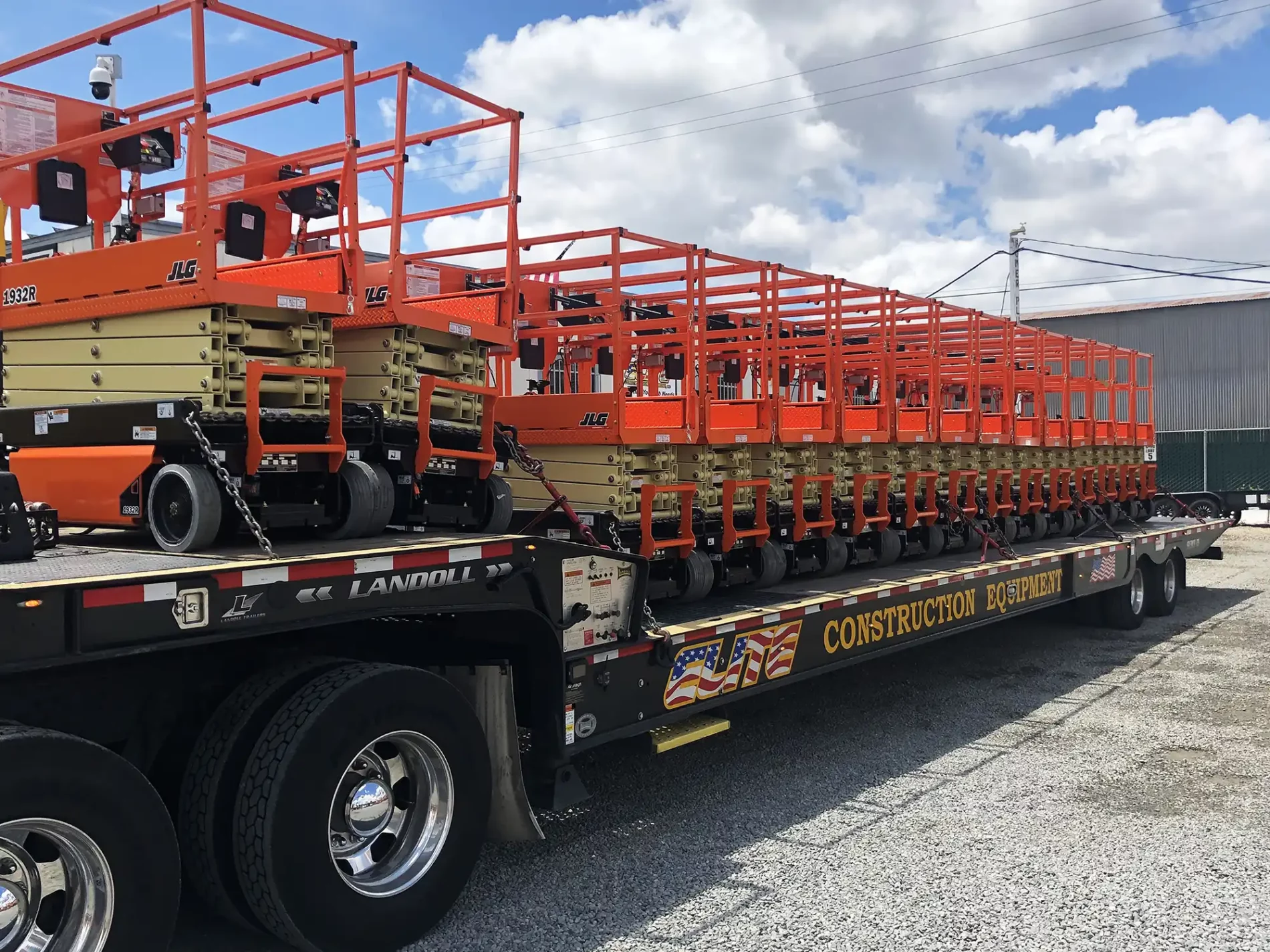
Elite Construction Equipment was founded in 2005 with a clear vision: to streamline the building process by providing site-wide building solutions. For twenty years and guided by its five core values – Excellence, Loyalty, Integrity, Teamwork and Enthusiasm – it has done just that. “We specialise in aerial lifts, material handling, and job site support solutions for all of construction,” says Joe Szabo, part-owner and General Manager of Elite. “Over the years we’ve built a reputation of excellence, reliability and personal service. Unlike the large nationals of the world, we focus on long term relationships, quick response times, and a higher standard of care. Our fleet has grown and we plan on continuing this upward trajectory.”  

Elite did not start with ideas of grandeur about being the biggest rental equipment company in the game. The plan, both then and now, was quality over quantity. “We launched in 2005 with just a handful of units and a vision to compete through service, not just size,” Joe says. “We knew we were never going to be the biggest, but we were always going to make the best of what we’ve got and provide the best service we can. That’s the goal.”

“We knew we were never going to be the biggest, but we were always going to make the best of what we’ve got and provide the best service we can. That’s the goal.”

From modest beginnings came steady growth and the introduction of new site solutions. By working alongside contractors and crews on the ground, Elite were able to identify gaps and opportunities in job site needs, and then expand its offerings to fill those gaps. “In 2010 we expanded our material handling and Mobile Elevated Work Platform (MEWP) to include scissor lifts, boom lifts and forklifts,” Joe says. General rentals like dirt equipment, generators, and light towers soon became part of the package too, as well as scaffolding, power tools, and safety and security systems. True to its mission, Elite quickly became a trusted support for its customer base who longed for greater efficiencies out in the field. “We expanded our fleet serving the larger General Contractor clients across Southern California like C.W Driver, RD Olson, and the subcontractors that work for them.” This success continued in the years that followed, with significant fleet expansion and some milestones worth celebrating. “In 2022 and 2023 we surpassed our previous threshold, adding rent partnerships to strengthen our customer reach,” Joe says.

This continued fleet expansion over the years has allowed Elite to establish itself as a one-stop solution to job site needs, which often means offering services beyond what your average equipment and rental company does. “We have expanded to offer a one stop solution to job site needs, meaning the trailers, toilets, trash, fence, everything you can think of. We’ve consolidated that buying power and we use it to our advantage to go to these vendors and say, give me the best pricing you can, I’ll give you all the business. We have to stay within market rates as we support these companies, but we’re providing a service where the Superintendent doesn’t have to make a deal on trailers and another deal on toilets, another on this and another on that. They just make one phone call and then forget about it. They can build their buildings, do what they were hired to do, and let us take care of the minutiae of the small stuff.”

Doing what it set out to two decades ago, Elite is now a full-service site solution company, dedicated at its core to providing the solutions that its customers need. Sometimes, to truly offer the best service to its customers and live up to its one-stop-shop claim, that means thinking outside the box. “Recently we’ve done something a little outside of our norm,” Joe says. “We put an on-site rental yard at a project in Palm Springs called College of the Desert. We actually staffed an on-site yard. We’ve moved a bunch of equipment there and we continually move equipment to the site before it’s needed, so we have on site already what the job needs by coordinating with the subcontractors and the Superintendent of the job site. As soon as we know the scheduling of the job, we can be there with the right equipment at the right time. And it’s already on site, so there’s no delivery fees, nothing. It’s just already there. That’s definitely a highlight. We’re very excited about that.” Another example of this innovate approach to job-site solutions is the recent addition of Elite’s Decals and Print Shop. “A few years ago we noticed that we were spending an exorbitant amount of money every month on buying our own decals. As the equipment comes in, the decals are damaged, so we rip them off and we put new ones on. We were spending a lot of money, so we started a print business, a decal shop within our facility here. Now we have over 2000 square feet of print shop with four printers, a flatbed, and we can do signage for job sites and a multitude of other things including safety decals for all of our equipment, plus branding decals. That business has grown way outside of just what we needed it for. We’re printing branding and safety decals for multiple other rental companies. We also do custom wraps, giveaway items, engraving, all that kind of stuff. You want a Yeti cup with a logo engraved on it? We can do that here now.”

Elite has made its mark on the construction industry by providing site solutions that work, building strong relationships that last, and making the most of its resources. Looking forward, Joe is clear on what the future of the company looks like. Growth is definitely on the agenda, but not the kind that is rushed and reckless, the kind that is measured and sustainable. “The future of the company is long term growth,” he says. “We have a plan to double our fleet size in the next ten years.” For Elite, despite changes to the wider rental market, its business as usual as they work towards this goal. “In the current day, we’re playing a key role in the market shift after Sunbelt Rentals acquired the local independents and consolidated some of the regional players. This shift positions Elite to capture top sales talent and new clients, expanding our customer base. Their vision is a little broader than ours, a little more focused. We just stay within our zone here and make the best of what we’ve got in front of us without looking too far ahead.” In an ever-evolving industry shaped by socioeconomic shifts, it’s a clever strategy to focus on the work at hand rather than attempting to predict an unpredictable market. And it’s a strategy that rings true to Elite’s commitment to quality over quantity, and a high standard of care.

The root of Elite’s past success is in its clever and continued expansion of fleet, but most of all its in its core values. By continuing to provide excellence in service, remaining loyal to its people, operating with integrity, championing teamwork, and doing it all with a sense of enthusiasm, Elite’s future will be one of success, growth, and longevity in the construction equipment and services space. “We’re very family oriented,” Joe says of the company culture at Elite. “Most of my employees have been with me for over ten years. I’ve got people that started with me eighteen and nineteen years ago that are still here. That’s the key to our success – building long-term relationships with our employees.” As Elite’s fleet grows and evolves in tandem with market shifts and new site demands, its twenty-year-strong values remain intact. “Keeping it small and keeping it real,” Joe says. That’s the way forward.

Building Beyond Retaining Walls

View in E-mag
View Brochure

Like many construction companies, Earth Retention Systems (ERS Walls) started with an idea, a pickup truck, and a small but determined crew. That idea began with Terry Chapell, owner of ERS Walls, who set out to become a leader in the retaining wall industry and has been installing retaining walls since the late 90’s. “The company started in 2009 with Terry, a five man crew, a pickup truck and an excavator,” says Brendan Turner, Estimator at ERS Walls. The company in its original form was mostly a retaining wall installer, and through Terry’s industry insight and unique ability to network, it grew year on year to where it is today. Now offering a turnkey approach to the construction of retaining walls and an integrated design-build approach to job specific applications, ERS Walls gets involved in a project from conceptual design to supplier selection and construction completion. Through Value Engineering, it ensures the most innovative and cost effective site solutions for its clients without ever compromising on quality or performance. With over 100 years of combined experience in Earth Retention Systems, the experienced crew at ERS Walls knows how to run a project on time, within budget, and to the highest quality standards. “We have close to 100 employees, seven to eight crews, and we’re doing a lot of work,” Brendan says. “We’ve grown tremendously through a good team and a lot of loyal guys, really young and hungry individuals. It’s a great environment.”

From the early days, ERS Walls was propelled forward by Terry’s ability to identify and move in the direction of new market trends. “We started out with only installing retaining wall block. We are now doing the final design for the walls placed in the backfill and providing a turnkey installation process which separated us from the competition,” Brendan says. “Now we are we doing that for large projects – I’m talking 1 million square foot warehouse projects along with heavy highway jobs mainly bridge abutments. We’re working with a lot of the Big Rhode Island contractors and the Department of Transportation. It’s been remarkable to see where we’ve come and how much we’ve grown. We’ve probably averaged 50 to 60% growth each year since I first started, and from that our scope has increased as well. We take on more responsibility, we take on more work.” As such, when it comes to more complicated projects, ERS Walls has become a go-to partner for many clients who trust them to find solutions where others find only problems.

“We started out with only installing retaining wall block. We are now doing the final design for the walls placed in the backfill and providing a turnkey installation process which separated us from the competition.”

Reflecting on company milestones, Brendan looks forward to where ERS Walls is headed. This is reflective of the company’s collective forward-thinking mindset and a commitment to progress that is evident throughout our conversation. “Some milestones that we’re looking to hit is expanding to the Department of Transport and doing more heavy highway work,” he says. “We’ve got the commercial work pretty much handled, and now we’re trying to take our design build to the heavy highway side.” But Brendan’s forward-thinking mindset is certainly not for a lack of past achievements. Along with consistent growth and continued longevity despite socioeconomic challenges, many of the company’s milestones can be found in its impressive project portfolio. “There’s just so many, and every single one is unique in its own way,” says Brendan, “but the one I’d like to touch on the most is Blackstone Logistics. That one had 30,000 square feet of retaining wall and about the same in sound wall. The challenge we had to overcome was working with two systems that were basically right on top of each other. The way it was designed, it was going to be one system and a ridiculous amount of money. We came in and we said hey, let’s do some value engineering with the site. Let’s separate these systems, design them separately, but where they still work together. We saved the developer quite a bit of money, and with that we also got the project done well before schedule. The project shows the variety of what we can do, from value engineering to working with two completely different systems, building them both simultaneously. That was pretty unique.”

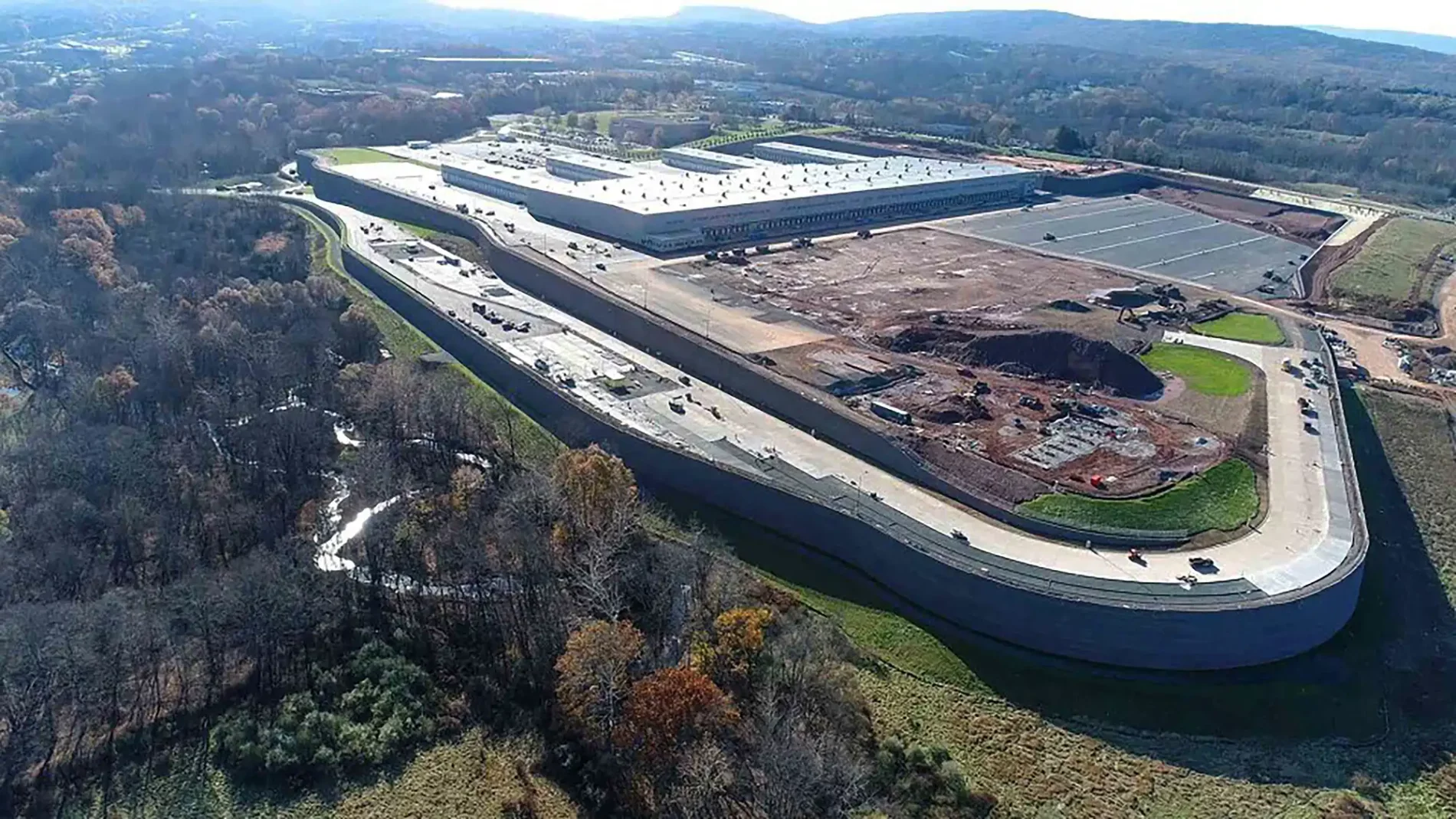
For Brendan it is these kinds of jobs – the ones that present unique challenges and demand innovative solutions – that bring the most satisfaction. “It’s a feel-good moment, first when you get the job and then when you can save your customers some money. It’s like a different puzzle every time we look at these projects. I enjoy it because I’m trying to solve a puzzle and do it the correct way, but also the cheapest way. That’s a big part of what we offer.” Also on the ERS portfolio is projects for large clients like Medline, for which they did some anchoring with soldier pile and lagging walls, and Fedex, a 400,000 square foot project and one of the largest segmental block retaining wall projects in the country. “We were installing close to 3,000 sf a day on Fedex project in Middletown Connecticut. It was great to be a part of, and everyday was a challenge working with the amount of material that was part of this unique design” says Troy Chappell, Vice President of ERS. “Amazon Uxbridge was another very unique project,” Brendan says. “It was well over 70 feet tall, a massive segmental block retaining wall with geogrid reinforcement. With that height, it’s very hard to perform a retaining wall within schedule and within budget, but with our Value Engineering, determined on-site crew and retaining wall design, we were able to make it work.” Similar to the scope of Blackstone Logistics and Amazon Uxbridge is a 1.3 million sf UPS facility located in Grafton which ERS is currently working on. “Not only are we constructing a near 70ft tall retaining wall but also performing a noise wall directly behind the retaining wall. We have 100 days to construct a 130 thousand SF retaining wall and are ahead of schedule to complete.”

The company’s forward-thinking and growth mindset, as reflected by Brendan and owner Terry Chapell, is not all about numbers, scale and profit. “What we’re looking for as a company in the next few years is – and I know this is what Terry would say too – is something that will not only support him, but his family and everybody that has helped this company grow. His son Troy now has two little boys and the long-term goal is for them to come into this family company and eventually take it over, along with myself and my family. Austin Caffrey, our lead foreman and a huge part of our company, has started a family as well. So when it comes to the business, our growth is for our families.”

It’s clear that Terry, Brendan, and the experienced team at ERS Walls are united in a shared vision – to build something much bigger than retaining walls. As they move through the years and take on new challenges, they are building family, longevity, relationships, and a trusted reputation. The reputation ERS Walls has built is backed by one of the best warranties in the market – a ten-year guarantee against defects in retaining wall construction, further supported by suppliers who also back their products for ten years or more. This commitment to quality and accountability not only ensures lasting results but also builds lasting trust with clients. “How we keep our clientele is through the relationships that Terry and myself have developed,” says Brendan. “Keeping those relationships as we continue to gain new ones shows who we are.” The company continues to be led by Terry’s ability to predict market shifts ahead of time and adapt to the newest trends. “I don’t know what we’re going to move on to next,” Brendan says, “but Terry saw the infrastructure and the heavy highway work coming three years ago and said we need we need to make a switch now. It happened, it’s happening, and it’s booming. He really has a good feel for that, so with that we kind of just say, Terry, whatever you want to do, let’s do it.”

A leader who has won the trust of his employees, as Terry Chapell has evidently done, fosters an environment of confidence, transparency, collaboration, and innovation, with a cohesive team working together towards shared organisational goals. “Whether we pursue more warehouse work or focus more on just selling designs and materials – there’s a million different directions we can go. I think through the next few years we’re going to get some feelers out, see what bites, and hit it hard.”

Innovation in Every Foundation

View in E-mag
View Brochure

Not all soil is naturally suited for the work of construction. Sometimes, projects call for additional systems to stabilize the ground and secure excavation sites. This process, known as earth-retention shoring, is carried out to the highest quality in Ontario by HC Matcon Inc. Founded in 2001, HC Matcon Inc. is a full-service shoring and deep-foundations contractor specializing in sustainable solutions such as helical piles, micropiles, driven piles, ground improvement, shotcrete, and structural shotcrete. The company forms part of the wider HCM Group, which also serves Ottawa and Western Canada.

Dawson Ham, Estimator and Project Manager at HC Matcon Inc., offers insight into the company’s work and the innovative engineered systems it has become known for. “When you have an excavation site in close proximity to a building, or one that is deep enough to warrant support, we design and install the systems that hold those excavations open,” he explains. “Essentially, those elements are required when the ground on the site you’re working on isn’t suitable for safe open excavation. Additionally, sometimes you have to install deeper foundations to ensure the building is held up and doesn’t settle.”

As Dawson notes, the type and quality of the ground beneath a project is of vital importance, often requiring work in and of itself. “Ground improvements are needed in construction scenarios where existing soil conditions are too weak, compressible, unstable, or permeable to reliably support structural loads,” he says. “They are commonly required when traditional foundation solutions are not feasible or would be too expensive. These measures address poor ground by increasing strength, reducing settlement, improving drainage, and enhancing overall stability.”

To this end, HC Matcon has successfully completed ground-improvement work across three sectors: residential, industrial, and municipal infrastructure. From a residential perspective, the company executed the Metz Project—part of repurposing the old Schneider’s site in Kitchener. This project involved the use of Rigid Inclusions, a high-modulus grout column system typically installed through weak, highly compressible soils to reduce settlement and increase bearing capacity. Another residential example is an apartment building at 460 Keil in Chatham, where drilled displacement piles were implemented.

The same DD pile method has also proven effective in industrial and municipal projects, including a battery-plant build for Asahi Kasei in Port Colborne and foundation work at the Harvie Hill Reservoir. “Drilled displacement piles are a type of augered pile,” Dawson explains. “Instead of removing material, the soil is displaced laterally into the surrounding ground, forming a regular-shaft pile.”

HC Matcon offers a wide variety of deep-foundation and shoring techniques, including caissons, caisson walls, soldier piles and lagging, footing tie-down anchors, rock and soil anchors, helical systems, micropiles, underpinning, and shotcrete construction.

The company was among the first in Ontario to introduce the shotcrete method, following its successful use in Western Canada by a sister company. Shotcrete involves conveying concrete through a hose and projecting it onto a surface at high velocity. It is particularly effective for stabilizing excavation walls or existing structures. “We have used it in many different applications,” Dawson says, “one of which was the rehabilitation of the Gardiner Expressway. It’s especially useful when you can’t simply reconstruct a structure—you just need to rehabilitate it and extend its life.”

As HC Matcon has expanded, pile driving has become another important part of its business. “As the company has grown, we’ve started executing different scopes and different construction methods,” Dawson explains. “We won a very large pile-driving contract for the NextStar EV battery plant in Windsor, which at the time was the largest private investment in Ontario. Pile driving is where you use a hydraulic or diesel hammer to drive a beam into the ground. Tooling up for that project, we acquired more cranes and grew to be dominant in that sector.”

The NextStar Energy project remains one of HC Matcon’s flagships. Building on that momentum, the company delivered a driven-pile solution for South Niagara Hospital. “Because of the fleet and capabilities we developed for Windsor,” Dawson says, “we were able to take on this next project, which was very schedule-oriented because they were anxious to get hospitals up and running.”

When HC Matcon first began, its core business lay in residential construction. “We had primarily done a lot of work in residential sectors, which in Canada has become relatively stagnant now,” Dawson explains. “We’re somehow experiencing a shortage of homes, but the homes are costing too much, so they’re not getting built.”

In response, the company has pivoted strategically. “Thankfully, one of our strengths is our ability to innovate and move between sectors,” Dawson says. “As residential began to slow down, we changed gears and focused more on infrastructure projects.”

HC Matcon has since moved decisively into civil, infrastructure, and industrial work. “We see a lot of companies struggling in the industry, but we’ve been able to secure larger projects like battery plants and hospitals,” Dawson notes. “As the country’s population grows, there’s a rising need for wastewater and storm-water pumping stations too, and we’re fortunate to have people on our team with experience in that area.” A prime example is the St. Rose Stormwater Pumping Station at St. Rose Beach Park, which demonstrates the company’s capacity to manage challenging soil conditions. “When we’re doing shoring we can use a cantilevered system up to a certain depth,” Dawson says. “When depths exceed those limits, we use either internal or external bracing. If you imagine a square excavation, internal bracing holds the sides from within, while external bracing uses tie-backs—angled rebar that’s grouted in place. The adhesion of the grout and the weight of the ground above hold the excavation open.” The choice of method depends on many factors, including negotiations with surrounding properties and, ultimately, soil type. In the case of St. Rose, internal bracing proved the best option, enabling HC Matcon to manage difficult ground conditions and support expanded stormwater capacity for a growing population.

Looking ahead, Dawson hopes to see a revival in residential construction, which would mark a step toward addressing the national housing shortage. “We just finished a project for affordable housing units in St. Catharines,” he says. “That city has a large homeless population. As constructors we feel a responsibility to help our communities. On this project we were able to innovate and reduce costs, which helped us win the work while also keeping prices lower for those who need it most.”

HC Matcon understands the broader implications of the housing crisis—not only its impact on the general population but on vulnerable communities as well. With more than two decades of residential experience, the company is ready to re-enter that market when conditions improve.

However, a return to residential construction will not mean stepping away from the industrial sector. “I believe we’ll continue to see strong demand in infrastructure,” Dawson says. “The government has invested heavily in battery-plant development, so we’ll keep our eyes on large private-industrial and infrastructure projects.”

At every level, HC Matcon’s operations are underpinned by a commitment to sustainability and waste reduction. “It goes back to our essence,” Dawson says. “Our strength lies in design. Shoring is relatively niche; a lot of it depends on experience and data. Sometimes we see newer engineering grads designing shoring systems and using excess material—heavier steel or stronger concrete than necessary. We focus on providing the safest and most efficient design, and through that we reduce waste.”

“Shoring is relatively niche; a lot of it depends on experience and data. We focus on providing the safest and most efficient design, and through that we reduce waste.”

That efficiency, he adds, cuts both costs and emissions. “If holes are deeper than they need to be, machines run longer, consuming more fuel and materials. By optimizing design, we save time, money, and carbon.”

While HC Matcon has its sights set on continued growth, its priorities remain unchanged. “It’s always the plan to grow,” Dawson says, “but our growth is ensured only by the quality of the work we perform. We’d never prioritize expansion over quality, because it’s our returning customers—those who’ve seen our work firsthand—who keep us moving forward.” That commitment extends to the company’s own workforce. “As we grow, we want to keep as many of our people as we can,” he adds. “There’s a shortage of homes and also a shortage of skilled workers. We won’t compromise safety or bring in people without the necessary experience for complex jobs. Residential work is less specification-driven, but infrastructure and industrial jobs require seasoned professionals, and we rely on people who know the industry inside out.”

HC Matcon’s success rests on its ability to pivot between markets, leverage in-house expertise, and deliver innovative designs. Backed by the values of Teamwork, Innovation, Service, and Sustainability, the company looks forward to many more years of success in the specialized business of earth-retention shoring.

Lean & Local in New Hampshire

View in E-mag
View Brochure

In the early 1950s, not long after Weaver Brothers Construction (WBCC) was incorporated, the Interstate Highway Era began in the State of New Hampshire. This period saw the construction of Interstates 93, 89, and 95, projects that reshaped New Hampshire’s transportation network and fueled economic growth. The momentum of this highway work continued in the decades that followed, and with a small team and a John Deere bulldozer, the Weaver Family made its mark on the evolving New Hampshire infrastructure. From the 1970s, and under the new leadership of Herb Goodwin alongside partners Richard Smith and Roger Bates, Weaver Brothers Construction continued to grow and diversify by becoming heavily involved in the construction and reconstruction of the state’s railroads. By the time the Bates family completed the buyout of the company in 1994, Weaver Brothers Construction had fully established itself as a leading road and earthworks contractor, an accolade that holds strong today.

“We focus mainly on the New Hampshire Department of Transportation and local municipal projects,” says Adam Bates, Project Manager & Secretary to the Weaver Brothers Board of Directors. “It’s about 95% road work. Occasionally, we’ll get involved with some heavy civil site work, but usually it’s road and highway transportation jobs, and we do all our own earthwork and utility work. When it comes to bridge work and paving, we work with various subcontractors.” With a team that typically ranges from 45 to 65 employees, WBCC handles projects of different scales, from smaller $100,000 jobs to major $50 million undertakings. “It’s a two-part deal,” Adam says of the company’s service offering. “As far as public sector work goes, we’re generally a prime contractor, occasionally working as a subcontractor if it’s a bridge prime project or something like that. A primary portion of what we do is anything civil related, so excavation, earth and rock moving, drainage, water line, and underground utilities. We will work with anything other than gas. Then it’s all the other stuff that goes along with it like your environmental controls, your traffic controls, and managing subcontractors.”

While there are no Weavers involved in the company today, WBCC is still very much a family-led operation. “The company’s gone through several generations of various families,” Adam says, “but we are still a very family orientated business.” The company’s current leadership team is as close-knit as it gets, made up of Adam, his brother, his father, his uncle, and even his childhood best friend, and together they carry forward the rich history that Weaver Brothers represents. “I’ve been here for 21 years,” Adam says, “which is actually kind of crazy. I can’t speak to anything before my time, but some big moments that I’ve experienced were getting some of our first very large-scale contracts. It’s also hard to put a real judge on that because I’m relating it to my generation. In today’s money those jobs would probably be 50k, $1,000,000.”

In more recent history, and a project with a scale and value that is significant to this modern generation, is Weaver Brothers work on the I-93 expansion. “That really opened the door for several more large-scale projects which we are still currently working on,” Adam says. “Fast forward to a few years ago, we landed the contract for the new exit 4A in Londonderry, building a new bypass road from Interstate 93 into Derry. Now we are currently working on the second contract of that project which is going to bring us through 2028. We’ll also be bidding a third phase of it that when its advertised in the next year, year and a half.”

It is WBCC’s continuous investment in technology that makes it truly industry leading, and that makes it operate to the highest efficiency. Ben Inman, one of the company’s partners and Adam’s best friend growing up, is WBCC’s lead person in the machine control portion of the business. Ben leads the company in its use of cost saving technologies including machine control systems from Milton CAT and SiTech Northeast, as well as using drone technology to survey projects and gather quantities. “We consider ourselves, at least in the state of New Hampshire, one of the leading contractors on the technology forefront,” Adam says. “We may not be one of the largest ones, but we probably have one of the largest investments in this type of technology, and I think that’s part of why we’re able to operate with such a lean overhead.” Running a lean business despite the scale and volume of its projects is something that WBCC prides itself on. “We contribute that to hard work and efficiency,” Adam says, “efficiency being probably the number one contributor.”

“We may not be one of the largest ones, but we probably have one of the largest investments in this type of technology.”

Without this industry-leading investment in technology, which is ever-evolving through perpetual innovation, Weaver Brothers would not be the highly efficient Lean Machine that it is today. “We’ve got the 4A project with the first contract completed and we are in the second contract of that now,” Adam says of where the company’s currently at. “We’re just in the finishing stages of our third large scale rehab project on Interstate 89 in the Warner to New London area. We’ve been working on that stretch of highway for the last five years.” Weaver Brothers hopes to maintain its momentum on the large-scale highway projects that have long defined its history, though much of that depends on the New Hampshire Department of Transportation and available funding. “I think the DoT are going to maintain a level amount of funding,” Adam says, “but there’s certainly some large-scale projects on the horizon that, if New Hampshire can’t find a way to increase the funding, those are going to be put off.”

Conscious of this fact, WBCC remain open to smaller projects, and will not see themselves at a loose end if the DoT does not deliver a pipeline of large-scale work. “If these large-scale projects get postponed, some being the further widening of 93 through Bow and Concord and the I-293 expansion in Manchester, we’re going to change our approach and the way we look at the smaller projects that come along. We’ve already got a couple of smaller projects that are in the early stages, like building a roundabout in Hopkinton, and doing a new signalized intersection in Loudon. We just wrapped up a taxiway project for the Lebanon airport. Airport work is not our primary focus, but when the right projects come along, we do like to go after them. We’re also doing some municipal work for the town of Warner and the Town of Hopkinton. We do a lot in the Central New Hampshire area.”

This ability to pivot between big and small jobs is part of the reason why, for almost eighty years in business, Weaver Brothers has never needed to work outside of the State of New Hampshire. The choice not to broaden its geographical footprint is just that – a conscious choice – and one that allows them to remain lean and agile while better serving the place it calls home. “We’ve certainly been taking on a lot of larger projects,” Adam says, “but we like to maintain our size because we can grow and contrast with the industry as far as our workload.” By keeping its operations local, Weaver Brothers has built deep connections across New Hampshire – not only within the construction industry, but also throughout the local communities it serves. By proudly supporting various youth groups, sports teams, and local charities, WBCC helps makes New Hampshire and the little pockets of community within it a better place. WBCC also offers a Scholarship Fund in memory of late President Mark Bates, which provides significant financial assistance to New Hampshire students attending Plymouth State University and seeking a bachelor’s degree in Physical Education or Business. WBCC recognizes the importance of the business community within New Hampshire too and has built valuable partnerships with the Associated General Contractors of New Hampshire, New Hampshire Good Roads, and the NH Department of Transportation. These initiatives, partnerships and outreach programs are each driven by a single purpose – to strengthen and support New Hampshire’s local and business communities.

Backed by the support of its local community and equipped with an experienced and driven team, a non-negotiable set of family values, a lean and local business model and the latest innovations in construction technology, Weaver Brothers continues to do as it has done for over seventy years – to shape the landscape of New Hampshire, one road at a time.

A Concrete Family Legacy

View in E-mag
View Brochure

When Italian immigrant Joseph P. Carrara started his career in the marble industry, he did so building barns for farmers and pouring foundations by hand. This operation, labor-heavy and growing in demand, led JP to purchase an old concrete mixer truck and a batch plant to supplement his business. The company grew from those humble and hardworking beginnings, and the rest is Carrara-family history. “He had four sons and it all grew from there,” says Joe Carrara, JP’s grandson and current General Manager of the company that is known today as JP Carrara & Sons. “We have three ready mix plants now, two in Vermont and one in New York State. My father started the precast division in the early seventies and grew it very quickly.” After completing college and spending some time working in New York City and Boston, Joe returned home and, just as his father had done, continued expanding the company’s product offerings along with his brother PJ. “And now here we are,” Joe says. “Time flies!”

JP Carrara & Sons (JPC) is a ready mix and aggregate supplier, with the capability to produce all of its own crushed stone and sand. “We have various quarries, so that’s our ready mix aggregate division,” Joe says. “Our architectural and structural precast divisions are the largest generator of revenue force, and structural precast is our main volume of precast. We do everything from bridges, schools, stadiums, parking garages, and we have a couple of large pier projects we’re doing now. We have a more diversified product line compared to our competitors in our market area. We can pretty much make anything.” As JP Carrara & Sons has evolved over the decades it has continued to be, as Joe puts it, a “family affair.”

The current JPC management team is third generation, made up of Joe, his brother PJ, and his two cousins Bob and Christine. With lots of moving parts and different product lines, each member of the management team has his own area of expertise, while they all collaborate in pursuit of the company’s shared vision. “We all wear lots of hats,” says Joe, who as well as being company President, manages the precast division. “My brother PJ manages our ready mix, aggregate, shipping divisions, and my cousins are involved in the ready mix operations in our Rutland facility, and they handle all the company administrative work like accounts receivable, payroll, insurances.”

“My brother PJ manages our ready mix, aggregate, shipping divisions, and my cousins are involved in the ready mix operations in our Rutland facility, and they handle all the company administrative work like accounts receivable, payroll, insurances.”

Also forming part of the company’s portfolio is hollow core planks, which are precast prestressed concrete components typically used as structural floor or roof deck systems in single and multi-story buildings. Under Joe’s father’s direction, and after landing a huge job at a military base in New York State, JPC set itself apart in the hollow core space when it introduced its eight foot wide planks. “Our competitors make them four foot wide,” Joe says. “There’s half as many picks to do with the eight foot plank, half as many joints to grout, and it’s half as much caulking to do. The wider plank can handle larger mechanical openings without the need for supplementary steel support for the narrower planks.” These benefits ultimately have the same result – time and cost savings for the customer. The military base job that set this innovation in motion required over one million square feet of hollow core slab, with building modules of eight foot and three inches wide. “It was such a big job that it justified the expense of a brand-new production line, and then we stuck with it because we saw all the advantages.” We have a lot of competition now in the hollow core market. It’s a bit of a commodity product and with high volume and low margins. It’s probably the easiest product line to deal with from a liability and production standpoint.” The eight-foot planks, finished with smooth surfaces that can be made ceiling and carpet ready, giving JPC that competitive edge.

In similar fashion to the clever introduction of its eight-foot planks in a market that was not yet accustomed to them, JPC recently led an innovative project for Tesla’s Cargo Car Manufacturers. “It ended up being an interesting experience,” Joe says. “They wanted to team up with a Precaster to design prefabricated supercharging stations, so we came up with an idea to put four charging stations on a precast slab with all the electrical conduits cast into it, including recesses and anchor bolts for the charging stations to be mounted. We shipped our slabs to a facility where they pre-wired them and mounted the charging station units. The whole unit is then shipped in one piece so they can just plug and play them together, saving the time and expense of hiring multiple contractors for each site across the country. Telsa covered the cost of a new production line for us to make them. We built just under 1000 units and they were shipped around the country, and even to Canada and Mexico.”

On the subject of interesting projects, Joe mentions some more that capture JPC’s diverse portfolio. There’s Rochester Elementary School, a total precast structure with insulated wall panels that was taken from design to occupancy in just ten months. There’s the Rockingham Bridge over the Williams River, an innovative precast concrete design featuring two distinct bridges with individual substructures and continuous girders. There’s the award-winning Assembly Row Complex in Somerville, also known as the Montaje, a large hollow core job adding over 600,000 square feet of retail, 1,800 residential units, and 2.8 million square feet of office space to the development.

Because of its ability to significantly reduce construction time and traffic disruptions while improving safety and quality, Accelerated Bridge Construction (ABC) is gaining huge traction in the North American construction market. JPC, highly respected in the precast field, is well positioned to follow that market and reap the rewards. “We’re big into accelerated construction,” Joe says. “If they have to replace a bridge, they try to accelerate that whole process by using precast. We will precast the entire thing, not just the beams but the abutments, the approach slabs, and the girders.” Once everything is precast and prefabricated, the road will be shut down within a certain timeframe to

allow for the demolition of the existing bridge and construction of the new one. “They couldn’t do that previously with traditional methods,” Joe says. “We recently did a job west of Boston, the Mass Pike Accler-8 I-90 Bridge Replacements project, where we did eight double-barrel bridges over eight weekends. Each bridge was shut it down at 6:00 PM on Friday and had to be open to traffic at 6:00 AM on Monday. There were many different types of connection details which required a lot of coordination to be sure each component lined up with each other.” This ABC method of construction is a fitting metaphor for how JPC operates – many moving parts, each vital in their own right, working in tandem to ensure the success of the finished product.

Innovation is central to the success of modern construction techniques such as accelerated bridge construction, and JPC are on the forefront of this through its research partnerships with local universities. “We’ve teamed up with a group of PhD students at MIT who have written software to structurally optimize precast sections to reduce the amount of material needed and help reduce the carbon footprint of precast products,” Joe says of this initiative. “We’re in contact with young software engineers who are writing software for the ready mix and precast industry. Right now, our batch programs for running the ready mix plant along with project management and precast production – it’s all separate software. They’re working to consolidate it into one package. Their product is taking off, and it’s fun to see. We’re working with a PhD graduate professor at Purdue who developed an innovative technology which uses sound waves to test concrete at any age to determine its compressive strength. We’ve been doing prototype work with them, along with Massachusetts DOT on a couple of projects.”

Because JPC covers so many different product lines within the industry, and as it makes its name in the ABC space, the company has the potential to be very busy into next year. “We manufacture more bridge components than anything else,” Joe says. “Precast has gained market share because it’s so fast for the DOTs, along with concrete’s increased durability compared to steel. We have a several of these accelerated bridge projects going as we speak, as well as three stadium jobs. We also have a project we’re doing for Maine Maritime in Castine Maine, where they’re delivering a new multi-mission training vessel that carries 600 cadets, and they’re building a new pier for it. We’re involved in a lot of design-build projects, working with architects, engineers, contractors, and providing our input on which products to use for different applications in the structures. We have several stadium projects in the works in the greater New England area, and several bridge projects too. We were recently awarded a multi-span bridge project south of Boston that has a hundred precast components, which will be a nice job for us.”

While JP Carrara & Son’s future is not yet written, the foundations put in place by each generation will ensure the company will continue to be driven by family, quality, innovation, and many more years of success in the ever-evolving concrete market.

Beyond Steel: A Family Legacy

View in E-mag
View Brochure

Dean Steel Erectors (DSE) is a Virginia-based subcontractor providing expert steel erection, crane rental, welding, and structural steel connection services. What started out in 1973 as a one-man welding machine quickly evolved into a large steel operation with over 50 employees, a fleet of equipment including five cranes, and licenses to operate in ten states. “It’s escalated for sure,” says David Fisher, “and we’re still family owned.” Led today by the daughter of founder Willie Dean, DSE is upheld by the values that come with being both a family-owned and woman-led business.

A safety-first mindset, a commitment to quality, and a duty of care to its employees and their families – these are just some of the values that come to light as I get to know, from the perspective of David Fisher, this well-established and longstanding steel machine. A structural steel company at it’s core, DSE’s work can be described in short as erecting the skeleton of a building. But this description simplifies a metal-heavy process that in practice requires a great deal of skill, experience, and attention to detail. Beyond steel erecting and crane rentals, DSE is also a certified welder, structural steel connector, and a decking and shear stud installer. “Steel columns, beams, bolting and welding things together; that’s where we shine,” David says, before taking me through the process from fabric to finish. “The heavy stuff is the columns and the beams and the girders, massive pieces of steel that arrive in trucks to the job site where our men work to offload them with cranes and forklifts. We then use equipment to hold them in while we bolt or weld them in place. Once the big bones are up, we fill in the gaps between girders and beams with joist bars that lace through, and then on top of that we place the sheets of metal decking. They might pour concrete for floor slabs and things like that on top of the decking, but we’re just dealing with the metal. Then we’ll do the peripheral stuff like the bent plate and the angle that runs around the building, smaller handpieces that we can hold and weld in place. Sometimes we shoot shear studs on top of the beams with the decking to hold everything in place. The smaller stuff comes after the big equipment and the big metal pieces are done.”

None of this work, however, is undertaken without first creating a Safe Plan of Action for every job, reflecting DSE’s non-negotiable commitment to the safety of its employees and customers. This is true of its crane rental service too, which offers long and short term rental and a 24-hour, 365 day-per-year emergency service.

While DSE has made its home in Harrisonburg, Virginia, its footprint spans across state borders. No job is too logistically or geographically challenging for DSE, a company that finds fulfillment in perpetual movement. “Harrisonburg is where Willie lived and that’s where our office is,” David says. “But we have found enjoyment and fulfilment in serving not just Virginia, but all across the forty-eight continental states. We’ve gone across the entire country, all the way to California. We consider it a company milestone that we can serve the country at large.”

“But we have found enjoyment and fulfilment in serving not just Virginia, but all across the forty-eight continental states. We’ve gone across the entire country, all the way to California. We consider it a company milestone that we can serve the country at large.” 

The quality craftsmanship that DSE has become known for can be seen across its diversified portfolio of commercial and industrial projects. “Warehouses, courthouses, schools, and the like. That’s what we do,” David says. Whether working with large fabricators or small local contractors, on single-day projects or ones that span months, that signature DSE craftmanship remains top priority. DSE’s standout projects come in the form of local treasures like the Augusta County Circuit Court, and extend all the way across the country to a self-storage building in South California. “The Augusta County Courthouse was a good one,” David says. “It’s local, and that’s meaningful to us because, besides the logistical ease of it, we can all see it go up.” The erection of the new courthouse marked a local effort to build a lasting community landmark and to provide safe and secure court facilities to Augusta County. “It was a nice sizable project and a great local effort.”

Earlier this year, DSE took its operations further afield to Los Angeles to erect a large self-storage building called Banner Self Storage. “That one was unique because it was in downtown Los Angeles, surrounded by skyscrapers seven storeys tall. It was kind of a logistical nightmare, but our project managers worked hard to make sure everything worked out. It was significant because we were all the way across the country and trying to deal with the big city and everything that comes with it.” Another project, Project White Diamond, took DSE to Pennsylvania where they had to manage the challenges of erecting a 1.3 million square foot building during the thick of the global pandemic. “It was a huge project to work through with added regulations in place, but a success overall, which we were very grateful for.”

Much of DSE’s work comes from repeat customers, many of whom have been trusting DSE for decades to erect their buildings safely, securely, and to the highest quality standards. “You’ve probably heard of Frito Lay?” David asks, highlighting not a single project but DSE’S ongoing relationship with the manufacturer, marketer, and seller of snack foods. A subsidiary of PepsiCo, Frito Lay is a household name globally when it comes to potato chips. “Throughout the years and the decades we’ve done numerous projects for them.”

Putting up building after building is routine in the construction industry, and since this is something that everyone in the field can lay claim to, it is not where DSE finds its true fulfilment. Instead, like the family values its rooted in, DSE finds fulfilment in taking care of its employees and their families. “We have no crazy plans for expansion right now. What we prefer to focus on, at the moment at least, is the families we support. Looking at the construction industry, you put up buildings, you put up more buildings, and it’s not always super fulfilling, but what we do find real fulfilment in is looking after our employees and their families. Without this company, who knows where some of these guys would be. We’re so grateful that these good, hard-working men can provide for their families with five or six children, because of what we do at Dean Steel.”

DSE values its long-serving and highly-experienced team, many of whom have been with the company for decades. With the same energy and care, it also fosters the potential of the future generation. It recognises that real synergy can be achieved when seasoned professionals share their knowledge and fresh minds bring a new perspective. The result is a dynamic workforce driven by experience and innovation to create a more efficient, adaptable, and forward-thinking construction operation. “We try to treasure the experience we already have. Like Tom,” – David’s manager – “who has worked here over twenty years. Our longest running employee has been here for over thirty years. We treasure the experience, but we’re also trying to mentor new talent and usher in the nextgeneration of workers to continue our commitment to safety, excellence and providing for our employees and their families.”

Looking ahead, the future of DSE is not defined by an endless pursuit of bigger and better, but rather by a commitment to its community, its employees, their families, and the industry at large. Under the leadership of Willie’s daughter and with two of his grandchildren now part of the team too, the family line continues and with it the strong sense of family that has always been the foundation of Dean Steel. It seems DSE have cracked the code to success and longevity by understanding that while the construction industry is at an all-time high, the challenge is less about securing project and more about ensuring a stable, long-term, and happy workforce to see them through.

Built Like Family

View in E-mag
View Brochure

With a legacy dating back to 1951, Bruns Construction Enterprises has grown from a one-man operation into a multi-division enterprise with the ability to self-perform a wide range of construction services. “Our story began in 1951 when the company was founded as REB Construction by a single employee,” says Neil Bruns. “From there the company steadily expanded, driven by hard work, strong values, and a commitment to delivering quality work. Today, we offer a wide range of construction and development services through several specialized divisions. As a primarily self-performing contractor, we handle much of the work in-house including site work, concrete, steel erection, and electrical, plumbing, roofing, glazing, hvac. This gives us better control over quality, scheduling, and overall project performance. We’re also active in real estate development, helping bring projects from concept to completion through careful planning, investment, and execution.”

While Bruns has evolved over the years it has stayed true to the same core values it was built on, which are faith and family, integrity and honesty, taking ownership, working smart, and being enjoyable to work with. These core values are evident as Neil, along with his colleagues, Ted and Jason Bruns, and Dave Mason talk me through Bruns Construction Enterprises and the family of companies that make it.

Bruns Building & Development has its roots in the company’s beginning, originally founded in 1951 as REB Construction. “The rebranding to Bruns Building & Development marked a key milestone as the company expanded its self-perform capabilities and began delivering more complex, turnkey projects,” Ted says. “Today, it operates as a full-service design-build contractor, with the ability to self-perform critical trades like site work, concrete, steel erection, electrical, plumbing, roofing, glazing, hvac and remodelling. The team takes pride in delivering turnkey projects where we can control the quality and pace of the work, often exceeding expectations on schedule-sensitive jobs.” In 1979, Rockford Lumber was purchased, which later evolved into what is now known as RCS Construction. “Officially renamed in 1998, RCS Construction focuses primarily on light commercial construction, and has become especially well known for its work on assisted living and senior care facilities. RCS brings a personal, detail-oriented approach that’s well suited for those environments.”

Around that same time, the evolving company saw an opportunity to expand its service offerings and established Bruns General Contracting in 1982, creating new avenues for growth in commercial and industrial construction. “In 1996, we added Ohio and Indiana Roofing, extending our reach into the commercial roofing industry and giving us a stronger presence across the region.” Ohio and Indiana Roofing specializes in commercial roofing systems, handling everything from new installs to replacements and repairs, focusing always on long-term performance and value. 2013 marked a turning point for the company when Bruns Construction Enterprises was established. “This brought all of our companies under one unified umbrella,” Dave says, “aligning leadership, streamlining operations, and reinforcing our identity as a multi-division enterprise.”

Since then, and under the Bruns Construction Enterprises umbrella, the company has continued to expand its service offerings in line with market trends. “We continued building on that momentum with the formation of Bruns Industrial Construction in 2021 to better serve the growing demand for large-scale industrial and heavy commercial work. These jobs typically require more coordination, tighter tolerances, and a higher level of technical execution. The division allows us to focus on larger-scale projects without losing the hands-on, self-perform approach that’s become a Bruns hallmark.”

The most recent addition to the Bruns family is Glassco, which was launched in 2023. “Glassco further expands our capabilities into commercial glazing and rounds out our ability to provide integrated project solutions. While it’s still in the early stages, its creation filled an important gap in our project delivery capabilities. It’s made up of an experienced team and has already completed several successful storefront and curtain wall installations. Glassco is positioned for strong growth and adds an important piece to our ability to provide a complete exterior envelope solution.”

These divisions operate individually and in tandem to allow Bruns Construction Enterprises to deliver high-quality, integrated construction solutions while staying true to the values that define its almost 75-year legacy. “Each company brings a different strength to the table,” says Dave, “but they all share a commitment to quality, efficiency, and accountability. Our structure helps us stay flexible, but also brings the strength of a well-aligned team working toward a common goal. While each company has its specialty, our ability to integrate those services under one roof is what allows us to consistently deliver well-coordinated, high-quality projects. Our design-build divisions — Bruns Building & Development, Bruns Industrial Construction, and Bruns General Contracting — deliver full-service solutions and stand behind their work with a 5-year warranty on self-performed scopes for select design-build projects. That kind of long-term warranty is almost unheard of in our industry and speaks to the level of pride we take in what we do.”

Reflecting on these major milestones, and as the company approaches its 75th anniversary next year, Jason says that “it’s a reminder of how far we’ve come and how much more potential lies ahead. From a one-person operation to a family of companies working together as one team, each milestone along the way has been built on relationships, ownership, and a commitment to doing things the right way.”

The success of Bruns Construction Enterprises is evident in its people, its processes, and the projects each division leads. “Between Bruns Building & Development and Bruns Industrial Construction, we’ve had the opportunity to lead some truly standout projects that demonstrate the strength of our self-perform capabilities and the trust our clients place in us.” Notable projects that exemplify this include the Eldora Ballroom renovation and the Ansonia Athletic Complex. “These projects varied in scope — from historic renovations to large-scale industrial builds — but all required close coordination, schedule discipline, and hands-on execution from our crews across multiple trades. They reflect our ability to deliver complex design-build projects efficiently while maintaining high standards of quality and communication.”

“These projects varied in scope — from historic renovations to large-scale industrial builds — but all required close coordination, schedule discipline, and hands-on execution from our crews across multiple trades.”

RCS Construction, meanwhile, continues to define itself through its focus on light commercial and assisted living projects, with work that highlights both technical precision and community impact. The division has delivered projects such as Boardwalk Village, a vibrant lakeside community in Celina, Ohio, inspired by the Florida Keys. Officially opened in 2022 with 14 cottages, the development has grown year by year and today features colorful vacation rentals, dining, and recreation spaces, with future phases set to add more cottages, restaurants, sports facilities, and event spaces. The project reflects not just the team’s ability to deliver a complex multi-phase development, but also its role in creating spaces that strengthen local tourism and community life. RCS Construction has also completed the Piqua Center, and earlier delivered a state-of-the-art auto sales and service facility for Kern’s Ford – Lincoln in 2017. The 11,885-square-foot building gave the dealership a modern space tailored to the needs of both customers and staff, and remains a showcase of RCS’s versatility in light commercial construction.

Ohio and Indiana Roofing has completed a number of large-scale commercial roofing projects throughout the region, including work for schools, medical facilities, and industrial buildings. OIR is actively working on the first Buc-ee’s, a Texas-based travel center, to come to Huber Heights, Ohio. “This location will be a 74,000 sq ft facility with 100 gas pumps and 24 electric charging stations. The roof assembly consists of a mechanically attached 50 mil Duro-Last single ply membrane roof system over two layers of 3” polyisocyanurate insulation to achieve an R-Value of 34.8. The unique thing about this project they will have over a 60’ diameter of the Buc-ee’s logo installed in the center of the roof that we will be part of coordinating.” Another notable project is the ODOT Headquarters, which is the largest contract in OIR history to date. “This is a new construction project, installing a fully adhered 80 Mil Duro-Tuff Fleeceback membrane over 5/8” Dens deck coverboard, over 2 layers of 2.5” ISO, over 5/8” Dens deck, over vapor retarder. The project consists of 3 buildings which total 187,000’ Sq Ft.”

As a newer addition to the Bruns family of companies, Glassco has quickly made its mark by delivering high-quality glazing systems on a variety of commercial projects. “While we haven’t yet completed a signature or large-scale landmark job, the team has built a solid foundation, and we’re proud of the early momentum. With several promising projects on the horizon, we’re excited about what’s to come and the role Glassco will continue to play in supporting our larger builds. Across all companies, what truly makes a project stand out is the collaboration — not just among our divisions, but with our clients, design partners, and communities. Regardless of the project size or scope, we’re proud of the care, ownership, and professionalism our teams bring to every job.”

Looking ahead, the future of Bruns Construction will be driven by sustainable growth, continued collaboration, and investing in its people. “The future is bright for Bruns Construction Enterprises,” Dave says, “and we’re focused on growing in ways that strengthen both our company and the communities we serve. For Bruns Building & Development and Bruns Industrial Construction, we see ongoing opportunities in design-build work, especially where clients value a self-perform partner that can deliver quality, control, and efficiency. We’re continuing to pursue projects that align with our strengths in concrete, steel, site work, and electrical — particularly in the commercial, industrial, and institutional sectors. As demands grow more complex, our ability to handle the work in-house gives us a clear advantage in both execution and client experience. For Glassco, the goal is steady and strategic growth. As a newer division, we’re focused on building strong client relationships, growing our team, and taking on larger, more complex glazing scopes that align with the needs of our other divisions.”

The team at Bruns believe that across all divisions, long-term success depends on the strength of the company’s people. “We’re committed to creating opportunities for growth from within — whether that’s through internal training programs, leadership development, or mentorship for the next generation of builders. We know that when our people grow, our company grows with them. We’re also focused on refining our processes, integrating technology where it adds value, and continuing to build on the trust we’ve earned over the years. We’ve come a long way, but we’re just getting started — and with our 75th anniversary on the horizon, we’re looking forward to the next chapter with the same values and work ethic that got us here. We’re continuing to build out our self-perform capabilities and improve how our divisions work together on fully integrated projects. That means better coordination, more efficiency, and stronger outcomes for our clients. From a business standpoint, we see opportunities to expand both geographically and strategically. That includes broadening our reach in current markets, growing newer divisions like Glassco, and continuing to take on larger and more diverse projects across the commercial, industrial, and institutional sectors. At the same time, we remain committed to the values that have guided us since 1951. Those principles are as relevant to our future as they have been to our past. Whether it’s through strong client partnerships, or continued investment in innovation and process, we’re excited about where we’re headed — and we’re confident the best is yet to come.”

Consistency, Collaboration & Confidence

View in E-mag
View Brochure

Over the years Shawnlee Construction of New England has adapted to market trends and embraced new innovations, but at its core it has remained what it always was – an expert framing company built on consistency, collaboration, and confidence. “We’ve always been named Shawnlee Construction,” says Keith Monahan, Director of Operations. Keith has been with the company for almost twenty years, and has witnessed it go from strength to strength as it’s perfected its craft over the decades. In 2026, Shawnlee will have maintained its name for forty years, a testament to the company’s longstanding position as a trusted framing contractor. “We are a wood framing subcontractor primarily,” Keith says, “but we also do weather barrier install, porch framing and decking, window install, and prefabricated balconies which are provided by one of our affiliate companies.” These traditional services remain in high demand in the New England framing market and therefore form the bulk of its portfolio. Still, Shawnlee understands that as times change, it’s important to adapt. “We’re trying to move into light gauge metal load bearing wall systems and various floor systems that are associated with that,” says Keith. “It’s important to be able to keep the volume up, so we’re trying to delve into other aspects that are similar to what we already do, just with different materials.” An expert in the field of framing, Shawnlee Construction is well positioned to adapt to modern methods of construction by applying the same level of expertise and quality that traditional methods demand.

“It’s important to be able to keep the volume up, so we’re trying to delve into other aspects that are similar to what we already do, just with different materials.”

Shawnlee’s story is one of collaboration, powered by relationships with its long-term clients and affiliate companies. Since 2010 Shawnlee Construction has been 100% owned by UFP Industries, a materials company and manufacturing giant rooted in growth and innovation.“ They’re an international company that does everything from treating of wood materials with preservative and fire-retardant treatments, industrial packaging, and retail where they sell decking and products online and through big box stores and lumberyards. They are the number one buyer of southern yellow pine, definitely in the country, if not the world. We’re in a specialised wing where we provide the labour services, but with the materials that they provide for us like prefabricated wall panels, prefabricated floor and roof trusses. We source all of our components from them, and we have their backing.” UFP-owned companies work hand in hand, with each benefiting from pooled resources and shared expertise. “They recently acquired a company that fabricates light gauge wall panels and light gauge trusses,” Keith says. “We leverage all of their capabilities and their expertise, and we get an insight on the lumber market via their purchasing department. They’re well-rounded with their assistance and expertise, and that helps us gain an edge over others.”

Between its decades of experience in the framing industry and its relationships with UFP affiliate companies, Shawnlee can provide a turnkey service to its customers in the residential and commercial markets. “For wood framing, the foundation gets put in place, we stand all the structural and sometimes non-structural wood walls, and then the floor systems all the way up through to the roof. Once the building is erected, more often than not we’ll be installing the windows and weather barrier. We don’t do finish carpentry, but we do have an affiliate company that does the interior finish, so everything from casework to interior trim cabinets and interior doors.” Keith mentions some of UFP’s acquisitions which have provided new avenues of growth for Shawnlee and allowed the company to branch out into new service offerings. “With our affiliates, we cover almost everything other than the mechanical trades and roofing. There’s Shepardville Construction that does the interiors, and Exterior Designs that does all the exterior finishes, metal panels, fibre cement siding, and rain screens. There’s so much that goes on with the companies that are right alongside us. All of our companies combined contribute to a job’s overall success.”

Reflecting on some of Shawnlee’s standout projects from over the years, Keith finds satisfaction in both the process and the finished product. “When you drive by places that you’ve worked on that was once an empty hill and now there’s a big building that’s supporting a lot of people, that sense of satisfaction is there for me.” One such project is The 305 Waltham for Erland Construction, one of Shawnlee’s longstanding customers. “It’s a massive building with five stories of wood over two or three levels of concrete, and two interior courtyards. Even though we only have five stories of wood, from the outside of the building it’s imposing, perched atop a hill with seven to eight total stories. It’s one of our bigger recent projects, and definitely a sight to behold. As you’re driving along Route 95 or 128 in Waltham where there’s lots of office buildings, you can see this one right on top of the hill behind them that stands out.”

An expert in its craft in the traditional sense, Shawnlee is open-minded when it comes to trying new things and embracing innovation. This is evident in The Lore in Salem, a project completed for Dellbrook JKS, another one of Shawnlee’s longstanding customers. “It’s a five-building project, and the first one where we’re supplying and installing the prefabricated aluminium balconies, provided by Endurable Building Products. It’s something that we’ve never done before, but with the benefit of having an affiliate company, they’re supplying us with all the materials. It’s our first attempt at installing these and it’s going well so far. It’s good to have a bit of a test, to see how the whole process goes and then continue to build on that for the future.”

From his experience, Keith understands that it’s not always the largest projects that are the most complex, and for that reason, the Province Post project for Delphi Construction is worth mentioning. “I like to call that one the end of the Earth, because it’s in Provincetown at the very tip of Cape Cod. It’s on the smaller side as far as projects go, but very challenging. Cape Cod has nicely detailed buildings to fit in with the whole theme and aesthetic of the area. Way out at the tip of Provincetown it’s really a tough job because it’s long travel, it takes dedication to go there day in and day out, and there’s very few people who are willing to deliver materials. So while it’s not a huge project, it was definitely challenging and a good accomplishment, showing that we’re willing to take on the more difficult projects that are logistically or geographically challenging.”

Like the rest of the region, Shawnlee is tentative about the future with the looming threat of potential tariffs and the effect of interest rates on the market, but having seen its way out of challenging socio-economic pressures in the past, Keith is confident in its ability to face whatever comes its way. “It’s been business as usual since COVID,” he says. “Things have kind of settled down and gotten a little bit more normalized. There’s a little bit of pressure with potential tariffs and interest rates that are affecting the market, but next year, if things start to break free, we could see a big jump.” Ultimately, Shawnlee’s plan for the coming years is to do as it has done up to this point – as Keith puts it, just keeping everything good and steady. “In 2021 we went through a changing of the guard where I assumed a new role as Director of Operations and Derek Alexander assumed a new role of Estimating and Purchasing Operations Manager. We were prepared for these changes through many years with the company, and Shawnlee as a whole is strong because of similar circumstances. We have three employees who have been with the company for greater than thirty years, eighteen who have been here for twenty to thirty, and sixteen who have been here for ten to twenty years. That shows the longevity of the company, and the dedication and loyalty that a lot of people who work here have. With that, there are relationships that were established by people who have worked here for the entire existence of the company. We’re in a place now where we’re trying to foster and continue those relationships, but also develop new ones, to work with general contractors that we haven’t worked with much in the past and build on that through mutual trust and cooperation.”

“Beyond that, there’s always a need to push for innovation and modifying the way we do things. Construction is one of the most reluctant industries to take on new ideas and new methods, but there’s definitely a need for it, especially as the labour pool shrinks.” Keith takes me through some other innovations in the framing space that are set to become commonplace in the coming years as the demand for modern and more efficient methods of construction heightens. “Prefabricated floor cassettes can be built in a factory so that once it gets up to site, there’s less labour required. There’s cross laminated timber that we’ve been trying to get into, which is really cost prohibitive at this point, but becoming more and more prevalent. As that comes more into the fold, we’ll be looking to get more into that. Also branching out into the light gauge metal world, which is a little bit foreign to us, but the processes are almost exactly the same as what we already do, so it’s a very logical evolution for the company.”

For Shawnlee Construction, who has established itself as one of the most experienced and trusted framing contractors in New England, it is very much business as usual. Shawnlee will remain consistent in its ability to foster close and collaborative relationships while seeking out new ways to add value to its clients through innovation, and will move forward into this often-uncertain market with purpose and confidence.

Streamlining to New Heights

View in E-mag
View Brochure

Since its incorporation in 2023 LCAB Holdings has been in the process of, as COO Jeff Tegman says, “building a diversified portfolio of commercial construction subcontractors.” The path to achieving this goal is in the clever acquisition of well-established companies – some of whom are at pivotal moments in their journeys – that may ultimately join forces under the LCAB umbrella to benefit from greater efficiency and operational synergies. “There’s opportunity right now in the acquisition space,” Jeff says. “A lot of baby boomers have founded and built successful companies, and by virtue of the population and the age, a lot of these companies are becoming available for some form of transfer. In many cases there’s not a natural son or daughter that wants to or is available take that on. That’s where we come in as an acquirer.” 

LCAB recognizes that not all family-owned companies are naturally handed down to the next generation, and its mission is in the belief that just because the family link may break, the company doesn’t have to. “It’s not too different from when either a smaller corporation or a large one comes together as a way to realize cost savings and synergies. That is a part of what we’re doing, but we’re not sticking to a single trade such as roofing, we’re building a portfolio that has a variety of critical services that any mid to large size commercial construction project would need. Our thought process is that we can provide a one stop shop for customers. We’re buying companies that have long standing customer relationships, and those will continue to move forward. But at its core, as we’re building the portfolio out, eventually there’s going to be opportunity there for those individual companies to refer business to each other and cross sell.”

Wormley Brothers Enterprises, Inc., a roofing company, and Holt & Holt, Inc., a drywall and specialty contractor, are LCAB’s first acquisitions, both of which were handpicked by the holding company because, as Jeff puts it simply, “we just really liked them.” Wormley Brothers, one of Georgia’s most respected roofing contracting companies, brings years of success in the residential and commercial roofing space. “We closed on that business in December of ‘24, so we’re currently finishing up the integration phase with them,” Jeff says. “They’ve been in business for over 38 years, building a strong reputation for quality across most of the United States. We acquired the company from the founder, Bryan Wormley. It’s very much a family led business, and there are still family members who continue to work in the company today, including one of the Wormley Brothers. They focus primarily on the commercial construction sector, although in the past they have done some level of residential.” Wormley Brothers provides expert roofing services – primarily metal frame and membrane roofing – to a variety of different projects across multiple sectors. “A lot of restaurants that you see in the Atlanta area,” Jeff says, “then some larger projects too, like assisted living communities. There’s a lot of really great work that’s gone on in innovative products for roofing, and Wormley has really stood out with the two major suppliers, Duro-Last and Carlisle SynTec Systems. Maybe people don’t think of roofing and innovation going hand in hand, but the roof is a critical piece to ensure the protection of the building and everything inside”.

Well respected in the industry for its quality and innovation, Wormley Brothers has a number of notable awards and accolades to its name. Most recently, the company won the Duro-Last Platinum Contractor Award for the eight consecutive year, as well as securing the Carlisle SynTec Systems Perfection Council Induction. Both of these achievements are a testament to Wormley’s unwavering commitment to excellence in roofing services. “They’re very dedicated to quality and customer service,” Jeff says, “and so they have a great reputation. When the opportunity came up to acquire Wormley we were very excited, and certainly very excited when we finally got it across the finish line.”

“When the opportunity came up to acquire Wormley we were very excited, and certainly very excited when we finally got it across the finish line.”

As a newer holding company, LCAB has adopted a rich history through the companies it has acquired. “Wormley has grown since 1987 and gone through different evolutions,” Jeff says, “through the mix of its customer base to focusing on the commercial space, specifically with metal and membrane products which is a core part of what they do now. Going forward, we’re very excited as the parent company to have

Wormley as part of the portfolio because of the reputation they carry.” Of Wormley Brothers rich project portfolio that spans almost four decades, Jeff highlights a few projects that he believes show the diverse cross-section of people the company has impacted. There’s Love’s Travel Shop, a big truck stop in Valdosta GA that serves as a major logistics hub as well as a gas station, convenience store, and other services for freight carriers. One of the company’s larger projects is the Building Kidz Phase 2, a Child Development Centre which offers infant, toddler, pre-school and kindergarten programs in the Roswell area of Georgia. “Another one that stands out is Annandale Ville,” Jeff says of an assisted living facility in Suwanee, GA that specializes in helping people with brain injuries. “It’s a pretty cool project from a construction perspective, but it’s always fun to understand the people that are behind the project, and who’s staying dry under that roof.”

So, what does the future hold for LCAB, a holding company equipped with the experience and legacy of its acquisitions, along with the energy and excitement that comes with being a newcomer to the industry? “We’re currently in a pretty heavy acquisition cycle,” Jeff says, “and so that’s what we’re balancing right now, helping to integrate the companies that we have acquired and helping them take a fresh look at their systems and processes. For companies that have been in business for 35 or 40 years, sometimes there’s a natural tendency to fall into habits, but as much as possible we try to take the “if it’s not broke, don’t fix it” approach. We’re trying to take the expertise and the resources that LCAB brings to the table and find where we can add value to those organizations. But generally, we acquired these companies because they’re already very successful and have a strong team in place. These aren’t turnaround projects, these are very well vetted companies that we know have solid financials and solid operating systems in place that we want to capitalize on, and to make sure that they continue doing what’s made them so successful over the years. “Prior to the Wormley Brothers’ acquisition, we acquired its sister company, Holt and Holt,” Jeff says of another exciting addition to the LCAB family. Holt & Holt is a drywall company with over 40 years of experience delivering top-quality drywall, metal framing, sheathing, insulation, and acoustical services for commercial projects such as schools, churches, hotels, retail and office buildings. “We’re looking at opportunities for them and seeing where we can bring more value to their customers as their portfolio grows.” Together, these two companies have laid the foundation of LCAB’s ultimate goal, which is to build a portfolio of key trades in commercial construction and simplify the process for commercial developers.

“Employee benefits is one example of where we have started to see the portfolio strategy pay off,” Jeff says of LCAB’s continuous in-house improvements. “This was always part of our strategy – how can we provide the best to our employees and potentially do so at a better cost? We reviewed the health plans so that the carriers look at and quote for the combined organization as opposed to the individual companies, and we’re very pleased to see that the strategy is working. The rates are significantly better than what they’re currently paying. We’re excited about being able to help from a financial perspective by cutting costs where it makes sense, but not at the expense of quality. We can provide better benefits and better options for the employees, at a better cost to the organization. As we continue to grow and expand through both acquisitions and organic growth, we see even greater potential for opportunities and supply chain efficiencies. For example, if we’re buying X amount of steel across all of these organizations, we can start to use that buying power to get better pricing, and find better suppliers that can potentially service the companies better.” Moving through this cycle of growth, LCAB continues to find opportunity and to step in as acquirer, not to overstep or disrupt, but at pivotal times during which change is a necessity. In this sense LCAB is in the business of taking something great, and by process of simplifying and streamlining, elevating it to new heights”. 

Ground Up to Sky High

View in E-mag
View Brochure

Jacqueline Electric and Contracting, Inc (JEC) is an Electrical Contracting company based out of South Easton, Massachusetts, founded in 2010 by President, Jacqueline Gorman. The story of JEC is an inspiring tale rooted in family and hard work, from Jacqueline picking up tools from the age of fourteen, to her son and daughter following in her footsteps years later. I speak with Jacqueline in JEC’s 15th year of business – a milestone made more impressive by the fact that the company has weathered an economic downturn, a global pandemic, and countless other market pressures since its launch in 2010. “It was tough to establish a business in 2010 when the market was down,” Jacqueline says. “I worked hard to become diversified and to think outside the box on how I could grow and develop the company.” Jacqueline reflects on a time when companies operated in a state of uncertainty, and so establishing relationships with vendors as a new business posed significant challenges. “Those first five years were a hurdle, establishing relationships and proving that we would be a solvent company. There were some bumps in the road but we survived, and we grew really quick.” Strength and determination is at the core of JEC, and of Jacqueline as the woman who leads it. It’s fitting that Jacqueline has woven her name into her business—Jacqueline Electric and Contracting, Inc—given that she commits herself so fully to it.

Operating in seven states, JEC provides electrical services to retail, industrial, commercial, and medical/dental clients. Jacqueline says, “We try to be diversified with the private sector and the public sector, so anytime the market takes a shift, my job is to make sure we can adapt.” JEC is a Certified Women Owned Enterprise (WBE), which has its benefits. “It’s been a huge plus getting into the public marketplace. We started getting bigger projects, high rise buildings in the city, which was a big stepping stone. That really took the company to another level with developers seeing what we can do.” Jacqueline adds, “It gave me the competitive edge.”

“We try to be diversified with the private sector and the public sector, so anytime the market takes a shift, my job is to make sure we can adapt.”

Jacqueline’s engineering background also gives JEC a distinct edge. She has completed specialized courses in electrical engineering, HVAC, and plumbing to deepen her technical expertise and enhance the firm’s capabilities. “I provide a lot of design-build solutions. If a general contractor has a problem on site, they hire me in to revisit the project and bring solutions to the table.” During COVID, when products were scarce and difficult to source, Jacqueline developed design-build alternative solutions that enabled JEC to complete projects quickly—at a time when many other contractors couldn’t. She is also a natural problem solver, highly sought after for her expertise in solving complex problems through value engineering. “I do a lot of value engineering on projects,” Jacqueline says, “When [clients] approach me, I bring solutions to the table.” With her knowledge and expertise, she maximizes value for her clients by balancing cost, performance, and function, helping them make smarter choices and she has not once, in 15 years, missed a deadline.

Jacqueline’s multi-trade knowledge was put to the test on the high-rise Cosmopolitan project in Boston. At over $3 million USD in value, the project was a huge milestone for the rising company. “Our first high rise,” Jacqueline says, “and at that time our largest contract. It was a former Cathedral Church built in 1850, infilled with six levels of apartments. It’s a historical site in the city. It was a very high profile, prestigious job, with townhouses on the upper levels going for [millions]. It showed people what we can do.” A year into the project, the owner approached JEC with their vision of taking the upper levels and reimagining them as townhouses. The owner had been told that it could not be done due to power constraints. Enter Jacqueline, who sees solutions where others see problems. “You need to know the different trades, the different equipment, the loads, and what can be designed,” Jacqueline says.  “I came up with a solution that allowed us to redo the distribution and get power.” After months of costly delays and an insistence that it couldn’t be done, Jacqueline’s solution was accepted. “I came from a field background, starting in the field at six years old and working with tools at the age of fourteen. I can innovate someone’s future and design systems to work for what they need.” Jacqueline’s proven track record of delivering tangible value to the projects she leads has allowed her to make big moves in her field while gaining the respect of her peers. “I built up a relationship and moved on to three or four other projects,” Jacqueline says. “[My clients] know at the end of the day I am going to pull through a project on or before schedule. I’ve never taken on a job that I could not deliver, because I refuse to. If there’s a job that I can’t do or can’t deliver on time I’ll be the first person to say I’m not going to do it, because my name is out there. I’ve been in the trade over 40 years, and my work is based off my reputation out there.”

Jacqueline’s engineering background led her from doing ground-ups, mixed-use buildings to developing underground pad sites. Pad sites are concrete slabs on which electrical equipment is installed to accommodate future tenants. “The developer will give me ideas of what they’re looking to market those pad sites for, and my job is to bring enough power to those pad sites for future tenants. I get called in to develop primary switch banks and duct banks, working close with the utility companies. I do all the underground, the transformer vaults, precast pads, manholes, all the load calculations.” One of many successful pad sites for JEC has been in Mansfield, MA. “On this pad site they built a big complex across from the Mansfield Xfinity Centre where all the concerts happen, and a hotel went in.” Pad sites are particularly efficient for commercial and residential construction—which JEC has leveraged to its advantage.

JEC is in a perpetual state of diversification, as can be seen with the L3 project which saw JEC branch into clean rooms. Jacqueline says, “It’s pipe work, cranes, a lot of high uplift work, which is time consuming. The big portion of clean rooms is your electrical and HVAC into static proof rooms. There’s a lot of bonding and grounding and protecting the penetrations of those rooms from static electricity.” Whatever the project, Jacqueline trusts that her team is out there representing her well in the field. She recognizes the value of her people and what they bring to the table. “Sales feed egos, profits feed families,” she says. “I tend to go with the profits and run a leaner shop, so it’s not just 55 guys, it’s 55 families. I don’t think of just that one employee, I think about keeping food on the table for [their] family.”

At the heart of JEC, from office to field, is a strong sense of family. “My team [is] the foundation of the company,” Jacqueline says, “I’ve got loyal men [and women] and they represent me very well. You’ve got to surround yourself with good people with positive attitudes Jacqueline is equally committed to employee development, championing initiatives like the JEC Apprenticeship Program and co-op partnerships with multiple vocational schools. Jacqueline believes in helping her team learn and grow right along with her.

As a family owned-business, many of the good people that Jacqueline surrounds herself with are not just like family, they are just that—family. In fact, both of Jacqueline’s children and her husband have joined the JEC team. “I share all my experiences with my [children]. I always tell them, to run a business you’ve got to make sure you’re well-rounded in every aspect. You better know the field, and you better know engineering.” Jacqueline hopes that if her children experience this culture, they will be well-equipped to carry the next generation of the company. “My [children] see through me what it takes to run a business,” she says. Her daughter has her construction license and hopefully in the next two years both her daughter and her son will have their electrical license. “They both want to be diversified, because you never know how this market’s going to change. To be successful, you better be able to bounce into something else. You better be able to get back out on the field, find out where it went wrong, and rebuild your company again.” By doing this, Jacqueline is not only building a future for her family, but also making sure the JEC team will continue to succeed and grow, no matter what the future holds.

Cutting Edge Carpentry

View in E-mag
View Brochure

Custom Design Innovations is a full-service carpentry and drywall subcontractor based in Jamaica Queens, serving both the commercial and residential sectors at scale. Specializing in interior construction, CDI offers a comprehensive range of services including drywall and metal framing, acoustical ceilings, taping and finishing, rough carpentry, millwork installation, light general contracting, 3D scanning and modeling, and installation of doors, frames, and hardware. “We also do exterior framing,” Angel says, expanding on his company’s extensive list of capabilities.

A union carpenter from the age of eighteen, Angel Marquez spent fifteen years working for Prince Carpentry where he moved up the ranks to foreman. “I started running a major project in New York City,” he says of a pivotal point in his career to date, “before starting Custom Design Innovations in 2017. Now the people I used to work for as a carpenter are my clients.” Angel’s experience out on the field, from newly qualified carpenter to foreman running major projects, gave him a competitive edge when he left the stability of a large company and went out on his own. His experience remains beneficial today as he manages the operations of a rapidly growing company. “Especially when it comes to bidding the jobs, knowing how the jobs work, and actually executing them.”

CDI started out as a second-tier subcontractor, which meant it answered to, and was paid by, a first-tier subcontractor hired by the GC. “We were doing black iron, doors and hardware, and would work with other drywall companies doing some of their scopes,” Angel says. Being a second-tier subcontractor comes with a level of payment risk, and being further removed from the main contractor restricts a company’s ability to influence project decisions and timelines. Naturally, CDI’s goal was to work directly with the General Contractor as a first-tier subcontractor, so when this became a reality, it was a huge company milestone. “As far as revenue goes, we jumped in 2017 from making $350,000 a year doing small home improvement projects, up to $8 million in 2020, then $9 million, and we’re going to close out this year at close to $20 million.” In the fast-moving world of construction, 2017 is not all that long ago, and so the jump in revenue from then to now is significant, and reflective of a company that is doing something right. Angel agrees that the company grew almost too fast, but such is the nature of sweeping success in an industry that values a job well done.

During this growth spurt, CDI landed a contract at the UBS Arena in Belmont Park, Elmont. This was a large-scale project for a high-end client, with custom ceiling work carried out on the arena’s large, open space. From small housing contracts to 700,000 square feet arenas, CDI has proven its ability to compete with New York’s bigger and longer-established ceiling and drywall companies. In recent years, CDI has been present in multiple terminals across JFK Airport—the busiest US gateway for international traffic with over 30 million passengers passing through its terminals each year.

This comes after completing successful contracts at LaGuardia Airport in Queens and Newark Airport in New Jersey, among others. At JFK, the company has been able to showcase its diversity, working on high-profile fit-outs for brands like Starbucks and Tory Burch. The company has worked on multiple fit-outs in Terminal 5, as well as providing the exterior framing for Terminal 4. CDI’s current projects span Terminals 1, 6, and 8, as well as the main terminal, contributing to the ongoing transformation of JFK’s passenger experience. “We’re very diverse when it comes to the scope,” Angel says. “Not every job is the same. What makes us a little different is that not only do we give you a full package, but we also work for other drywall companies, doing their drywall taping or their doors and hardware exclusively. We have a cleaning service that we do post-construction, so when the project is all said and done, the General Contractor hires us to do all the final cleaning without a cleaning crew.” This added service gives CDI a competitive edge, enabling it to deliver beyond the standard full package that so many claim to offer.

“What makes us a little different is that not only do we give you a full package, but we also work for other drywall companies, doing their drywall taping or their doors and hardware exclusively.”

Diversity is embedded into the company—reflected both in the wide range of services it offers and the diverse sectors it operates in. From hospitals and hotels, restaurants and retail spaces, universities and theatres, the CDI team has successfully navigated nearly every corner of the construction landscape. Operating across a wide range of sectors in New York’s dynamic and fast-paced market, Custom Design Innovations consistently delivers top-quality services that are both customizable and innovative—true to the promise in its name. “Another high-profile project is the NYPD Bomb Squad Building where we’re doing all of the exterior and interior,” Angel says of one of the company’s more unique projects. “We are also on a big NYCHA project on Staten Island, which is a residential renovation of seven buildings. We just started the Queen’s Botanical Garden renovation, which is all the exterior framing and all the interior fit-outs for the gardens. Most of our jobs are kind of high profile, which is good.” With each project, CDI adapts to unique client needs while maintaining a standard of excellence that reflects its reputation as a leader in innovative construction solutions.

As a certified Minority Business Enterprise (MBE), CDI benefits from significant advantages such as access to government contracts and corporate diversity programs, boosted visibility through exclusive directories and networking events, and opportunities for training, mentorship, and business development. This certification also enhances CDI’s credibility and gives it a competitive edge in markets that value diversity and inclusion. As such, the company is very active in the Public Works space, where it can provide a top-quality service while allowing General Contractors and clients to fulfil their minority participation.

CDI’s MBE Certification, and the opportunities that it brings, is a contributing factor to the company’s continued growth. This is further supported by the company’s commitment to the Environmental, Social & Governance (ESG) Framework, which evaluates a company’s long-term sustainability beyond its financial performance. For CDI, this means advocating for inclusivity at all levels, upholding ethical business standards, and enhancing operational efficiency while minimizing its environmental footprint. In today’s market, clients are increasingly guided by ESG values when making decisions. By prioritizing these values, companies not only enhance their sustainability and reputation but also position themselves for significant growth and opportunity.

“We’re growing in size right now,” Angel says, and so it seems the growth spurt that took off in 2017 has not yet reached its peak. CDI’s plans for the future, under Angel’s steadfast leadership, includes the purchasing of a company warehouse and tripling its number of staff in the next couple of years. “We are still up and coming and we have a lot of work considering the size and age of our company,” Angel says. “But all my employees and myself being in the business for a long time—that’s what’s driving the company to grow so fast. A lot of my staff are people who have been in the industry for a very long time. My field supervisor staff are retired carpenters and retired tradesmen who now help me run and supervise the field. A lot of the Project Managers and Executives that work with us have been in the field for a long time too. We’re seasoned in the industry; we know what we do and where we bid at and where we’re going.”

As Custom Design Innovations enters its next chapter, one word continues to define its business model and drive its ongoing growth and success: innovation. It’s more than just part of the company’s name—it’s the foundation of its identity. Having witnessed significant transformations and challenges in the industry since 2017, CDI understands the importance of leveraging cutting-edge technology in lieu of adhering to traditional, outdated methods. CDI is recognized among its market for integrating advanced technologies like Building Information Modeling (BIM) and 3D scanning, AI-driven estimating, and LightYX automated layout tools. Moving forward, the company sets out to enhance efficiencies in carpentry and drywall that streamline project delivery. It is this unwavering commitment to innovation that equips CDI with the resources and tools it needs to meet future challenges and continued growth head on—without ever compromising on quality. As long as there is construction there is a demand for innovation, and as long as there is a demand for innovation, there is a steady stream of opportunity in the pipeline for this forward thinking, innovation-led team.

Rooted and Rising

View in E-mag
View Brochure

Today’s fast-paced construction climate is supercharged by cutting-edge technology, rapid development, and mounting economic and labor challenges. With so much at play, it’s easy for construction companies to lose sight of the industry’s core values. A truly great construction company is one that evolves with the industry while at the same time staying grounded to its roots. Panko MC, a full scope commercial and residential HVAC company based in Hackettstown, New Jersey, exemplifies this balance.

Modern HVAC air conditioner unit on concrete slab outside of duplex house.

While embracing the latest advancements in HVAC technology and adopting a flexible approach to the ever-changing market, Panko MC remains rooted in its mission, which is to deliver a high-quality HVAC service with integrity, expertise, and a personal touch. A servicing company by nature is not just a once-off provider, but rather a lifelong partner providing ongoing support to its clients. Over time, Panko MC has cultivated strong relationships with its clients on both sides of the Hudson River, earning a reputation for consistent quality and dependable service. The company has built a loyal customer base that continues to rely on it for regular HVAC servicing, and their commitment to doing the job right has turned many first-time customers into lifelong partners.

When I meet with the company’s President, Marek Pankowski, I get the sense that the beating heart of the industry—that is, the personal touch that built it—is alive and well. Marek started out in the construction industry over twenty years ago, trying his hand at small residential work and organically building a client base from one house to the next. “I started working in HVAC in 1998,” Marek says. “In 2007 I registered my business, and then in 2010 I really went out on my own. People liked my work and appreciated that I was honest with them.” The knowledge and experience Marek built over time paved the way for his expansion into the commercial sector, where he found a wave of new opportunity and a gateway to further growth. “I got to do some service work for clients that had businesses, and that’s how I started moving up and growing.” Today, Panko MC services everything from small residential units to large commercial units and everything in between. “We also do design, where a client will call us to say they want to design the system for big commercial and residential buildings.” About 75% of Panko’s portfolio is now big commercial, but Marek says, ever grounded to the company’s roots, “I’m going to keep pushing for small work too.”

2017 was a pivotal year for Panko MC, defined by an office reorganization, landing its first government contract, and hiring staff to accommodate the increased workload. “When we jumped from strictly residential to doing more commercial and taking on government projects, that’s when I realized I needed more people in the office to follow the workload,” Marek says. “Plus, that really opened up the markets in downtown New York City, Brooklyn, and Long Island. We really expanded from there forward.” It was during this pivotal year that Panko was awarded its first Post Office job for the federal government, marking the beginning of a partnership that holds strong today.

Panko’s work with government-run entities such as the United States Postal Service and the state boards of education has been integral to its success, as this line of work offers a stability that is harder to come by in other sectors. This is particularly beneficial to small to medium sized companies, for whom entering the federal space can mean steady work, less payment risk, and long-term growth potential. Another high-profile client providing a steady stream of work is the Fashion Institute of Technology (FIT) in New York City, which Panko has been servicing since 2018. In the healthcare industry, where optimized HVAC systems are crucial to occupant comfort and patient recovery, Panko has provided its services on multiple projects within the Montefiore Nyack Hospital campus.

Marek believes that the future of Panko MC is in its servicing operations, which was the catalyst to the company’s early success. “We really want to push on more services,” Marek says. Servicing allows Panko to work directly with its clients, which makes for a personal and responsive customer experience that is harder to achieve with the involvement of a General Contractor. This direct engagement helps build stronger relationships and ensures that client needs are addressed more efficiently. Recognizing the value of this approach, Panko is strategically investing its resources into expanding its service capabilities. “We’re building a good service department and looking for new work in New Jersey and New York,” Marek says. “Expanding servicing is our goal for this year.”

At the same time, Marek has his sights set on more HVAC design, which broadens the company’s offering and allows it to provide a full scope of HVAC services to its valued clients. With an engineer on board as part of the Panko core team, this is an avenue of work that is set to take Panko to new heights in the coming years. Allie, Panko MC’s Administrative Assistant, mirrors Marek’s point about prioritizing and expanding the company’s service department. Plans are already in motion to grow the service team further, and this investment underscores Panko’s belief that a personalized, hands-on approach is key to its continued growth and long-term success. Allie highlights the company’s desire to secure more consistent work on the West side of the Hudson River. “We do a lot of work in New York City, and we do have jobs that are based in New Jersey and Pennsylvania,” she says, “but we want to see that increase in the coming months and years.”

Under Marek’s leadership, the Panko team is motivated not solely by monetary success, but by reputation. “We all work for money,” Marek says. “My goal is to grow and build a good reputation. That’s what I’m aiming for. Simple.” More on the company’s reputation from Christian, one of Panko MC’s Estimators. “We’ve done a good job as a company to show ourselves as dependable and reliable,” Christian says. “When you call upon us, you know that things are going to be done not just right, but in an honest way. Being able to increase the service side of our department, and to become more of a name in New Jersey where we’re talked about through word of mouth, I think that’s the growth we’re looking for.” From day one, the Panko name has been associated with dependability, honesty, and integrity. “That’s where we started,” Christian says, “so we’re trying to hold up those values.”

“Being able to increase the service side of our department, and to become more of a name in New Jersey where we’re talked about through word of mouth, that’s the growth we’re looking for.”

Marek is striving for steady growth in the coming years, keeping pace with the expanding scale and reach of the construction industry within the New York Metropolitan area. He understands from experience that meaningful progress starts small, or as he says, “neighbor to neighbor.” It was through smaller service jobs that Marek earned the trust and reputation that ultimately led to larger, more complex projects. Being in touch with his roots, Marek remains committed to offering a reliable, personalized service as the foundation for sustained, long-term growth.

Looking further afield, the company also has its sights set on expansion into Pennsylvania, which will be a key step in its broader strategic growth plan. Panko MC evolves in step with the HVAC industry, which is being shaped by trends such as climate change, aging infrastructure, and rising demand for sustainable, high-efficiency systems. As the climate shifts, so too does the demand for smarter, more efficient heating and cooling solutions, thus presenting a significant opportunity for HVAC companies. The growing complexity of systems required in high-rise residential and commercial buildings presents new avenues for innovation in both system design and ongoing maintenance, and being heavily involved in these sectors, Panko is well-positioned to capitalize on this. Aging building infrastructure provides further opportunity as it brings with it a demand for system upgrades, retrofits, and maintenance to meet modern efficiency and environmental standards. With the right positioning and strategy, Panko MC can carve out a strong presence and continue to grow and thrive in this exciting market.

Driven by Innovation, Defined by Quality

View in E-mag
View Brochure

J.R. Hobbs is a leading HVAC specialty contractor headquartered in Lawrenceville, Georgia, and serving the Southeastern United States. Founded in Atlanta in 1971, the company designs, builds, and installs HVAC systems for multi-family residential and commercial construction projects, with a presence in eleven states including Georgia, Florida, and the Carolinas. Working with general contractors and owners/developers, J.R. Hobbs offers a broad range of services across different building types including new multi-family developments, renovations, student housing, senior living, high-rise/mid-rise buildings, and light commercial spaces. Travis Riley, Director of Commercial Services, has been particularly busy in recent years as the company moves through a period of rapid expansion in the commercial space. “We are growing and expanding the new business unit,” Travis says. “We’ve taken our successes as one of the larger multifamily HVAC subcontractors, and we’ve leveraged that into a full commercial HVAC service team. It’s become an independent vertical within the company.” Our conversation speaks to that growth and how it came to be, as well as the company’s ethos which is built on a safety-first mindset, a commitment to employee development, and a drive towards perpetual innovation.

Workers making final touches to HVAC system. HVAC system stands for heating, ventilation and air conditioning technology. Team work, HVAC, indoor environmental comfort concept photo.

J.R. Hobbs offers a comprehensive range of HVAC services, starting with preventative maintenance to ensure systems run efficiently and reliably. In addition to routine care, the company provides on-demand repair, diagnostics, and equipment replacement, including major equipment like chillers, boilers, and cooling towers. Tenant finish-outs are also part of the J.R. Hobbs package, which involves modifying existing HVAC systems to meet the needs of new building occupants, as well as complete redesigns for evolving spaces. For new construction and clients starting from scratch, J.R. Hobbs handles ground-up commercial HVAC installations, ensuring efficient and code-compliant systems from the outset. In facilities where high indoor humidity, mold growth, and condensation pose challenges, J.R. Hobbs can develop scientifically backed solutions to solve these moisture-related issues. The J.R. Hobbs team also delivers engineering solutions that bring greater efficiencies to the projects it leads, such as CAD design and Building Information Modeling (BIM), as well as experience with LEED green building certification standards.

The J.R. Hobbs approach has been refined over five decades and is now expertly applied to all jobs that make up the company’s portfolio. Whether its multi-unit residential or commercial, J.R. Hobbs book of work showcases its capability in delivering even the most complex HVAC solutions on time, on scope, and within budget. “We’ve done some chiller change outs and redesigns for Marriott,” Travis says. “We’ve done some large-scale swap-outs at Sam’s Club, where we come in over three days and remove and replace 25 to 30 Rooftop Units (RTUs), which is a pretty big lift.”

While smaller local contractors may view such jobs as large-scale, they have become routine for JR Hobbs, who has become known in its markets for doing them often and doing them efficiently. As part of its commitment to providing an efficient service, J.R. Hobbs ensures its work is carried out with minimum downtime, so that the client can continue its operations with as little disruption as possible. “Coordinating all of that and minimizing downtime for the client is something we do a lot of,” Travis says. This is perhaps what a client appreciates most in a HVAC partner; knowing their system is taken care of without upending the day-to-day running of the business.

In addition to its strong focus on quality and safety, J.R. Hobbs is also known for its commitment to innovation. It incorporates advanced systems such as Variable Refrigerant Volume (VRV), which uses the latest in air conditioning technology to serve up to 62 indoor fan coils from a single modular unit. “We did an interesting project for an industrial client where we designed and installed a steam recovery system that is making their spaces cooler while also saving them about 8% on their operating costs,” Travis says, offering another example of innovative thinking. This steam recovery system captures and reuses steam from heating, humidification, or other HVAC processes, and instead of wasting it, returns the condensate to the boiler or steam generator. As a result, energy efficiency is improved as the use of fuel, water, and chemical is reduced. The system is used in both commercial and residential buildings, both of which benefit from lower operating costs and environmental impact by recycling heat and water within the HVAC system. These are just some of the many ways J.R. Hobbs can bring innovation to its projects. Because the team is often involved in the project from the design stage, this allows them to educate the customer on emerging technologies while ensuring engineering standards align with efficient building methods.

“We did an interesting project for an industrial client where we designed and installed a steam recovery system that is making their spaces cooler while also saving them about 8% on their operating costs.”

The past few years have seen J.R. Hobbs move rapidly into new markets, finding success after success by applying the logic—if it’s not broken, don’t fix it. Improve it, yes. Adapt it slightly to satisfy demands of diverse markets, always. But in the most part, the J.R. Hobbs approach from market to market is much the same. “We’re in the southeast right now and we have a growth expansion plan to be in all forty-eight contiguous states in the next ten years,” Travis says. An ambitious target, but one that is achievable by applying the ‘cookie cutter’ growth method that has underpinned the company’s growth trajectory to date.

This growth approach sees the company apply its proven strategies from one state to the next to scale its operations. With a proven business model, J.R. Hobbs believes that there’s no need to reinvent the wheel every time you enter a new market. Instead, the wheel can be fine-tuned to meet local demands, while at its core it remains the same reliable engine that consistently drives the business toward success. “There are lots of companies out there that grow by building a big conglomerate,” Travis says. “We’re kind of going the other way with it and fueling our growth organically.” J.R. Hobbs leverages the power of local knowledge and relationships by hiring the best local talent in prospective markets. “We will open a city by finding the right initial teammates in that city who are already doing this work, and bringing them on board. This cookie cutter growth pattern, it’s almost like starting to franchise. We’re fueling our expansion organically by having three or four cities and having successes there. We’ll build those teams and do a good cohesive unit, and then we’ll replicate that in three or four more cities. What that’s allowed us to do is provide full state support for Florida and Georgia. We have competitors that are in Atlanta, different competitors in Savannah, and then in Jacksonville, different competitors again. We’re growing an organisation that allows us to now go to a restaurant chain or a vendor chain or a retail chain, and say, hey, we can be your one stop shop for anything HVAC in the entire state of Florida, Georgia and Carolina.” This is an attractive proposition for large, fast-paced companies who have had to navigate the challenges that come with managing multiple contractors. “We’re allowing these companies to just deal with one contractor that performs in-house work.”

J.R. Hobbs has grown organically since its founding in 1971 and continues to follow that steady, sustainable growth trajectory today. “We plan to continue growing our commercial service department,” Travis says of the company’s future outlook. “We’re spreading through the southeast and we’re doing it strategically, with the intention of being able to increase our coverage for existing customers as we gain new partners.” Systematic, internal growth is what’s on the horizon, driven by a fully certified team of experts who share in the company’s vision.

As it continues to expand, quality and safety remain set in stone as the company’s non-negotiables. “We have a robust safety program with its own Director of Safety that complies with all OSHA and other requirements,” says Travis. “We have partnerships with every major equipment manufacturer, supplier, and vendor. Some companies are focused on just Trane or Carrier, but we work with pretty much everything.” The company’s long-term relationships with vendors and manufacturers give it buying power when it comes to securing the best prices on the market, a benefit that directly translates to the customer. “We also have an in-house sheet metal fabrication shop too where we manufacture all of our own duct board and light sets, which is one of the ways we’ve invested so that we can keep costs down for our customers.” By pioneering emerging technologies, prioritizing safety, managing its operations in-house and leveraging big opportunities in the commercial sector, J.R. Hobbs has fine-tuned a clever business model that will stand the test of time, and with that, the future is theirs for the taking.

From Shovel to Skyline

View in E-mag
View Brochure

It started with a shovel—and a vision. In the early 1950s, Sam Sorbara saw potential where others saw empty land. He scooped up real estate across the Greater Toronto Area and turned it into a thriving portfolio of industrial and commercial developments. That bold move laid the foundation for what would become the Sorbara Group of Companies—now a powerhouse in Ontario’s real estate world.

HADY Construction Associates grew out of that legacy. What began as a team focused solely on building for Sorbara quickly evolved into a go-to builder for clients across the GTA and Southern Ontario. When Sorbara’s land reserves began to dwindle, HADY didn’t slow down—it scaled up. “They came to us because they saw the quality. The way we work. The results,” says Peter Naccarato, HADY’s Director of Construction. “We deliver value. That’s why they stay.”

Today, under Peter’s leadership, HADY is a modern construction force built on old-school values: craftsmanship, integrity, and hustle. It’s still family-run, still hands-on, and more driven than ever. And after weathering some of the industry’s toughest years, it’s hitting new heights. “2023 and 2024 which were good years,” Peter says from his Etobicoke office. “Now we’re grinding to get back to that pace in 2025.”

That grind is real. The COVID-19 pandemic hit construction hard—delays, price hikes, labor shortages—but HADY turned crisis into catalyst. Demand surged in essential sectors like food and automotive, and the company answered with rapid growth. “We ramped up hiring, took on more work, and expanded the team,” Peter says. “Now it’s about keeping that momentum going.”

“We ramped up hiring, took on more work, and expanded the team. Now it’s about keeping that momentum going.”

Just as pandemic dust began to settle, new challenges emerged: a tariff war with the U.S. that’s put several projects on pause. But HADY’s not slowing down—they’re already laying the groundwork for what’s next. Peter is candid about the challenges of the past year. “This tariff war between Canada and the United States has hindered some of the projects we had scheduled—it’s put them on the back burner. We’re hoping that’ll straighten out soon and get us back on to breaking ground.” Still, he remains optimistic. “We’ve seen tough times before. We’ve got a strong team, solid relationships, and decades of experience. That’s what helps us weather storms like this one. We’ve done it before, and we’ll do it again.”

That resilience is on display in HADY’s recent portfolio. Take the Mercedes-Benz/AMG flagship dealership on the Queensway: a 120,000-Square-Foot temple of glass and steel, complete with a state-of-the-art service center and commanding views from the Gardiner. “That’s a signature build,” Peter says. “It speaks to the kind of trust major players like the Zanchin Automotive Group place in us.” Or the Hyundai/Genesis dealership at Dufferin and the 401—what Peter calls “probably the busiest crossroads in Toronto.” With 26,000 square feet of underground parking and split-level showrooms upstairs, it’s both a logistical feat and a retail showpiece. “It turned out great and just opened earlier this year,” Peter notes.

But HADY’s work doesn’t stop at luxury autos. Their footprint is growing in big-box retail, food manufacturing, and high-tech distribution. A recent project with Anatolia saw them build two large-scale warehouses, —one 90,000 SF, the other 180,000 SF—just north of the city. Now, they’re handling tenant fit-outs to bring those spaces to life. Then there’s the AI-powered distribution hub for YaYA Foods, built on the bones of a 1960s Goodyear plant. HADY transformed the aging structure into a cutting-edge, 180,000-square-foot facility with robotic storage and retrieval systems. “It’s next-level,” Peter says. “You’ve got robots moving product through the warehouse like clockwork. It’s a game changer.” The robotics were implemented by Moffett Automation Group out of Ireland, while the automated storage system was designed by the Checkpoint Group in Montreal. “The food is produced in the adjacent building and moved to the new one, where robots transport it into the RAC system and air-store it. When customers place an order, robots deliver the products to the shipping docks,” Peter explains.

Innovation is in their toolkit, but so is adaptability. HADY’s a rare breed—equally adept at Design/Build, Project Management, and classic General Contracting. Need approvals, architects, and execution? They’ve got you covered. Just ask The Big Apple in Colborne, who tapped HADY to manage the 25,000 SF stand-alone storage building for their Big Apple facility, from idea to ribbon cutting

Over two decades, HADY has built more than 45 auto dealerships across the GTA. From Acura and BMW to Genesis and Volkswagen, they’ve become a trusted partner to brands looking for both polish and performance. “We’re doing a full refresh on the Mercedes in Newmarket right now,” Peter says. “It was built in 2000—time to bring it up to the new design standard we used on the Queensway.”

Even as markets shift and funding sources dry up, HADY’s eyes stay open, and their feet stay moving. “When private money pauses, we go where public money flows,” Peter says. “We’re knocking on doors—school boards, institutions, whoever needs to build.” That relentless mindset is what defines HADY. Through recessions, pandemics, and trade wars, they’ve never stopped showing up, toolbelt on, ready to work. No drama, no gimmicks—just solid builds, delivered with precision and pride. “At the end of the day, construction is construction,” Peter says. “Put a shovel in the ground and build something.”

And that’s exactly what they’ve done—from humble beginnings to high-profile builds, HADY Construction Associates keeps shaping the skyline, one shovel at a time.

Reimagining Housing Solutions in Massachusetts

View in E-mag
View Brochure

Massachusetts, like much of North America, is grappling with a severe housing crisis marked by limited supply, surging demand, and skyrocketing costs. While federal and state governments work to secure funding to address this issue, the construction industry is tasked with turning these resources into tangible solutions. At the forefront of this effort in Western New England is Western Builders Inc., a Granby, Massachusetts-based firm celebrating its 50th anniversary on May 22nd, 2025. Known for its preconstruction, general contracting, and construction management services, Western Builders has earned a reputation for integrity, reliability, and collaboration. I had the opportunity to speak with President Bryan Hughes, Marketing & Communications Specialist Heather Roy, and Project Executive D’Lynn Healey from their Granby office, where the company was founded in 1975.

“Western Builders is more than a contractor; we’re problem-solvers and long-term partners, and we pride ourselves on being the kind of company people want to work with again.,” says Heather Roy. “Our robust corporate foundation, supported by substantial bonding capacity, allows us to prioritize building honest relationships with subcontractors, owners, architects, and our own team. This trust-based approach ensures we deliver on our commitments. Everyone here—from leadership to field staff—takes ownership in the success of each project.” This ethos of accountability and partnership has been the bedrock of Western Builders’ longevity, a point emphasized by D’Lynn Healey, who has been with the company for two decades. “When I started at Western, I was the young newcomer,” she recalls. “I’ve watched colleagues who began and end their careers here, which is rare in this industry. Our unity has enabled us to weather economic downturns, regulatory shifts, and labor shortages—challenges that have sidelined other firms. We take pride in that resilience.”

The construction industry is inherently volatile, closely tied to economic cycles. Western Builders’ ability to navigate these fluctuations stems from its cohesive culture and long-term perspective. “Construction rides the economy’s waves,” D’Lynn explains. “We’ve faced recessions, changing building codes, and workforce challenges, but our team’s commitment to sticking together has been our strength. It’s allowed us to maintain consistency and trust with our clients, even in turbulent times.” This stability is reflected in the company’s workforce, where superintendents with over 20 years of experience bring deep expertise to every project. “Our people are our greatest asset,” Heather adds. “Their dedication and knowledge set us apart in an industry where turnover is common.”

Western Builders serves a diverse range of clients in both public and private sectors, resulting in a varied portfolio that includes affordable housing, senior living facilities, academic institutions, and cultural landmarks. The funding source for a project often dictates its trajectory. “Public projects typically involve competitive lump-sum bids for state-owned properties,” D’Lynn explains. “Private projects, on the other hand, might be funded by developers’ capital, income tax credits, or other financial mechanisms. Our role is to understand the funding landscape and provide preconstruction services and value engineering to ensure every dollar is maximized.” This meticulous approach helps clients avoid costly missteps by aligning design and construction decisions with budget realities.

A significant portion of Western Builders’ work focuses on affordable housing, much of it funded through the Low-Income Housing Tax Credit (LIHTC) program. Bryan Hughes elaborates: “LIHTC projects are complex, often spending three to four years in preconstruction. We collaborate with design teams to refine plans through value engineering, ensuring projects meet budget constraints while adhering to Minority and Women-Owned Business Enterprise (MBE/WBE) requirements and sustainability standards like Passivhaus. Regulatory and pricing changes over these years add complexity, but we act as a guide, helping clients secure tax credit approvals and navigate the process.” In contrast, private sector projects are less encumbered by regulations but are heavily budget-driven. “We run multiple cost scenarios during preconstruction to give owners a clear picture of expenses,” Bryan says. “Delivering honest estimates, even when they’re tough to hear, is critical to a project’s success.”

One of Western Builders’ standout capabilities is managing occupied renovations, particularly in sensitive settings like senior housing and public spaces. These projects require meticulous planning to minimize disruption while ensuring safety and operational continuity. D’Lynn recounts a notable example: the renovation of the Naismith Memorial Basketball Hall of Fame in Springfield, Massachusetts. “This was a seven-phase project in a partially occupied space,” she says. “We transformed the interior into a modern, interactive experience for visitors, upgrading it to meet current technology standards. The Dome’s exterior panel skin posed a unique challenge—it was like a giant puzzle. Each panel was numbered, removed, and replaced, with roofing work completed underneath. We had to innovate on the spot, as there was no precedent for such a structure.” This adaptability underscores Western Builders’ ability to tackle complex, unconventional projects with creativity and precision.

“We transformed the interior into a modern, interactive experience for visitors, upgrading it to meet current technology standards.”

Efficiency is a guiding principle at Western Builders, permeating both project execution and internal operations. “The construction industry has evolved rapidly, and we’ve kept pace by adopting new technologies and processes,” D’Lynn says. “While some resist change, we’ve embraced advancements in new technologies, safety protocols, and construction methods. Our team’s forward-thinking mindset drives us to master new techniques, whether it’s installing innovative building envelopes or exploring modular construction.” This commitment to innovation is reflected in the company’s diverse construction methods, which include traditional wood-frame buildings, steel-frame structures, and cutting-edge sustainable designs.

Bryan highlights several recent projects that exemplify Western Builders’ commitment to innovation and addressing the housing crisis. The Amethyst Brook project in Pelham, Massachusetts, consists of two LIHTC-funded buildings, one of which is built to Passivhaus standards. “Passivhaus is a highly intricate, energy-efficient design that demands exceptional construction quality for airtightness,” Bryan explains. “This project positions us at the forefront of sustainable building, a trend we expect to grow as energy efficiency becomes a priority for clients.” Another groundbreaking project is South Holyoke Homes, a 20-unit modular housing development for income-eligible residents. “The units are prefabricated in Pennsylvania and shipped to Holyoke,” Bryan says. “This was our first foray into modular construction, driven by the need to keep costs down. It’s a repeatable model that could help address housing shortages in other communities.”

The Baskin West Main Residences in Chicopee, Massachusetts, represents a shift to steel-frame construction for Western Builders, which has traditionally focused on wood-frame projects. This 105-unit high-rise, slated for completion in summer 2027, is part of a broader effort to revitalize Chicopee’s riverfront. “After years in preconstruction, this project is transforming a site with an abandoned industrial building into a vibrant community,” Bryan says. “Steel-frame construction requires different sequencing and quality metrics, so it’s an exciting challenge for our team.” Similarly, 775 Worthington Street in Springfield addresses critical housing needs through permanent supportive housing. “This development includes shelter beds, emergency housing, and long-term support for the homeless,” Bryan notes. “It’s a testament to our mission of providing solutions for those who need them most.”

These projects serve as a blueprint for scalable housing solutions, demonstrating Western Builders’ willingness to experiment with new methods and materials. “We’re not just building buildings; we’re testing ideas that can be applied elsewhere,” Bryan says. “Modular construction, sustainable design, and urban redevelopment are all part of our response to the housing crisis.” The company’s 50th anniversary has prompted reflection on its past achievements and a renewed focus on the future. “This milestone commemorates where we’ve been, but it’s also about where we’re going,” Bryan explains. “We’re investing in technology—project management software, estimating tools, and safety systems—to stay ahead of industry trends. We’re also bringing in younger staff and fostering their growth to ensure a strong succession plan.”

The construction industry faces a looming challenge: an aging workforce and a shortage of new talent entering the trades. Western Builders is addressing this by partnering with a vocational school in Holyoke, offering co-op programs that alternate between classroom learning and on-site experience. “We want to spark interest among the next generation,” Bryan says. “By showing young people the opportunities in construction, we’re building a pipeline of skilled workers.” This initiative aligns with the company’s core values of determination, accountability, and integrity, which guide our decisions, shape our culture and define what it means to be part of this team.

As Western Builders looks to the next 50 years, it aims to expand its market while remaining rooted in its local community. “Our relationships with local subcontractors give us a competitive advantage,” Bryan says. “We know the region, its challenges, and its opportunities. As we grow, we want to bring our expertise to new areas in need of housing, all while staying true to the clients who’ve trusted us for decades.” This balance of growth and loyalty underscores Western Builders’ unique position in the industry. By embracing innovation, fostering talent, and prioritizing partnerships, the company is not only taking on complex challenges, but also proving what’s possible when construction is driven by purpose and partnership.

A Force for Change

View in E-mag
View Brochure

Though recent years have seen a positive and much-needed push for diversity in the workplace, the construction industry has a long way to go. It takes a true change maker, backed by the right attitude and experience, to truly make a difference when it comes to leveling the playing field. Kayla Palmer, the award-winning President & Co-Founder of Palmer Construction and Marine Company, is on a path to being that change maker. Kayla was still in her senior year in college when she co-founded Palmer Construction & Marine Company alongside her husband Luke Palmer (Project Manager) and father-in-law Paul Palmer (Vice President). “The company was founded as a family-driven mission to serve our community and address a clear need for safer, higher-quality infrastructure,” Kayla says.

“We saw firsthand the gaps in both the heavy civil and maritime industries and made a commitment—together as a family—to step in with heart, dedication, and integrity. What began as a desire to help our own family and those around us has grown into a company rooted in purpose: delivering construction solutions that prioritize quality, safety, and long-term impact. Our journey is built on the belief that when you lead with commitment and care, you can help build a better future for everyone.” The Cherokee-owned small business specializes in the infrastructure and marine industries, serving federal, state, tribal, and private markets. Rich with experience in civil construction as a General Contractor, it has self-performed reparation works to crane tracks and car bodies, bridge barring assemblies, welding and H-pile, tugboat maintenance and repair, dirt work and concrete, and bridge demolition. The list goes on and continues to grow in tandem with the company.

While Kayla has experienced hardship in the industry as a young Cherokee woman, she ultimately sees her position as an advantage. “Being a double minority is undoubtedly challenging,” she says.

“Whether you’re navigating those unique hardships as a minority, as a young entrepreneur, or simply starting a new business, you’ll encounter obstacles. These challenges are part of the journey regardless of your background or experience. What matters is how you face them – leveraging your unique perspective and determination to overcome doubt and pave your own way to success. There’s not a lot of women-owned companies in construction. We’re unique, we’re different, we’re providing a different perspective. I’ve definitely faced people in the industry who are not used to a woman my age coming into pre-work meetings or bidding on projects. But it’s okay to be a change maker. It’s okay to be different.” Palmer has become widely respected as a woman-owned company and has won multiple awards for its significant contributions to the construction and marine sectors. “We received the Woman-Owned Business of the Year 2024 by Cherokee Nation TERO,” Kayla says. The award celebrates Native-owned businesses for their cultural leadership and community impact, while supporting a wider effort to promote economic growth and cultural preservation. Kayla has also been awarded on an individual level for her efforts in the industry, winning the Young Entrepreneur Award in 2025 from the Oklahoma Small Business Administration, and the Rising Star Award in 2024 from the Oklahoma Small Business Development Center. She was further recognized when she became one of ten women accepted into the University of Tulsa’s Cherokee AcceleratHER Fellowship, which is designed to accelerate the growth of venture-scalable business led by Cherokee women. As part of the program, for which over 200 women-owned companies applied, Kayla reflected on her experience in the industry as a young Cherokee woman. “The most powerful thing you can do as a woman entrepreneur is to trust your own vision and voice. You will face challenges – whether it is being in a male-dominated industry or dealing with doubts from others – but remember your unique perspective is your greatest strength. Always stand up for what you believe in, even when it feels like you’re the only one in the room. Your passion and vision will carry you through the tough moments.”

Since it was established in 2021, Palmer Construction has been busy building its name and working on high-profile jobs, many of them for Tribal Governments. It has completed over 150 projects in that time, all of which were completed on time, within budget and to the highest of standards.

Whatever the project, it is Palmer Construction’s mission to give 110% every time. “In early 2024, the company repaired, reskinned, sandblasted and repainted a large fleet of barges. “There were around fifty to eighty in total that we repaired,” Kayla says of one of the company’s largest contracts to date. “Some were major, some were minor.” Another of Palmer’s high-profile projects was Bridge 22 over Little Pryor Creek. “We managed a team of subcontractors on this project. We also self-performed many key components of the project, such as laying aggregate base for the roadway, dirt work, laying sodd under the bridge, setting rip rap, siting the steel and poured concrete for drilled shafts, shoulder work, and two driveways.” Kayla says. “We built a three-span bridge and laid about a quarter mile of roadway down. There was a bridge there previously that we had to tear down first.”

More recently, Palmer has started work on a Softball Field in Adair County. “This job includes demolition, new construction of a field, lighting, utility works, and concrete works. They just put a concession stand in and had us tie in all the utilities. We’re a general contractor, so we had our subs do that while we self-performed the earthworks side of it and provided project management and coordination.” Palmer’s highly-experienced team of project managers ensures seamless coordination as they oversee every detail, while its Quality Control Management (QCM) certification ensures every project meets the highest standards of excellence and compliance. “We did some maintenance on barges throughout that time too where it was more on call, as well as a lot of excavation and earthworks, and clearing and grubbing demolition on the bridge job. We just won a job for another tribe, the Inkana Bridge project out in Sulfur, which is a pedestrian bridge rehabilitation.” Palmer Construction is also out in the market for a potential large barge job, which, Kayla says, “we are very, very confident about.”

It is this confidence in Palmer’s capabilities that has led the company to where it is today, and that will carry it forward to where it wants to be. “We’re trying to decide the best way for us to grow and scale our business,” Kayla says. “The company offers diverse heavy civil and specialized marine construction services, positioning itself to capitalize on infrastructure investments across various sectors. We are actively pursuing the purchase of land by the water to expand our maritime operations, with the long-term goal of becoming a leading ship and barge builder in Oklahoma. At the same time, Palmer aims to establish itself as a major general contractor in the heavy civil market, with expertise in Bridge building and critical infrastructure, and a strong commitment to delivering high-quality, safer infrastructure that serves communities for generations. We want to be doing heavy civil projects on a larger scale, and to build our crews and our inventory.” But for Palmer Construction, providing heavy civil construction services to the community is only part of the story.

“The company offers diverse heavy civil and specialized marine construction services, positioning itself to capitalize on infrastructure investments across various sectors.”

Palmer Construction’s three pillars—Innovation in Infrastructure, Experience & Excellence, and Community & Legacy—tell a story of a company that is a force for positive and lasting change, and one that exists for reasons far beyond commercial growth and economic gain. What the company ultimately wants, with Kayla at the forefront leading the way, is to promote equal opportunity and provide high-quality job prospects for women, men, and people of all ethnic backgrounds. “We are committed to driving business growth while making a meaningful impact on the community,” Kayla says. “As a woman and Cherokee-owned enterprise, Palmer is deeply focused on creating high-quality job opportunities that promote equal opportunities, ensuring both women and men from any ethnic background have pathways to meaningful, well-paying careers. In addition to workforce development, the company collaborates with tribal partners and engages with state, county, and federal markets to support community initiatives and infrastructure projects.” At its core, Palmer Construction is in the business of helping people. By its very nature as a builder of bridges, the company plays a vital role in connecting the communities it serves and improving the experience of future generations through infrastructure that stands the test of time. As it expands it remains dedicated to inclusive growth, long-term social impact, and in the company’s own words, Building the Future One Vision at a Time.

Powering New York City

View in E-mag
View Brochure

SJ Electric is an electrical contractor based in New York City, specializing in the Electrical Installation and redesign of all types of residential buildings. SJ Electric first came on the scene as a small but determined electrical contractor, with a team of six men doing strictly public works. “The New York City Housing Authority was our first go-around,” says Founder and Principal of SJ Electric, Bob Amabile. Bob joins me from SJ Electric’s Lynbrook office alongside his partner, Brian Kay. Bob and Brian first met when they worked together at another electrical contracting company in New York. When Bob started SJ Electric in 1995, Brian believed in his vision and came along for the ride. “After three or four years we were doing Housing Authority work as well as private work,” Bob continues, “and in 1998 we did our first high-rise building.” This project, which came about as a result of Bob’s extensive industry experience, was the beginning of what would later become SJ Electric’s specialty. “From that point forward, we started to primarily do high-rise residential buildings in the five boroughs of New York City.”

Electricity and electrical maintenance service, Engineer hand holding AC voltmeter checking electric current voltage at circuit breaker terminal and cable .

In 2008, after over a decade of early success, Brian joined Bob as partner of the company. Navigating the challenges posed by the post-recession construction industry, SJ Electric set out to establish itself as one of the only premier residential electrical contractors in the city, striving always for the finest quality. “Redesigning projects and value engineering for our clients to save them money is our forte,” Bob says. “We pride ourselves on being able to redesign, coordinate and facilitate the installation of electrical work on concrete superstructure projects in a short amount of time. Not all companies are able to do this. We do everything from service work, fire alarm, security, low voltage, data, all the job systems as well as lighting and power.” SJ Electric offer in-house engineering services too, as well as 3D Building Information Modelling that allows it to provide its clients with a digital representation of a buildings electrical systems across its lifecycle. “With electrical work,” Bob says, “there’s nothing we don’t do.” This year the company celebrated its 30th Anniversary, with Bob and Brian still leading the way.

“We pride ourselves on being able to redesign, coordinate and facilitate the installation of electrical work on concrete superstructure projects in a short amount of time.”

Reflecting on thirty years in business, Bob recalls some of the company’s milestones from along the three-decade journey. “I think we did maybe $1,000,000 worth of business in that first year,” he says, which is a small feat compared to the $100 million the company recorded in 2024. “That’s got to be a milestone, right?” He also thinks back to 2001, a pivotal year for New York City. When the Twin Towers fell, it was SJ Electric who redesigned the full electric system at Ground Zero to power it back to life after the devastating loss. “We did the recovery down at the World Trade Centre after 9/11,” Bob says, “which included all the stadium lighting and the temporary power. We were actually the first contractor there under a contract.”

When SJ Electric started out it did so as a union company, signing a Collective Bargaining Agreement with the International Brotherhood of Electrical Workers (IBEW) Local No.3, which established legally-binding standards for working conditions and benefits. From the outset SJ Electric’s priority was the wellbeing of its people, and this remains the case thirty years on as it upholds union agreements with both IBEW Locals No. 3 and 25. As well as higher wages, job security and enhanced career prospects, union companies ensure workers enjoy a better work-life balance and are treated fairly in the workplace. Leaning towards companies that provide such benefits in an otherwise uncertain political and economic climate may seem obvious, but the trend in North America’s construction industry tells a different story. Recent years have seen more non-union companies come in and saturate the market, and its companies like SJ Electric, a union company for thirty years with an unwavering commitment to the wellbeing of its people, that suffer the consequences.

Portrait of a worker, constructing and checking development of a small business hall. Reliable civil engineer working on a construction site, foreman at work, another man in the background

Despite being a $100 million dollar company, SJ Electric are actively trying to recapture work that it has lost in New York. This is not a reflection of the company itself, but rather the market shift from majority union contractors to a more open shop environment. “The industry in New York has changed over the last eight years,” Bob says. “That’s been a big undertaking for us. We’re trying to get back to where we were eight years ago by recapturing marketplace that we’ve lost to non-union companies, and then move on from there. It’s not easy.” But SJ’s commitment is just that: unwavering. And so, despite the challenges posed by non-union companies, the plan is to hold strong rather than follow suit. A union company at heart, SJ Electric’s people will remain its priority no matter what the ever-changing industry throws its way.

Despite union companies holding a less fair market share than they once did, SJ Electric has been successful in securing a prestigious book of work in the high-end residential sector as well as commercial work for clients such as ESPN and Disney. “We’ve done everything from affordable housing, which we still do, all the way up to the super high-end 220 Central Park South, a billionaire-only building in New York City.” A standout project for SJ Electric due to its high-profile, location, and top-quality finish, 220 Central Park South is a high-rise residential skyscraper on the aptly named Billionaires Row. The building houses some of the city’s most expensive apartments, two of which sold for over $100 million. It is no surprise then that the building was finished to the highest electrical specification, with SJ Electric as the trusted contractors to bring it up to the high standard that prospective buyers expected as part of the hefty price tag. “We did all the apartments and condos there,” Bob says. “It was very fancy, with very high-end finishes.” It is a development that is representative of the high-end service for which SJ Electric has become known, and as one of the city’s tallest buildings, it leaves that SJ Electric stamp on the New York City skyline.

“We’re heavily involved with the Electrical Contractors Association,” Bob says, “which is a trade organization that that covers all the union electrical contractors.” Bob is the 54th elected President of the association’s New York chapter, NYECA, which places SJ Electric at the helm of the industry. This Chapter is the largest of its kind in the United States, comprising of the leading electrical contractors in New York City, Westchester County, New York and Fairfield County, Connecticut. This experience, along with a strong reputation established over three decades, carries the SJ Electric name forward into a market that is both difficult to navigate, and brimming with new opportunity. As a union company, SJ Electric remains committed to its people as it continues to find new ways to serve them. “Our electricians in the field have three pensions, full medical, dental, and eye care,” says Bob. “Our people’s children and spouses can go to college. They’re well taken care of, whereas non-union workers are paid a basic minimum wage. We’re creating a better life for the people who work for us, and we would like to continue that. So along with the IBEW and our contractors, we’re trying to figure out a way to compete with non-union companies. Ultimately our goal is to make our company strong economically while taking care of our people. We have a lot of people who have worked for us for almost 30 years, and we now have children of those people working for us.”

So, what’s on the horizon for New York’s premier electrical contractor as they move toward an industry that is brimming with equal part challenge, equal part opportunity? “I’m getting old, and Brian’s catching up!” Bob tells me in good spirit. “As the old guy, my ultimate goal is to carry on what we started and continue this through the generations.” Bob’s son, Robert, joined the management team as partner last year, while Brian’s son Christopher will be joining the team this summer once he graduates from the University of Pittsburgh. Bob’s two youngest son’s also work with the company. As such, the future of the company is still in the experienced and capable hands of Bob and Brian, but helped along by the youth, enthusiasm, and fresh outlook that their sons bring to the table. While there is significant challenge in recapturing marketplace lost to non-union companies, the hard work ethic that has placed SJ Electric at the peak of New York’s electrical contracting industry thus far, will continue to light the way forward.

Building The Alcorn Way

View in E-mag
View Brochure

One might expect Alcorn Construction to be just like any other general contractor. However, after looking at the company’s website, you can clearly see their focus on their people, processes, and partnerships. Alcorn Construction is an award-winning and partnership-powered general contractor providing a level of service that partners would expect from an in-house construction service. For more than sixteen years, the company has specialized in relationship-based commercial construction, serving the Colorado Front Range and Phoenix metro areas. Alcorn delivers projects for a wide-range of sectors, including office, light industrial, retail, multi-family, low-income housing, and senior living, to name a few. As a woman-owned company, Alcorn Construction has created a culture and workplace in which employees from all walks of life can contribute and thrive. “Our mission is to be a place where great, high-performing people love to work,” says President Derek Simpson, who brings more than 25 years of construction industry experience to the Alcorn management team. “Our people approach their work knowing that they are empowered and encouraged to always do the right thing and create unforgettable experiences for our customers. We invest in services that help with preconstruction, entitlements, safety, and quality – all aimed at providing excellence on projects – from concept to completion. On top of that, our unique blend of being easy to work with, driving excellence, and doing things the Alcorn Way help make the construction process easier for our partners.”

2008 is a year we remember not for booming business and abundant opportunity, but for hard times brought on by economic collapse. At a time when so many companies were bidding farewell to a challenging market, Alcorn Construction was just entering it. “In 2008, Amy and Chris Alcorn started Alcorn Construction, with a vision to operate like an in-house construction company for customers who wanted a high level of service.” While timing may not have been on its side, Amy and Chris’ hard work, dedication, and ability to adapt was. “As a result of starting the company just before the Great Recession, Chris and Amy quickly found that new construction work was drying up. So, they pivoted to become experts at tenant finish work, all while maintaining the vision of behaving like an in-house construction company. In 2011, as the economy began to rebound, Alcorn completed their first successful ground-up project and continued to provide the high level of service that their tenant finish customers had come to expect, by bringing a Design-Build mindset to every project,” says Simpson.

After riding the wave of 2008 and the recession that defined it, Alcorn has grown, largely through customer references, from a $1.5M start-up working out of Amy and Chris’ basement to an award-winning $100M+ general contractor with offices in Colorado and Arizona. Today, Alcorn is led by Simpson as President, with an experienced executive team that includes Jim Roland (Senior Vice President, Arizona), Scott Boal (Vice President of Operations in Colorado), and Matt Newman (Vice President of Finance), that continues to embody Amy and Chris’ vision. “We have kept the vision of adding value like an in-house construction company,” Simpson says. Like any growing company, Alcorn has seen ups and downs throughout its history. Yet, through strong leadership and a dedicated team, the company has seen an overall upward trend in total volume – the most significant of which came between 2019 and 2024. In just five short years and notwithstanding a worldwide pandemic, the company increased its volume by more than 110%. “We’ve done this by focusing on several key areas,” says Simpson. “By implementing the Entrepreneurial Operating System and strategic planning, we’ve grown our volume of work in Colorado, and brought a new office online in Arizona.” Then there’s Alcorn’s team, which has been a significant factor in the company’s growth trajectory from the outset. “We’ve focused on building a team that live and breathe our core values. Alcorn values its people and their development, so we invested in hiring an in-house Talent Manager who has been essential in developing a pipeline to bring on new talent. Finally, we developed structured processes for onboarding new employees, mentoring them, providing an environment that fosters growth and development by giving employees the opportunity to own their work.”

“We’ve focused on building a team that live and breathe our core values. Alcorn values its people and their development, so we invested in hiring an in-house Talent Manager who has been essential in developing a pipeline to bring on new talent.”

The Alcorn Construction team understands that successful companies value time above all else, and in service of this, are not in the business of wasting it. While the process of bidding can result in small gains, early engagement with an experienced general contractor adds significantly more value to complex construction projects. The Alcorn ‘On Board Early Process’ is comprised of four stages – Align, Plan, Execute, and Support – and ultimately saves the client both time and money. “We love to get involved on projects early through Design-Build or Design-Assist methodologies to help customers be confident in their decision making and help get their projects get done faster and at a lower cost,” Simpson says. Alcorn Construction’s entire business model is geared towards simplifying the process for its clients, and this is reflected in its 80% repeat business rate. As a full-service general contractor, Alcorn offers a number of services that others don’t. “We offer in-house preconstruction services to help customers understand the cost of their vision and assist with value engineering projects, so they get what they need at the best price possible. Additionally, we have an in-house Director of Land Use Entitlements to help customers get through the entitlements process faster – a service that is especially helpful to our Colorado customers. We also have an in-house Compliance Manager to oversee all aspects of safety, quality, and environmental compliance on our job sites.” By bringing more of these services in-house, Alcorn was able to develop more processes that provide a higher level of service to all their customers.

Alcorn Construction boasts an impressive portfolio of successful projects that have enhanced its reputation and contribute to the company’s growth. Underlying each of these growth factors was a consistent focus on quality. Some of the company’s standout projects over the last several years include Parc Santa Fe, AMP Robotics, Open Studio Architecture, Evans & Milwaukee Townhomes, SNÖBAHN, and Palm Gateway Logistics Center, all of which demonstrate that Alcorn commitment to quality. A project the company is currently working on in Colorado is also a stand-out. “Our Arista 36 project in Broomfield, Colorado consists of three industrial tilt buildings,” Simpson says. “Our team has made substantial progress on the project, and as of right now, we have all the concrete panels tilted into place with the roof construction well progressed. The project is slated for completion in Q2 of this year. Construction on Arista 36 commenced in the Fall of 2023 with the challenge of rerouting an irrigation ditch that ran through the site. A new box culvert had to be constructed to reroute the irrigation ditch that dissected the site and ran through the location of Building 2. Construction of the box culvert required the excavation of a 55’ deep trench, which had to be completed before the old irrigation ditch could be taken out of service. The timing of design approvals and the construction timeline created a critical path for the construction activities on site. Thankfully, the team pushed hard and were able to get the trench done in time so as not to impact the overall construction schedule. The weather is not always kind to us in Colorado. Thankfully, we have a great team leading the charge, and the project is scheduled to finish on time.” The Alcorn project team, as well as a group of incredible trade partners, have made it possible for Alcorn to deliver on its promise to its customer, LaPour Partners.

Guided by its people, processes, and drive to create incredible partnerships, Alcorn Construction is a company with a clear and integrated future vision. “As we move forward, Alcorn is excited to explore and evaluate new opportunities in various project types and markets,” Simpson says. “With the team we’ve built and the talent pipeline we’re developing, we can go anywhere. As a company, we’re dedicated to nurturing our relationships with existing customers, ensuring that we deliver the very best of what Alcorn has to offer. We will continue to explore, offer, and implement new services and technologies to ensure we’re helping customers get exactly what they need. And, by staying true to our core values and fundamentals, which have shaped Alcorn into what it is today, we are confident that our team will continue to provide exceptional care to our customers.”

Building Better

View in E-mag
View Brochure

Optimum Construction is a New England-based Construction Management and General Contractor with a footprint that stretches across the North Shore, New Hampshire, and Vermont. Operating out of its offices in Danvers, Massachusetts and Portland, Maine, Optimum Construction serves the multi-unit housing, institutional, healthcare and commercial sectors. As Construction Managers, Optimum manages everything from budget and schedule, hiring of subcontractors, health and safety coordination, onsite management, and quality control. It also provides preconstruction services to include cost estimation and value engineering, and the full scope of project management services. Each of these services have one thing in common: relationships. Optimum’s refined approach is not only driven by tight schedules and budget awareness, ingrained professionalism, and access to materials and suppliers but by building relationships. It is this approach, along with its five core values, that allows Optimum Construction to consistently deliver quality projects while making friends along the way.

President Kendrick Ballantyne and Vice President Ryan Lessard founded the company with one simple idea; that success is defined by the quality of our relationships. The pair were friends first and business partners second, having shared the same hometown and high school experience before a serendipitous meeting on a job site later in life. In this sense the company was founded on friendship, which lends to the strong emphasis on building relationships it maintains to this day. “That’s really the foundation of the company,” says Marketing Director Levi Woodard. “To build relationships first.” Optimum Construction sees construction not only as a job, but an opportunity to live out its passion for getting to know people. “Kendrick and I have known each other for 25 years now and have worked together for the last two and a half,” says Ryan Bird, Project Executive of the Massachusetts office at Optimum Construction and another reflection of the company’s relationship-first approach. “I’ve known the company and I’ve known Kendrick’s character, who he is and how he’s developed this company by getting the right people on board. A big part of the reason I joined is the company culture and how we present ourselves to the industry and to prospective clients. We’re living by what we do, and the core values of the company are ingrained in every conversation we have internally. It’s really important to maintain that.”

Optimum Construction’s core values are tightly woven into the fabric of the company, its employees, and the relationships and projects that it builds. It is these core values, upheld since the company’s founding, that best tell the Optimum Construction story. First on the list of core values is Listening, which forms the foundation of good communication and represents the company’s commitment to paying attention to real priorities. “There’s no collaborative aspect to a relationship when you’re just telling people what to do without knowing who they are, what their story is, or where they’re coming from,” says Levi. Next up is Plain Talk, a core value that is championed by President Kendrick who believes that telling the whole truth to bring clarity and direction is the most efficient path to get from an idea to the completed project. It is understood company-wide that a straight conversation, whether that’s between clients, employees or subcontractors, has the ability to bridge the gap between two sides and ultimately put an end to conflict or confusion.

“There’s no collaborative aspect to a relationship when you’re just telling people what to do without knowing who they are, what their story is, or where they’re coming from.”

The core value that guides Optimum Construction as it navigates challenges and changing market trends is New Ways. Market trends in New-England often see companies travel North in pursuit of opportunity, for example from Massachusetts up to Maine. Optimum Construction, in alignment with this New Ways core value, did the opposite when it opened an office in Massachusetts. “Opening up an office in Danvers was a big challenge because we went South where most companies will go North,” Ryan says. We’ve worked for a client that brought us more work in Massachusetts, down to Pennsylvania and then Tennessee.”

Optimum Construction creates buildings that are both durable and beautiful, believing strongly that one does not need to be a sacrifice for the other. The company has built this belief into its core values by creating a new word, Dura-Beauty, which it defines as straight lines and square corners that reflect our company’s integrity for years to come. It’s a word that is clearly reflected in the company’s diverse project portfolio.

Shared Success is the last of the company’s core values and one that ensures everyone, from employees to subcontractors to clients, benefits from Optimum Construction’s work. It is the result of the first four values. “Our employees should have better lives from working with us. Their families should be encouraging them to stay with our company. Same goes for subcontractors. Same goes for clients,” Ryan says.

As is their way, the Optimum Team established a great relationship with the client which has resulted in further opportunity in the Massachusetts multi-unit housing market. “It’s really about the experience of the people we have on board that has allowed us to get to this point,” Ryan continues. “We have several large projects in the Greater Boston area coming down the pipeline. We’re lining up employees and resources to ensure we’re ready to manage these projects efficiently.” John F Kennedy once said that “a rising tide lifts all boats,” which sums up Optimum Construction’s collective mindset as it moves forward together in pursuit of the same vision. That is, to build durable, beautiful buildings off the back of great relationships, ensuring always that their success is shared with all involved.

“We just finished a 12,000 square foot new construction project in Danvers,” Ryan says, highlighting the most recent of Optimum’s dura-beauty buildings. This commercial project, in fact, encompasses Optimum Construction’s full set of core values. “It was a four-acre property that had some older buildings on it, an old Denny’s and a couple of old hotels that were demolished,” Ryan says. “This significant redevelopment project transformed the area, bringing new opportunities and improvements to residents and businesses.” Optimum is beginning phase two of this project which includes intersection work on Endicott St. to facilitate better traffic flow and provide easy access to the Liberty Tree Mall.

Another project Optimum is closing out is the new Gardner School in Cambridge, MA. This large-scale institutional project, situated in the heart of downtown Cambridge, was constructed on the ground level of a six-story residential building. This project presented significant challenges, requiring Optimum to navigate complex existing conditions, coordinate construction within a fully occupied building, and manage numerous logistical hurdles. Through strategic planning, clear communication, and expert execution, Optimum successfully delivered a high-quality educational facility in a densely developed urban environment.

“We’re building new relationships and pricing a lot of work,” Ryan adds. “The projects we’ve completed and relationships we’ve built have brought us to this point. The biggest thing for us is building relationships and a company culture with the core values that we’ve set in place.” At the heart of Optimum Construction is the ability to first build lasting relationships, and with that, lasting buildings. This is what drives the company, leading with five core values, toward a future in which the possibilities are endless.

Crafting History

View in E-mag
View Brochure

Architectural Sheet Metal is a widely used building material, appreciated industry-wide for its structural integrity, design versatility, cost-effectiveness, and fire resistance. It’s an in-demand building service and many companies across North America are proficient in providing it, but what’s harder to come by is the high-end application of it. Chicago-based roofing contractor Conrad Roofing has been in business for almost eighty years, during which it has carved its name as a high-end specialty restoration and sheet metal contractor. This has been particularly true since 1998 when Bogdan Bosak, having first worked with sheet metal in Poland and Germany in the nineties, took over the company from its original owners and found the niche he’d been searching for. Backed by years of experience and with a new vision, Bogdan set out to steer the company towards Chicago’s high-end roofing market. Conrad’s new CEO Wade Tutt, shares in Bogdan’s belief that roofs should be both functional and attractive.

Being in business for almost eight decades, Conrad Roofing has seen the industry shift from the traditional craftsmanship that defined the old world to the heavily automated way of the new and has responded by investing in a high-end fleet of computerized brakes and equipment. From its home in Illinois, Conrad was the first roofing contractor in Chicago to have and now operates a fully automated metal shop with German-manufactured computerized machinery like brakes and slitters which allows it to offer detailed fabrication of any design while staying true to old world craftsmanship. While Conrad Roofing appreciates that this new technology has been crucial in advancing the construction industry, it knows from experience that there are still some jobs that demand customized and intricate finishes that no machine is capable of achieving. Conrad Roofing’s service offering and allows it to keep up with the demands of the modern construction industry, it does not make redundant the more traditional method of craftmanship. “We can do 75% of our jobs with that machine,” Wade says, “but it’s that 25% that no computer is ever going to be able to replicate. That’s when the guys are sitting there with a small mallet and a leather pad, and they’re stamping the metal into a shape to match that old historical detail.” It is rare in today’s world of advanced technology and automated machinery that we see craft work in its traditional art form. That is, people making things with tools. “We’ve been a Craftsman focused company for almost 80 years,” Wade says. “Depending on the time of the year, we have a team of ten to fifteen craftsmen. Some of the guys have been with us for almost 30 years and the majority of them are Eastern European Artisans. We have about five guys who, depending on the complexity of the job, will sit around a fabrication table and take small pieces of copper, zinc, you name the metal, and fabricate even the smallest, most intricate brackets and finials to give a fine architectural detail. We’re one of a handful of companies in the whole Chicago Greater Metropolitan area that can do that type of work.”

“Depending on the time of the year, we have a team of ten to fifteen craftsmen. Some of the guys have been with us for almost 30 years and the majority of them are Eastern European Artisans. We have about five guys who, depending on the complexity of the job, will sit around a fabrication table and take small pieces of copper, zinc, you name the metal, and fabricate even the smallest, most intricate brackets and finials to give a fine architectural detail.”

Conrad Roofing’s knack for intricate craftsmanship has naturally led the company into the historical restoration sector, which forms a large part of its portfolio today. Whether that’s the restoration of one of Chicago’s Landmark buildings, or a new construction building that seeks to respect the historical area which surrounds it, Conrad Roofing has the skillset and the resources to ensure the job is done with care and attention. “We’ve got a team of guys that have been with us for over twenty years who can ensure the level of craftsmanship they learned in the old world is brought over to this one,” Wade says. Conrad Roofing has provided its high-end restoration services to Residential and Commercial projects across Chicago, establishing itself as a trusted name that rolls off the tongue when an architect is called in for this type of specialized work. “We’ve won a number of awards from the City of Chicago’s Landmark Association and that’s something we’re very proud of,” Wade says. “A lot of the architects in the city reach out to us when they’re looking for old properties to be restored, and we’ve subsequently been recognized for that.” Conrad Roofing’s notable achievements include the City of Chicago Preservation Excellence Award and the Oak Park Historic Preservation Award, both of which are reflective of the company’s established reputation in the field.

The profile of the award-winning company was raised even higher when HGTV, the network for home improvement and real estate programming, asked the team at Conrad Roofing to be part of a television broadcast about a Civil War-era flat restoration project they were doing in Chicago’s Bucktown neighborhood. The broadcast highlighted the complexities involved in blending historic and modern home design, and the opportunities presented by Conrad Roofing in making this happen seamlessly. “They were trying to match detail from a building that was built in the 1800s,” Wade says, “so we dismantled the decorative cornice, brought it back to the shop, and then re-fabricated it in sheet metal.” Another notable project for the company was the exterior restoration of the Goodman Mansion, which is a mansion in an old historical neighborhood on the South Side of Chicago. “That was a cornerstone project for us,” Wade says of the mansion that was originally built by the Goodman family in 1892. “We refabricated a significant amount of metal work on that, and we replaced the roof.” Conrad has restored many original properties built by some of Chicago’s most famous founding families over their 78 year history. Religious buildings by nature are both historical and intricate in design, and so the restoration of such buildings require a level of care and detail that only companies like Conrad Roofing, with its team of skilled craftsmen, can provide. “We’ve done a lot of work for the Chicago Archdioceses,” Wade says. “We just finished a large project for a Methodist Church out in the Chicago suburbs where we installed glazed Ludowici tiles, so that roof will last for 100 or so years.” The company has worked on two buildings that were designed by Frank Lloyd Wright, a respected American Architect who left a footprint of unique architecture in Chicago in the early 1900s. Shining further light on the company’s high-end book of work, Wade says, without providing too much detail, that “not many people can say they got to replace the roof on the home of a living president.”

Wade’s account of Conrad Roofing’s project portfolio only scratches the surface of what the company has achieved in its eight-decade long tenure in the Chicago roofing market. It’s projects and awards are sustained by a skilled and experienced team who, one roof at a time, continue to maintain both the functionality and the aesthetics of Chicago’s historical landscape. “We’ve always been known as a very historic company with a well-known brand of artists, but we’ve never really focused on growth,” Wade says. “Since I’ve taken the business over, we’ve really focused on the professionalization of the company by moving out of the paper era so to speak, and into the digital age. We’re starting to use a lot of technology to grow our business, and this month we’re launching a residential division for the first time. We’ve started to onboard a team of restoration consultants that are going to take that same level of craftsmanship that we’ve been doing on these high-end homes and bringing it to single family property owners in the Chicagoland area, because that segment of the industry is one thing that’s grossly missing in Chicago.” Wade quotes Bogdan when he says, “there’s nothing more important than your name in history.” It’s a sentiment that represents Conrad Roofing’s respect for the history that came before it, the part it plays in preserving that history through the restoration of landmark buildings, and the lasting company legacy it will one day leave behind. “Not a lot of roofing contractors in the Chicago market look at themselves as Craftsmen in the way that we do,” he says. “We want to really cement Conrad Roofing’s legacy for the next 80 years with diversified products, offering historical as well as modern solutions for a timeless look while also being very intentional about our approach to growth.”

Precision, Passion & Progress

View in E-mag
View Brochure

Marek Weglicki was not long finished school when he started his own business in Poland, mostly doing kitchens and soft furniture with a team of fitters. The business culminated in a 25-person crew, before Marek moved to the US in 2002 and started working with an Italian company doing custom metal work. “I started making connections with contractors, doing some side jobs,” Marek says. Two years later Marek reopened his Polish company on American soil with the same name, Bestmark National, which today is a professional millwork firm based in Irvington, New Jersey. Through one of Marek’s industry connections the team picked up work in Brooklyn’s commercial market doing amenity spaces and reception areas, and while the company had found early success in residential work, the New York commercial sector quickly became both its preference and its specialty alongside retail and hospitality.

Paramount Stage

Bestmark National’s early experience in the commercial market was directly with WeWork, who at the time were thriving in the business of providing office space throughout New York City. By the time WeWork moved on from New York and into the global market, Bestmark National had years of architectural woodwork experience under its belt in some of the city’s most impressive commercial developments. Today, Bestmark National’s portfolio is packed with notable commercial, retail, and hospitality clients including Paramount, Fubo TV, Alexander McQueen, and JP Morgan Chase. Bestmark National is also the approved nationwide vendor for Capitol One Cafes which combine banking, coffee, and community. “A couple of years ago we did the NHL flagship store in the Hudson Yards,” Marek says of another notable contract. “There was a lot of high ceiling work, all kind of high gloss panel, a lot of shapes, a lot of connections.” Kenvue, which is part of the Johnson & Johnson family, is another of Bestmark National’s large accounts, for which it is currently finalizing work on a new headquarter building.

Bestmark National secures work based on its core services, which are architectural woodwork, ornamental metalworking, and stone and solid countertops. These standalone services can then be enhanced through the company’s add-on services, which include upholstery, acoustical paneling, fabric wrapped panels, and specialty ceilings. As such projects are typically a combination of Bestmark’s core and add-on services, but sometimes, like in the case of the Paramount Theatre project, clients benefit from the full Bestmark National package. “One of our biggest hospitality projects is Paramount. It is an example of our full architectural package.” The restoration of the Brooklyn Paramount Theatre saw Bestmark National play a significant role in enhancing the building for modern use while preserving its historical features. “We were involved in pretty much every aspect, from early design stage and planning by the General Contractor. We were involved in the touch up of seven bars, multiple lounges, bathrooms, and various other key areas.”

“One of our biggest hospitality projects is Paramount. It is an example of our full architectural package.”

Bestmark National’s unique ability is showcased in the theatre’s skillfully crafted balcony balustrades. “We designed a replica of the original balconies and built them in shop, then delivered in piece and installed them on the side. We primed and pre-painted them and then they did some additional decoration. They look 120 years old, like in the original building.” Not long after the project was completed, Marek visited the venue for a concert and was able to experience it in all its revitalized glory. “It’s nice when you walk around and you hear people talking about all the interiors,” he says of the venue he helped to mould. “That really made me proud.”

On the back of this successful project Bestmark National has signed a direct contract with Live Nation, the world’s leading live entertainment company, which opens up a new avenue of work in the entertainment and hospitality industry. As part of this contract Bestmark National will provide its services to Live Nation venues throughout the country, preassembling external fixtures such as bars and food kiosks. Another project that represents Bestmark National’s skillset in the hospitality sector is the Clemente Bar, an intricately-designed lounge bar on Madison Avenue. “It actually had a different name when we started working on it,” Marek tells me. “One of the chefs passed away while it was under construction, and they renamed it after him. We were involved in the decorative panels. There was a lot of CNC work, and we also did handmade solid wood pieces. There was a lot of detail, flowers, all kinds of stuff. When you build projects like this it’s not like typical office furniture, it’s actually a piece of art, and whoever is looking at that is looking at a story.”

At every turn, quality control is top priority for Bestmark National and the service it provides. “Everything is coordinated with the client from the beginning,” Marek says, “then after approval of shop drawings we have a team of draughtsmen, or our CNC machine team, who implement the programs based on the drawing. From the point when we start carrying the material, we try to control the product at every step of production. We do our own delivery so we can control the shipping process and make sure nothing gets damaged. The biggest issue is controlling the product in between trades. If we need, we send a finishing team to make final touch ups on projects so we can get approval and get paid by the end of the line, and of course make sure the client is happy.”

Fubo Lounge

Bestmark National’s commitment to quality is recognized through the company’s membership of the Architectural Woodwork Institute (AWI), which holds it to a set of best practices in the architectural woodworking industry, ensuring quality in woodworking projects which is enforced by the AWI Quality Certification Program (QCP). “We have an in-house engineering team, so all of our shop drawings are made here. They’re heavily integrated into our process, so we’re there every step of the way. We are really involved from the very beginning all the way to the end, and all of our products undergo a very rigorous inspection phase before being packaged and shipped out.” For Bestmark National, quality control does not only start at the outset of a project, but instead is woven into the fabric of the company, even driving the hiring process. “At the end of the day, there’s no quality without a knowledgeable and passionate team, and we prioritize that when we hire. Most of our staff have years of experience and are highly trained. We’re really confident in our employees and our team.”

“At the end of the day, there’s no quality without a knowledgeable and passionate team, and we prioritize that when we hire.”

Not long ago, the company invested in new Computer Numerical Control (CNC) machines that have huge potential when it comes to carving. It is seeing the payoff of this investment as it gets to work on Printemps, the luxury department store hailing from Paris which is set to open on Wall Street later this year. The project comes with challenges in both its decorative design – think millwork trees with leaves and branches – and the historical nature of the building. Equipped with a highly-skilled team and its new technology, Bestmark National is up to the task. “The part we’re doing right now, they call this red room. The red room is an antique place where you cannot drill or attach anything to the historical details. This is a challenge for us, how to set up our designs without attaching to the original finishes which they want to protect. A lot of stress comes with this type of project, but we’ve been there before, and we always deliver on time.” Marek is confident that the Printemps job, once complete, will have a positive knock-on effect that will see the company secure similar projects in the future.

The next few years will see Bestmark National reposition itself in the market as it changes its business model from architectural woodwork fabricator to full-service provider of architectural interior solutions. “The Paramount Theatre; that’s what we’re aiming to do for our future projects. Instead of just providing those standalone services here and there, we want to take on everything for that single project. We want to add additional services in the architectural finishing world and to be able to provide more design assist services, so start projects earlier and work with the designers and architects from the jump.” Bestmark National’s plans to reform its business model are underway in tandem with its intention to extend its geographical reach. “With projects in Texas and Missouri we do have a nationwide reach,” says Marek, “and we want to expand on that in the next coming years.” With all this, there’s a bright and busy future on the horizon for the team at Bestmark National. Under Marek’s leadership the company will move forward with passion and precision, treating every project as a piece of art in pursuit of exceptional results and client satisfaction.

Stronger Together

View in E-mag
View Brochure

Stronghold Construction is a veteran and first responder owned organization founded in 2022 with a vision that holds strong today – to leave Oklahoma, and in particular its large community of tribes and nations, a little better than how it found it. The ownership team at Stronghold is made up of Zach Simmons, who comes from a construction background, Roy Lewis, who also hails from the construction world but more on the corporate structure side, and Danny Wanner, who is backed by over 17 years of banking experience. “We’ve set ourselves up in a way that our strengths don’t cross over each other,” Zach says, “so we very much rely on each partner’s expertise.” Zach and Roy both agree that Stronghold Construction was started out of frustration. “Projects are set up for failure from the beginning because they are handed to architects with ideas of grandeur,” Zach says. “Architects attempt to put a cost to the project, but it’s just not something they do well. We come into projects that are over designed or designed too large, and the client has already fallen in love with the design. They’ve run through multiple iterations, multiple renderings, and so when we tell them it’s 150% above their maximum budget, we’re automatically the bad guys and the relationship is adversarial from the start. We thought there had to be a better way to do this.”

“We thought there had to be a better way to do this.”

In delivery methods that offer an alternative to the low-bid approach that’s been the default in Oklahoma for over fifty years, Stronghold Construction has found that better way. “We focus primarily on CM/GC and Progressive Design Build (PDB),” Zach says, “which are effectively accelerated versions of the traditional design build model.” Both methods are relatively new to the market and not typically offered by construction companies. “CM/GC is a new concept coming out of Florida State University. It’s a method that was only very recently approved for federal procurement, and that has opened a lot of different projects that can be performed using it.” Collaboration is at the forefront of CM/GC contracts, under which Stronghold Construction act as CM, with a separate Design Manager (DM) Team contracted to the owner, and a separate team of Independent Cost Estimators (ICE). “We as the CM drive the full design process. The DM team produces a relative concept, we validate that as reasonable for the budget, and then it’s approved and the design team can start drawing it. The intent is that we are validating step by step, so by the time we get to a 75% set of drawings, the project is truly construction ready. This process allows the design team to be finishing up after the project has already started, and that’s the acceleration portion of this. We’re kicking jobs off as early as a 50% set of drawings, depending upon the project. You save money in pre-construction, and you shorten your schedule overall.” Because a lot of Stronghold Construction’s work is federal procurement, a team of Independent Cost Estimators is required to act as an objective third party to ensure a fair market rate. “They go through our bids from stem to stern and every penny, and then they give an acceptable range for every division of work that we price. If it’s out of range, they will recommend that the client not proceed with the project until pricing is either thought through more or rectified to a lower value.” Zach says that the method “opens up a collaborative think-tank between our teams, the design team and the ICE team,” allowing them to come up with solutions that will present efficiencies or savings that can then be translated back to the client.

“Progressive Design Build is very similar to CM/GC,” Zach says, “but it’s an encapsulated model. The CM and DM are a separate contract, like with traditional Design Build. The Design Manager would be under us, so we’re still directing and validating the design in the same manner. They are effectively just working for us as opposed to working directly for the client, and the Independent Cost Estimator is still contracted directly to the to the client.” Both CM/GC and Progressive Design Build offer an opportunity for client education that is lacking in more traditional methods. “Educating our clients about what is available in the industry, what means and methods we can use to make these projects more effective; that’s one of our primary goals. We educate clients about the true processes of construction, teaching them that their projects don’t have to be over designed and over budget, and that there is a method to approach that from the onset of the job.” Reflecting on three years in business, Roy says that “it’s been one major milestone after the other.”

One of the company’s earliest successes came with a project at the Normal Transit Center. This project involved the renovation of an old bank into a bus station in the Greater Oklahoma City metro area. “We were awarded that job seven or eight months after our founding, going up against companies that have been established in our market for more than 50 years,” Zach says. “At the time we only had one employee outside of the ownership group, so before the job closed, we had the opportunity to hire two more employees who are now the backbone of our company.

From hiring its first employee to landing its first real job and developing relationships with tribes throughout the state, Stronghold has been on, and continues on, a steady path of growth and progress. “The first package that we got invited to with the Seminole Nation of Oklahoma, was our first official program under this new method, was a huge achievement. It was a moment when I realized that we were not accidentally working this method, but purposefully working it. We were in a room full of experienced, talented, and sure-footed people, and it was exciting to be a part of that and to prove ourselves.” The first Seminole contract Roy speaks of was born out of a relationship the company had previously established with one of its contractors, Williams Dirt Service. “When WDS were awarded the program, they called and asked if we’d like to help them run it,” Zach says. “Little did we know that entity had just run a CM/GC method project with the exact same people we were going out to Pawnee Nation with. We got to learn from them in our own encapsulated project with our own design team. That’s what exposed us to the method, and right after that we were awarded our first tribal project. Those projects, the Pawnee Nation and the first package with the Seminole Nation, were really our defining moments in this method.” Of the company that introduced them to the method that defines Stronghold’s business model today, Roy says, “We count ourselves very fortunate to have found WDS. They are a professional bunch with decades of experience to back up their worth, but what has consistently wowed us is their integrity. They take their projects to heart, and they have treated us as though we were a part of their company. That is remarkable and rare in today’s professional world.”

Not long after those first projects with Pawnee and Seminole came CM/GC Package #2 with Seminole including 4 projects Civil & Vertical, and then a 20 Project package for the Kickapoo Tribe of Oklahoma. As Zach explains, these projects have been transformative in the company’s growth. “We’ve grown substantially every year since, exceeding even my wildest projections on what we might be able to achieve.” With over half of Oklahoma being Native American land, the state is widely agreed upon as one of the largest consolidations of tribal nations in the United States.

“Historically, you don’t get tribal work if you are not tribal owned, which we’re not,” Roy says. “In that first package we were awarded with Pawnee we told them blatantly that we’ve grown up around these communities, we’ve seen the level of construction that’s been provided, and we know we can do better. As we navigate these projects from the initial outset the immediate perspective of nearly all our clients is that we’re construction guys and were going to try to take advantage of them, that we’re going to try sneak money into the budget anywhere we can, so being bluntly transparent in everything we do is our shock and awe factor. The CM/GC or Progressive Design Build method requires a company and a client that’s willing to do the trust fall.”

Though in a position of strength as the name suggests, Stronghold Construction is not immune to making mistakes, but as Roy says, mistakes are often an opportunity for a company to rise to its full potential. “We make mistakes just like any other CM Firm would. The difference is we really take it to heart when we do. Our ownership groups, the various nations, the various municipalities that we work with, their representatives that have been designated as the decision makers for these different projects, they see firsthand how it affects us. But we never show up empty handed. We’re already three steps down the road, and we already have possible solutions. Our mentality is to have something that we can stand and be proud of next to the ownership group, and those fail points are great opportunities for them to see us for who we are. And word travels. The Tribal Nations are very close, and we’ve been afforded a lot of opportunities because we’ve had to prove ourselves and rise to the occasion.”

“We could go build Starbucks and grocery stores and retail centers,” Zach adds. “A lot of our market relies on that as the basis of their revenue, but we get the opportunity to affect true change to these communities. These projects have meaning, and as soon as we’re done, it’s not a drive through line for somebody to go get coffee, it’s a community center, or it’s a place for someone to better their health, or it’s somewhere children go to grow and learn. It’s providing a true revenue stream to these nations that is going back out to their members as additional financial support. We see the immediate effects of what it does to these communities when we finish a project, and we take a lot of pride in that. Our team becomes truly invested and truly cares about the people that we’re working with and the success of these jobs, and I really think, to Roy’s sentiment, that is what has spread about us.”

With the Kickapoo project actively in design, as well as a first-of-its-kind solar farm project for the Pawnee Nation, Stronghold Construction looks to the future with hopeful anticipation. “We want to increase our capabilities and our presence within these nations throughout the state,” Roy says. “These communities have a need and thankfully, so far, we are the people that are able to fulfill that need. Every time we enter a new Nation, it’s a completely different need, a completely different culture, completely different circumstances and different demographics. It’s an opportunity and a challenge each and every time, and our team really thrives on that. We would love to continue to do what we do, to spread the good word about the new process that we’ve fallen into and to show people the benefits of it. And while we’re at it, build some really cool things, leave a lasting legacy, and leave Oklahoma a little better than we found it.” With similar enthusiasm, Zach mirrors this sentiment. “It’s fun to be at the forefront of what hopefully repairs a lot of the issues affecting modern day commercial construction,” he says. “This is our name. This is our livelihood. This is our legacy. So, outside the revenue and the recognition of the projects, what we leave in Oklahoma is something we’re proud of, and that’s the primary focus of the company from its inception to its last day.”

Commercial Creativity

View in E-mag
View Brochure

Patrick and Lorraine Reidy arrived in New York from Ireland, drawn by the promise of opportunity and adventure. Armed with complementary skills—Patrick with BS in Mechanical Engineering and a Post Graduate Diploma in Computer based Engineering Systems and Lorraine as an ACCA- and MBA-qualified accountant—the couple laid the foundation for what would become a thriving partnership. Their journey to success was marked by years of dedication in their respective fields. Patrick climbed the ranks in construction, progressing from laborer to superintendent, project manager, and eventually account executive. On a similar upward trajectory Lorraine rose to become the CFO of a mergers and acquisitions firm.

American Express Centurion Lounge

In 2010, having established themselves as leaders in their fields, the couple joined forces to launch Reidy Contracting Group LLC. “We were coming out of the depths of the Great Recession,” Patrick recalls. “It was a grind to secure work and build momentum.” In the early years, Lorraine continued working full-time while managing the company’s accounts on the side, officially joining RCG in 2014 when the business had grown to sustain both founders. Since then, Reidy Contracting Group has grown into a trusted name in the industry, specializing in preconstruction, construction management, financial administration, sustainability, and project execution.

Launching in a post-recession environment instilled in RCG a commitment to resilience and adaptability. The Company’s success is rooted in creative problem-solving, transparent communication, and strategic diversification. Initially focusing on high-end commercial interiors for industries such as finance, banking, and law, RCG has since expanded into sectors such as hospitality, infrastructure, media and recently focusing on healthcare. “Diversification has been key to our success,” Patrick explains. “By branching into different sectors, we’ve positioned ourselves to navigate downturns in specific markets. “Notable clients include Columbia Presbyterian, Screen Actors Guild, Nitehawk Cinema, Hilton Hotels, Horizon Media, and many more.

Robin Williams Center

RCG’s portfolio exemplifies its versatility and expertise, showcased through the Warner Bros. Discovery headquarters project. This 360,000-square-foot fit-out spanned 13 floors, a cellar level, and a penthouse, incorporating modern office spaces, high-end amenity floors, a new penthouse structure with rooftop landscaping, fully equipped kitchen studios, and state-of-the-art production facilities. Another landmark project was Soros Fund Management, completed in 2016. “That was a turning point for us,” Patrick recalls. “It was twice the size of any of our previous projects, demonstrating our ability to deliver value not just through execution but also through our strong subcontractor relationships.” The project’s standout feature—a James Turrell architectural art installation—required meticulous planning and innovative solutions to overcome logistical challenges. During the COVID-19 pandemic, when much of the construction industry slowed, RCG secured a high-profile project for American Express: the 29,500-square-foot Centurion Lounge. The build-out included commercial kitchens, dining spaces, and event areas, requiring precise coordination and innovative virtual presentations. Another signature project was the 21-floor redevelopment of 360 Park Avenue South, a 400,000-square-foot transformation into a modern office building. Similarly, RCG’s work on the Empire State Building’s amenity space combined cutting-edge design with historic preservation, showcasing custom vinyl graphics, mosaic art, and unique features like a multi-sport court, and top of the line golf simulators.

Patrick emphasizes the importance of managing client expectations through clear and proactive communication. “Regardless of the technology you use, if you’re not communicating in real time with a level of clarity that ensures zero ambiguity, you are not managing expectations and you’re putting the project at risk,” he says. RCG’s use of virtual walkthrough technology and custom programming software underscores its commitment to efficiency and transparency. The company is also exploring the use of artificial intelligence to enhance quality control and streamline processes.

At its core, RCG’s success is driven by its people. “It’s about surrounding ourselves with the right team,” Patrick notes. “You can teach someone to read drawings, but you can’t teach them to care. That’s something we prioritize in our hiring process.” Respect and collaboration are fundamental values that extend to subcontractors as well. “We focus on building relationships based on mutual respect and timely payments,” Patrick explains. “If issues arise, we want to know our subcontractors have our back, and in turn, our clients back.”

“You can teach someone to read drawings, but you can’t teach them to care. That’s something we prioritize in our hiring process.”

RCG’s commitment to its employees and community is equally strong. By fostering a culture of growth, appreciation, and social responsibility, the company has created an environment where staff feel valued and supported. This dedication extends to charitable initiatives, including partnerships with organizations like Play Rugby USA, Crumlin Children’s Hospital, St. Dominic’s Family Services and the Greater Harlem Chamber of Commerce.

Celebrating their 15th Anniversary, RCG remains as ambitious as ever, striving to provide the highest level of service while adapting to an evolving industry. “Retention and referrals have been the cornerstone of our success,” Patrick says. “We’re confident but never complacent, always looking to improve and move forward. If you’re standing still, you’re falling behind.”

Leveling Up

View in E-mag
View Brochure

Cosan Construction is a masonry and self-leveling cement contractor based in Mount Vernon, New York. Founded in 2014 by Terence Ferguson and his partner Aaron King, Cosan first found its footing doing small scale masonry projects throughout New York City and Westchester, New York. Now in its tenth year, Cosan’s focus is on large scale, new construction projects where it specializes in structural masonry, self-leveling underlayment and gypsum floors. Terence joins me today to reflect on a successful first decade in business, and to discuss Cosan’s plans for steady growth and continued success. “Over time we earned a reputation for reliability and quality,” Terence says, “and as a result our contracts and client base grew steadily. Today we’ve got two divisions, masonry and self-leveling cement, with an overall workforce of two-hundred and fifty. Our masonry division has a strong presence in the affordable housing market, and we specialize in large structural masonry, or block and plank construction, as it’s often referred to.”

Reliability and quality are two of the cornerstones of running a successful construction business, and with this reputation carved out at an early stage, Cosan Construction was off to a promising start. “We have a proven track record of delivering the most aggressive superstructure schedules while maintaining unmatched levels of safety and quality,” Terence says. “On large projects it is typical for us to have a manpower of one-hundred and twenty guys while working on superstructure and brick façade simultaneously.” While some companies have been forced to cut corners when resourcing projects, the opposite has been the case for Cosan, and this is reflected in the company’s ability to consistently deliver projects on schedule. The scale of Cosan’s projects grew in tandem with its client base, but that attention to detail that earned the company its reputation in the early days did not falter off the back of the increased demand. Today, Cosan’s established masonry division offers its clients a turnkey masonry package that sees projects from engineering and shop drawing phase through to execution and closeout. “Shop drawings and engineering is the first step when awarded a project,” Terence says. “Our project management team develops drawings for CMU and brickwork which mitigates any potential issues or drawing conflicts. When it’s time to mobilize, we self-perform all aspects of our work. That’s everything from surveying, masonry, waterproofing, scaffolding, precast manufacturing, and trucking. Anything that could impact the schedule we perform in house and oversee to ensure that the project is running efficiently and on schedule.”

Self-leveling cement, known elsewhere as underlayment, is a self-leveling sub-floor that provides a smooth surface prior to applying floor finishes. Cosan Construction’s underlayment division does just that, on an exceptionally large scale. “We’ve got an underlayment division that works across all markets in the New York City region, as well as upstate New York and New England,” says Terence. “Our underlayment clients range from general contractors, CMS, concrete superstructure and flooring contractors, and we regularly install over 100,000 square feet a week.” Cosan hit a significant milestone back in 2018 when it partnered with Maxxon Corporation, which is the manufacturer of the underlayment products that Cosan installs. “We became a distributor and a certified installer for the Maxxon range of self-leveling cements, gypsum underlayment and sound control mats. This was a successful pairing to our growing masonry business as we could offer an additional service to our clients with the same efficiency and quality that they had come to expect from us. We install Maxxon product with a fleet of state-of-the-art pumps which automate batching and can pump as high as fifty floors.”

A typical week sees Cosan’s underlayment team operating throughout the New York City and New England Region. “They could start their week in the boroughs at an affordable housing development, then move to a condo building in Midtown Manhattan, then finish the week at a multifamily building in New England. Thanks to our partnership with Maxxon we have products to meet the diverse needs of each market. We install 2500 and 3500 psi gypsum cement, typically over precast plank frame construction for clients looking for a harder, more premium solution. We have 4500 and 5500 Portland cement based products which in some cases and can be left exposed for a natural concrete look finished floor. For projects requiring deep fill, we have low density fill product which is typically 80% lighter than traditional concrete. This product was proven popular in New York City in pre-war buildings, mill renovations and other projects where weight is a concern.”

Project by project, Cosan Construction honed its craft while remaining committed to maintaining its hard-earned reputation for quality and reliability. Cosan’s project portfolio is a testament to this fact, and Terence takes me proudly through some of the showstoppers within it. In the same year that Cosan elevated its self-leveling capabilities through its clever partnership with Maxxon, the company also completed its first Structural Masonry project. “The Gilbert was an 18-story block and plank structure on 1st Ave in Manhattan complete with full brick façade,” Terence says, “Both the superstructure and brick install came in ahead of schedule, and the success of the project reinforced our reputation of reliability and efficiency.” Next up is 560 Utica Ave, an affordable housing development and mixed-use building in Brownsville, Brooklyn. “We’re hired by Monadnock and we’re providing the masonry superstructure and the full brick façade on both towers. We’ve got about one hundred and twenty guys there on a typical day, and we’re self-performing everything from the masonry, waterproofing, and scaffolding.” 560 Utica showcases not only Cosan’s full suite of capabilities, but also its fundamental approach to doing business. Scheduled for 322 units, it captures the project scale that has become commonplace for the decade-old company. With a full scope of work including masonry and self-leveling, it captures Cosan’s ability to self-perform. With over one-hundred workers on site on a typical day, it captures Cosan’s commitment to providing the resources required to get the job done efficiently. And with the building at 75% at the time of interview and due for topping off in early December, the project captures perhaps one of Cosan’s most valued attributes: finishing the job on schedule. Another project that is representative of Cosan’s approach is 445 Gerrard Avenue in the Bronx. “445 Gerrard Ave was a 338-unit mixed-use building where we were hired by Menad to install the masonry superstructure, brick, façade, scaffold and self-leveling. We started the project in August of 21. It was a difficult project logistically, as the building was being built just feet away from I97. Despite this, we completed each 30,000 square foot floor in seven-day cycles. The upper floors of the superstructure were an intricate blend of masonry and structural steel. As the superstructure reached halfway, we simultaneously wrapped the building in brick at a rate of ten days per floor. Once the brick was complete, we poured Maxxon’s 3500 psi gypsum cement throughout the building.”

Next up is Rockaway Village in Far Rockaway, Queens, which Cosan has been working on since 2021.

“This is a multi-phase development with Lettire Construction and will have 1700 new residential units when complete. We have installed 360,000 square feet of brick façade, or 2.5 million bricks, and 700,000 square feet of self-leveling cement.” Terence goes on to showcase some projects within Cosan’s underlayment division, such as the Willits Point redevelopment in Queens for which they are pouring 650,000 square feet of Maxxon Level-Crete material along with lightweight concrete roof slabs. “This is the first phase of the redevelopment which will bring 2500 residential units, a hotel and a soccer stadium to the area. We’re also working on 520 5th Ave, a new boutique skyscraper in Midtown Manhattan, at 1000 vertical feet. This is the second tallest building on 5th Ave and our crews are pouring Maxxon Level-Crete, completing 3 floors per trip. We intend to pump the majority of this building from street level, adding a stage pump halfway to maximize efficiency. Considering the top logistics on the job we install at night, allowing other trades to resume their work on the freshly poured floors the very next morning. This, paired with pumping from the street from street level, reduces overall downtime for the self-leveling operations to 24 hours.”

After a successful first decade in business, Cosan Construction strikes a desirable balance between youth and experience. It has on its side both a young and energetic team, and a project portfolio packed with some of the largest buildings in New York and its surrounding counties. Reflecting on the last decade and looking forward to the next, Cosan Construction finds motivation, but not complacency, in its success. The plan is to move forward with the same energy and enthusiasm that carried the company through its first ten years, while maintaining the quality service and consistent reliability it has become known for. “Our plan for the future is to continue to invest in ourselves with new equipment and technology,” Terence says. “We feel this positions us well to offer our clients a high-quality service, safely and efficiently. We plan on steadily growing our client base and look forward to another ten years in the industry.”

Powered by Plants

View in E-mag
View Brochure

Ceres, pronounced ‘series’, is the Roman goddess of agriculture, respected by the ancient Romans as the provider of food and sustenance. It’s a fitting name for Boulder-based Greenhouse Solutions Company, Ceres, who is revolutionizing the modern greenhouse through energy-efficient and biophilic design. At its core, Ceres is a company that was born out of a devotion to growing plants, made up of Engineers, Architects, Builders, Plant Experts, Designers, and Tinkerers. The company was founded in September of 2011 by Dr. Marc Plinke, and today I’m joined by Chris Uhlig, Plinke’s partner and CEO of Ceres, who tells me the company’s story from seed to bloom. “Marc was building an energy efficient house at the time, probably one of the top ten energy efficient houses in the US. When you build a house like that, especially before it was standard, you get in touch with a lot of people.” One of the consultants that Plinke worked with called to attention the problem with greenhouses: that they are simply not built energy efficiently. The seed was planted, and from it bloomed Ceres.

Greenhouses, by their very nature as sources of food and sustenance, should exist to complement the environment rather than taking from it. This concept was lost over the years as greenhouses grew in commerciality, and a change was needed to get them back on the energy-efficient path they started out on. “At the beginning, the focus was on trying to figure out how to incorporate insulation into greenhouses and how to reduce power consumption to cool and heat the greenhouse,” Chris says. “We did that in mostly smaller greenhouses in people’s backyards, and we tried different designs until we ended up with one that we now build at a commercial scale.” It was the cannabis industry, which is on the rise in North America, that presented Ceres with its first significant commercial opportunity. “In 2015 we were approached by a cannabis company that asked us if they could use our technology and build a greenhouse within the city limits of Leadville, Colorado. The city had concerns about traditional greenhouses that are venting and the smell of cannabis within the city limits. It took us a week to convince the city that it’s possible to seal the greenhouse so that there is limited to no smell effect on the surrounding area. That’s how we got into commercial. It was a 3000 square foot greenhouse, so significantly bigger, and it was the first greenhouse we built with steel.”

From there, Ceres started to standardize at that commercial level, designing different sizes and different systems and expanding into new industries. “The cannabis was a driver at the beginning, but quickly we got involved with local farms that were experiencing problems with year-round growing.” Hyper-local farms, as they are known, allow for close relationships between consumer, chef, and grower that are not possible in larger agribusiness operations. Chris says that when you’re closer to the consumer, “you’re not just cutting down on logistics and carbon footprint, but you’re also increasing the intake of nutrients on the consumer side. With an end goal of reducing that time, ideally you harvest something in the morning and you eat it by the evening. That can only be done when you’re growing closer to the consumer.” Ceres offers a solution that addresses a worldwide need and as such has been approached by companies as far afield from the US as Europe and Asia. “We have our own patented technology and we sell our designs around the world,” Chris says. “We typically sell a standard plan for a GAHT® system, and then they can build it themselves.”

Over the years, and through an innovation-led approach to greenhouse design, the range of what Ceres has to offer has significantly increased. “We’re doing a lot of research facilities, working with USDA and universities that are looking at things like non-native species, and testing them in an environment where those species cannot escape. There’s a big focus on strawberries now, so we’re getting a lot of inquiries and engaging in that area. We’re doing seed facilities, which are interesting because you need to have very tight climate control in order to simulate the seasons and reduce the time from seed to production. If you can accelerate the evolution of genetics by essentially growing a thousand plants, picking the five that best fit your criteria, and then reproducing those five and accelerating that reproduction cycle, you can gain an advantage in the industry.”

Biophilic design is the concept of increasing a building occupant’s connectivity to the natural environment through the use of direct and indirect nature. Embracing this design concept, Ceres is creating buildings not only for plants, but for people. “In the past greenhouses were used in schools for production, to feed the children or to produce for the cafeterias. These days, the trend is to create classrooms in a greenhouse where the whole class sits together and is educated in the same room as the plants. There’s also the greenhouse restaurant or pub that grows its own hops, with the brewery combined in one big house. There’s Norwegian and Swedish style houses following the same concept, where you put a greenhouse over a house and the people living in it have access to a controlled or semi controlled environment even in the middle of the winter. There’s hospitals that want greenhouses for patients, to get out of sterile hospital environment and into an environment where they can touch the plants. Working with soil helps people suffering with PTSD and we have seen and built greenhouses for that purpose. Residents of elderly living and assisted living facilities, in the same respect, can benefit from touching plants.”

When Ceres designs and builds a greenhouse, careful consideration is given to “the customer’s needs, what they’re growing, how they want to grow, their temperature and humidity needs, CO2 rejection into the environment, type of irrigation, fertigation, automation and so on.” Every seed is unique in its growth requirements, and so greenhouses, if they are to accommodate this, must be custom designed and custom built. “We go through a schematic design planning process for the building,” Chris says. “We design the whole building including all of the systems, and if there’s a head house or additional rooms that are not just greenhouses, like a packaging room for fruits or a propagation room, we design those too. We then supply the materials and help with the construction in terms of project management of the facility. After the facility is done, we help with tuning the facility, because typically a customer knows how to grow and run the other side of the business, but now they have to deal with building systems that they’re not familiar with. Helping them get up to speed is an important aspect of what we do, and that’s not typical in the industry.”

From rectifying hotspots to replacing broken glass with new glazing, Ceres provides solutions that reach far beyond the initial design of the greenhouse. Greenhouse retrofits are on the rise too, which reflects an industry trend that is seeing less capital investment in new assets and more capital investments in maintaining existing assets. Each of the services provided by Ceres are ultimately in pursuit of the same goal, and that is to create a more sustainable future. “The main aspect of energy-efficient greenhouse design is to add more insulation to keep the environment more stable on the inside,” Chris says. “If you look at traditional greenhouses, they have four sides that are glazed and a roof that is glazed. Venting is the typical aspect for cooling, but heating is the problem, especially if there’s not enough sun and during the night time. Our building design, which orients the building East to West and has an insulated North wall, allows not only for insulation to be in the building but to reflect the photons from the sun back into the building. This allows us to retain the heat as well as the light inside the building better than any traditional greenhouse. To further retain that heat we have the ground to air heat transfer system GAHT®, which circulates the air inside the building. During the day the greenhouse heats up, so we take that excess heat and put it underground and cool the greenhouse in that way during the day. Then at night we reverse the process so that as the building cools down, that excess stored heat goes back into the building. When you want tighter controls of the temperature and humidity, you need a sealed room which requires different types of equipment.” This approach is significantly more expensive in terms of both CapEx and running costs, but in a lab environment where you’re experimenting with plants, it’s often a necessity. Ceres understands that a one-fit-for-all greenhouse does not work and has built its business around the art of bespoke greenhouse design. “What we’ve always tried to do is reduce the energy consumption in the building to begin with in order to get to net zero,” Chris says. “We are in the process of designing a completely passive greenhouse, but these technologies only work to a certain point, so it really comes down to what the customer wants. To get to net zero, you still need to supplement with things like wind power or solar power or regenerative power creation, so that’s part of what we’re doing today.”

“The idea is to grow one crop, whether that’s a fruit or a leafy green salad, or to grow multiple crops in our local communities, and then sell either directly to the consumer or to the local grocery stores and restaurants.”

Beyond energy reduction and net zero, Ceres is on a path to reduce time from harvest to consumption through energy-efficient greenhouse solutions. “We are on a path towards growing more food locally, and in that process reducing the environmental impact of food production and consumption,” Chris says. “The groceries that I buy come from California, Florida, Mexico, South America and Europe. The things that I buy and eat have been in warehouses, they’ve been in trucks, they’ve been cooled, they’re not fresh. They’ve lost nutrients and they have a huge environmental impact. The idea is to grow one crop, whether that’s a fruit or a leafy green salad, or to grow multiple crops in our local communities, and then sell either directly to the consumer or to the local grocery stores and restaurants. That’s the idea, and that’s the trend that we’re seeing. We’re focused on creating those solutions based on customer needs, and providing the ideal solution for that customer to grow in that environment. There haven’t been significant changes in the greenhouse industry for years. They talk about improvements and new material that they’re using, but those are solutions that are mostly built for moderate climates, not for year-round growing. There’s a gap that needs to be addressed, and that is where we’re coming in, to push the envelope on what can be done with greenhouses.” It seems that the potential of the modern greenhouse is endless and that Ceres, like a budding seed, is ready to take that potential and flower.

Masters of the Market Pivot

View in E-mag
View Brochure

The first years in business are notoriously challenging for a new company as it establishes itself from stranger to player in an unfamiliar market. The phrase only the strong survive comes to mind, and it is often within those formative years that a company’s strength is measured and its capability to survive decided. When LLNY Group started in 2017 it came on strong from the get-go, finding opportunity in storage buildings and commercial space projects for which it provided construction management services. “We wanted to hit the ground running and get things moving as quickly as possible,” says Owner of LLNY Group, Yosi Lecce. Those early days saw LLNY secure notable commercial projects in the New York tri-state area, hitting thousands of square feet and multi-million budgets. As intended, the company was off to a strong start.

LLNY Group quickly established itself as one of the top commercial construction companies in the New York tri-state area. Powered by a small but powerful team, LLNY provides full construction management services within the commercial sector and more recently, after a clever move towards opportunity, the residential sector too. Whether it’s guiding you through the preconstruction planning stage, handling negotiations and monitoring budgets as an experienced owner’s representative, or taking the lead on every aspect of construction management, LLNY ensures seamless execution from concept to completion.

When things took a turn in 2020 in the form of a worldwide pandemic, LLNY was still a relatively new company. “We were in the middle of a big storage building project at the time,” says Yosi, “But we pivoted and we managed to get some good clients that helped carry us through to where we are today. We’ve got a very small team and we try to keep it very nimble, very light, so that we’re more agile as we move in this changing market. This has really helped us pivot and move around as the industry and the economic climate changes. We’re not as locked down as some of the bigger companies are, and this allows us to move with the changes a little bit more, which has helped us greatly.”

“We’re not as locked down as some of the bigger companies are, and this allows us to move with the changes a little bit more, which has helped us greatly.”

LLNY have become masters of the market pivot, young and nimble enough to move towards new opportunities presented by unexpected challenge. This is true of LLNY’s recent move into the residential sector where there’s opportunity in low-income housing, affordable units, and regular-rate residential housing. Marion Ave, for example, is a 4-storey residential project in the Bronx for which LLNY Group acted as General Contractor. “That was an existing two-story building that was demolished, so it’s an alteration basically, but it’s essentially new construction. We built two four-story buildings with a joining party wall between each, plus a penthouse on the roof. There’s 10 units in each building, and this is primarily a low income, affordable housing build out. The finishes are a little nicer than what you’d typically find in affordable housing units offered in the Bronx, Brooklyn, Queens, or in the boroughs for that matter. We use nicer tile, porcelain, appliances and kitchens, and the developers care about their own product which unfortunately is not the norm in the affordable housing sector these days.”

LLNY Group applies a whole lifecycle approach to its residential developments, prioritizing robust finishes and ease of future maintenance. This is a favorable approach for both tenant and developer, both of whom are in these buildings for the long haul. “We try to really make these units as nice and as robust as possible to limit the tenant turnover for them and try to make maintenance as simple as possible. Once these guys build, they hold these buildings, so we try to really keep in mind how we can make maintenance carefree, worry-free and as easy as possible without impacting the tenant. Getting into the ground floor of that design process really helps us do that for them.”

What LLNY lacks in age, it makes up for in agility. Being a relatively young company, LLNY Group is well-positioned to embrace new software and techniques as they become available, without having to undergo a lengthy, costly and often disruptive transformation to bring them up to speed. Such software and techniques allow LLNY Group to approach projects with an innovative and problem-solving mindset, which sets it apart from its older competitors. “We’re constantly trying to implement new software, whether it’s field reporting, tracking material logs, or any kind of CRM, to help the process move along in a more streamlined way. This has helped us partner with some older guys that have been in the industry for much longer and that don’t really know the new systems that are in place these days. These partnerships have helped us get in front of some projects that we might not otherwise be able to get involved with, which has been nice.”

LLNY recognizes the importance of meticulous planning, budget management, and open communication in delivering successful construction projects, and that is exactly what clients can expect from the LLNY team. Budget management in particular is proving an affluent avenue for LLNY Group, lending to the fact that, as Yosi puts it, cash is king right now. “We work with developers now on some residential build outs, so we’re understanding the soft cost portion of the build out. We understand what the bank is looking for, how the funding works, and we can really help hold their hand in the pre-construction process, getting engineers and architects on board and fine tuning the design before we even put a shovel in the ground, value engineering their designs before we start construction. And we also know what the bank is going to want to see, so we know where we need to be in construction and what needs to get done first, and how these bank draws work. A really big aspect of what we do is keeping these projects moving with the proper cash flow and not getting caught behind.”

A recent project that captures the nature of LLNY’s diversified service offerings and its recent pivot into the residential sector is 3612 Bronx Blvd, a new construction residential development in the Bronx. “That’s a 16-unit building and probably one of the higher end buildings in this specific developer’s portfolio,” Yosi says. “Nice big windows right across from the park, nice big backyard space, tall ceilings. We built this thing from the ground up using Concrete Masonry Unit (CMU) construction with C joist and structural steel component. That one should be getting TCO soon, so hopefully they start leasing this thing up, get some tenants in, and then we move on to the next one.”

Still, it is the commercial sector that forms the bulk of LLNY’s portfolio, diversified in itself with unique storage, transit, and office build out projects. “Another big project we completed a couple years ago was a 50,000 square foot storage building in Hell’s Kitchen,” says Yosi, speaking of an eight-storey storage building in the heart of the neighborhood with a budget of €14,000,000. Completed in LLNY’s earlier years, this project demonstrates the company’s eagerness to hit the ground running during a time when the market was new and challenging. The result is an impressive, fit-for-purpose storage building that became exemplar of the scale and complexity that LLNY was capable of delivering, and that in fact it went on to deliver in the years that followed.

“We’re still grabbing projects and doing work as per normal,” Yosi says of LLNY’s vision for the future, “but we’re also looking to branch out into the public sector and start bidding on some public work, which will help us pivot as the market changes. We want to be diversified between public and private so that if one sector goes up or down, we can have a head start on the other side. We’re really looking to get into a development of our own. We’ve been boots on the ground looking for properties, and we’re getting close to hopefully signing up a deal or two and starting to develop for ourselves, so we have the teams in place as far as architects and engineers. We’re builders ourselves, so we understand the process and this puts us in a very good position to start doing our own developments.”

LLNY is well positioned to maintain its current streams of work while, light and nimble on its collective feet, on the lookout for new ones. In an approach that has become woven into the young company’s fabric, LLNY will remain strong, focused, and agile as it lets opportunity guide the way forward to a place where no project is too challenging, no budget too tight, and no vision too bold. In this spirit, and for many years to come, LLNY Group is raising the bar for commercial construction and cementing the future of New York City.

Tracking the Future

View in E-mag
View Brochure

A bird’s eye view over the United States would capture thousands of rooftops donning the Tecta America name, making them part of the nation’s leading commercial roofing company. This roofing contractor powerhouse is made up of over 4,500 professionals across 100 locations, specializing in commercial roofing, architectural metals and waterproofing solutions. Under the Tecta umbrella, and one of its founding members, is Schwickert’s, a Minnesota-based roofing and mechanical contractor serving the commercial and residential industry. Schwickert’s began long before the forming of Tecta America in 2000, with roots dating back to 1906 and a far less evolved mechanical landscape than the technologically advanced one we’ve come to know. It was the sale of mechanical air conditioning units and furnaces that defined Schwickert’s early years, before it developed into the roofing industry and became the multi-faceted company it is today. “What started out as a small, family-owned hardware company has developed into a prominent multi-trade contractor with 4 locations in 2 different states,” says Julie Leiferman, Director of Sales & Business Development at Schwickert’s. The Schwickert’s of today specializes not in one single service, but rather in hard work and going the extra mile for its clients, whatever the service.

“What started out as a small, family-owned hardware company has developed into a prominent multi-trade contractor with 4 locations in 2 different states.”

Julie has been with Schwickert’s since 2005 and has been witness to some of the company’s most formative years. “In 2000, owners Kim and Kent Schwickert got together with nine other roofing companies to form a corporation called Tecta America,” she says. “They were very innovative and very forward thinking in their thought process as far as developing the company, and very strategic in the way they went about getting that growth.” There are now over one hundred companies under the Tecta America umbrella, of which Schwickert’s is one of the largest. While Schwickert’s is cut from the same cloth as its Tecta America partners who focus primarily on roofing and architectural sheet metal, it is unique in its additional capability to provide mechanical, electrical, plumbing, heating, and air conditioning services.

Schwickert’s’ diverse range of services are applied in the most part to the commercial and residential sectors, both of which are responsible for a steady stream of work in today’s construction climate. HVAC and refrigeration are at the core, as well as plumbing, piping, duct cleaning, chimney sweeping, and roofing itself. “We do all kinds of roof systems,” Julie says. “Steep slope, low-slope, and energy-efficient.” Whether it’s a single-ply membrane, standing seam metal, or a Built-up Roofing (BUR) system, Schwickert’s specializes in providing solutions that are durable and reliable “When we talk about roofing and mechanical projects, we’re talking about your whole building and what makes it run.” Adds Connor Tanhoff, Marketing Manager at Schwickert’s “Behind the scenes, the mechanical systems create a comfortable and productive place to work or live, while the roof protects everyone and everything inside.”

Service by service, Schwickert’s became a one-stop-shop for its growing book of clients throughout Minnesota and Kansas. In the early 2000’s, Schwickert’s evolved in tandem with the collective push towards a more sustainable future, and its portfolio grew to even include green roof and solar projects. “Typically, we’ve started most of our different trades in house,” Julie says, “For instance, our electrical service was a strategic plan where we bought an electrical company. Now we’re doing that in-house and growing on it to offer security services, surveillance services on cameras, and audio visual. Our architectural metals division was started about 10 years ago. We were always doing sheet metal work for our roofing projects, so it was a natural evolution to start making our own custom metal panels and installing them. We’ve done work on the buildings you see now that the owners and architects love, with that metal finish and all the different kinds of fascia. We do all sorts of custom wall panels that give that unique look.”

From green roofs and military hangars, to school districts and ongoing work for the internationally recognized Mayo Clinic, Schwickert’s project portfolio is as complex as it is diversified. Yet, the quality of service that Schwickert’s provides is never lacking. The key to consistently operating at high-efficiency while covering so much ground annually is a truly customer-centric approach that goes beyond expected industry standards. The customer, no matter which of its services it is performing, is always at the forefront. “Over the last few years, we’ve put even more emphasis on our customer relationships,” Julie says. “We’ve always had good relationships, and we’ve always had a book of business, but when that worldwide recession hit in 2008, we thought about ways to make our business recession proof. We evolved our client relationships into more of a consultant role, where we can help them with their budgeting and their planning both long term and short term. We specialize in a lot of different things because we like to offer our customers solutions. We’re looking to help them and provide a solution to their need and become a lifelong partner with them. That’s our unique approach and how we tackle our customer relationships.”

In the spirit of providing innovative solutions to its customers, Schwickert’s is setting the standard for Facility Asset Management, which has become a key part of its business. Through their proprietary Tecta Tracker and HVAC Tracker programs, Schwickert’s can manage a client’s roof and mechanical systems in real time to mitigate costly downtime and maintenance disruptions. “We’ve always done service work,” Julie says, “sometimes taking it a step further by doing inspections or preventative maintenance. We had the thought to take that even further and track that for our clients, so we developed an innovative web-based tracking system, and that’s what makes us unique. A lot of other companies are doing preventative maintenance and annual roof inspections, but what they’re not doing is tracking that data and putting it into real life. Our clients can get on the web-based system and look at their building’s performance and at their short-term planning. What do I need to do for repairs to keep this in peak performance? What do I have coming up down the line in five, ten years, where I’m going to have that capital expense? That’s something unlike anybody else is doing. There are other kinds of tracking mechanisms, but nothing like that where it’s going to capture both their HVAC and their roofing all in one spot, and that’s going to give them forecastable information based on history.”

This ability to get ahead of future maintenance is invaluable in the construction industry, where disruption of operations can sometimes be very costly. Connor gives an example of how this tracking technology can be put into practice. “Every section of a roof will have a score based on our inspections. You might see that roof section A is probably going to need a major repair within the next 5 years, while roof section B’s got a good 20 years on it, so they can prioritize in that way.” This clever use of technology extends right down the line to a reroofing project, where Schwickert’s foremen walk the roof with a 360 Cam on their heads which allows them to safely share the progress of the job with the customer. This data is evaluated on an ongoing basis to ensure things are going as planned, operating within budget, and most importantly, that they are safe. Ultimately, the driving force behind Schwickert’s long list of successful projects and its approach to doing business is just that, safety. Schwickert’s safety-first mindset is recognized year after year by the prestigious ABC Accredited Quality Contractor award. “It hits on safety, quality, talent management, continuing education, and community,” says Connor, “so to even be eligible you have to be a gold or above in this STEP program, which is a safety program. This year we will be reapplying for top performer, which we’ve gotten before.”

As the construction industry continues to grow, and with it the competition, it is not enough for a company to simply get the work done and move on. “We’re looking to be an advocate for our clients for the entirety of their business and the entirety of their building,” Julie says. “They know that we’re there not just for the main project, but also throughout the course of maintaining it, helping them budget it, and getting as much life out of their systems as possible.” Being part of the Tecta America brand solidifies Schwickert’s reputation as one of the top performing roofing companies in the United States. That, paired with its customer-centric approach and innovative use of tracking technology, is what allows Schwickert’s to do business in a way that is efficient, sustainable, and recession proof. Derek Homrighausen is the President of Schwickert’s Tecta America and he had this to say. “Schwickert’s is built to succeed. We are always in a growth mindset, whether it be geographically or by growing our trades. We have a clear vision for the future and are always looking for better ways to get the job done. We are ready to continue leading the industry forward.” The future of roofing, as we know it and as we are yet to, is in safe and capable hands.

Enveloping Excellence

View in E-mag
View Brochure

Five years ago, Arcnova took over a struggling cladding company on the verge of bankruptcy. The company faced serious financial issues, a tarnished brand, and broken promises that threatened its survival. However, Arcnova saw the opportunity in the challenge. Through substantial financial investment, a rebranding effort, and a commitment to integrity, the company quickly restored the brand’s reputation. “We ended up changing the company name and took over a lot of its huge jobs,” explains Jay Selcuk (The Principal of Arcnova). This bold move laid the foundation for Arcnova’s success.

Arcnova is now a respected building envelope company, having successfully completed a diverse range of projects, including hospitals, student residences, long-term care centers, commercial buildings, institutional buildings, industrial facilities, and residential homes.

Starting with modest beginnings, Arcnova set out to become a leader in the building envelope industry. In just five years, the company has expanded its services beyond cladding to include glazing and roofing. “Within two years, Arcnova will be a full building envelope company,” says the principal. Today, the company offers a comprehensive suite of services, including supply, installation, engineering, and maintenance of building envelopes, with a particular focus on architectural panels and metal roofing systems.

“Within two years, Arcnova will be a full building envelope company.”

A prime example of Arcnova’s capabilities is its work on the Cornell Bus Terminal in Markham, Ontario. The company fabricated over 2,400 ACM panels, 1,344 Parklex panels, and 6,000 square feet of Zinc Standing Seam Systems. The project featured complex designs, including round and concave panels, which required innovative solutions and careful management. Arcnova’s ability to navigate these challenges and meet deadlines helped to build trust with clients, further proving the company’s capacity to handle demanding projects.

Another significant accomplishment was the Quad Phase 2 project at York University, where the company completed 100,000 square feet of cladding in just ten months. “This is the stuff of customer satisfaction,” notes the principal, emphasizing the importance of completing projects on time and within budget to foster long-lasting client relationships.

At the core of Arcnova’s success is its in-house engineering and fabrication capabilities, ensuring that each element is designed, fabricated, and installed with precision. Beyond installation, the company also offers ongoing maintenance to ensure that roofing and cladding systems remain functional throughout their lifecycle. This includes regular assessments and necessary repairs, ensuring continued performance.

A key factor in Arcnova’s rapid growth is its control over the supply chain. The company has forged strong relationships with trusted suppliers, ensuring timely material delivery even amid high demand and long lead times. “Last summer, one of my clients needed insulation, where regular lead time was six months and we made a few calls to our suppliers. The next day, it was on site,” the principal shares, demonstrating the value of these reliable partnerships.

As Arcnova celebrates its fifth anniversary, the company looks to the future with ambitious goals. The vision is clear: “We want to be one of the top three building envelope companies.” With a reputation for reliability, innovative solutions, and a dedicated team, Arcnova is well on its way to achieving this vision. The company’s success is driven by dedication, hard work, and a shared vision. With a solid foundation in just five years, Arcnova is positioned for even greater success in the years ahead.

Strength Beneath the Surface

View in E-mag
View Brochure

To most stories there is a beginning, a middle, and an end. The beginning is often humble, starting small and slow before it breaks the surface of the plot. The middle is a transformative period during which the story overcomes challenges, achieves milestones, and finds its audience. And sometimes the end, if you play your cards right in the beginning and the middle, is replaced by a legacy. Sealevel Construction’s beginning was in Thibodaux, Louisiana, back in 1997. A small construction firm operating primarily as a municipal contractor, Sealevel found its feet performing small municipal jobs. The middle of the Sealevel story spans over two decades and is one of hard work and dedication, resulting in a growth spurt that secured the company’s position within the market. Today, Sealevel is a private, locally owned heavy civil contractor working on high-profile contracts reaching values above three-hundred million.

HNC Lock Complex

Kathleen Rodrigue, Marketing Manager at Sealevel, says that the key to Sealevel’s continued success is its common-sense approach to doing business and its ability to foster lasting relationships. These drivers allow for projects to be carried out efficiently and cost effectively, which makes for satisfied customers and ultimately translates into repeat business and steady growth. “When I started here in 2019, Sealevel had about 150 employees,” says Kathleen, “and that number has grown to close to 400 now. That really speaks to how we were able to develop our lines of services and hone our craft while developing our team. We’ve really put our foot forward and have grown a lot throughout the years. We’re now operating in eight states, primarily in Louisiana and the Gulf Coast region.”

Following two busy decades, Sealevel has developed its capabilities to the point where it can self-perform an extensive range of services across the marine, industrial, municipal, and oil and gas sectors. This turnkey operation includes pile driving, drilled deep foundations, structural concrete, structural steel fabrication, marine construction, site work development, civil construction, and mechanical utilities. “Deep foundations are our bread and butter, and now due to all of the services we’ve added on, we can now complete multi-phased, complex projects turnkey.”

Sealevel has also acquired affiliated companies. Kathleen said, “We now have a tugboat company, Eagle Marine Towing, that handles all marine transportation and logistics, and a marine yard, Eagle Drydock and Marine Services, to service all types of marine equipment. We also have a heavy equipment repair company that facilitates repairs to cranes and an electrical unit as well. The company has truly grown in the last 10 years and has become a premier contractor in South Louisiana.”

Today, much of Sealevel’s work consists of large-scale, high-profile projects, including the Houma Navigation Canal Lock Complex, a multi-million-dollar initiative currently underway as part of Louisiana’s 2023 Coastal Master Plan. This navigation, flood protection, and hydrologic restoration project will allow for the maintenance of acres of wetlands within the Terrebonne Basin by limiting saltwater intrusion and distributing freshwater. The completed development will span 110 feet across and 800 feet in length and will sit directly adjacent to an existing floating structure called the Bubba Dove barge floodgate.

Robinson Canal

The completed HNC Lock Complex will allow vessels to travel in either direction on the HNC while the floodgate is closed to protect communities from storm surge or high-water events, ultimately benefiting the area’s ecosystem suffering from saltwater intrusion. “This is a project that Terrebonne Parish and neighboring communities have been wanting to execute and accomplish for many years now,” Kathleen says. “When funding for the project finally became available, Sealevel won the general contract, which is $320 million and expected to span over the next four years.”

The HNC Lock project is Sealevel’s biggest project to date, and the company’s extensive service offering makes it possible for them to self-perform most of the scope of work. “We’re installing all the sheet piles, and we have about 1,000 pipe piles of various sizes that were also installing, about 1,000 concrete pilings of various sizes, and timber piles. We’re doing all that turnkey. We’ll also be self-performing all the site work which we’re doing right now, and we’re handling all of the structural fabrication components through our fabrication division, Specks Fabrication and Cutting. We’re also installing all concrete on the project.” Phase 1 of the project saw Sealevel dredge over 1 million cubic yards of material to prepare the area for the lock complex and create 150 acres of marsh in six areas north of the complex along the navigation channel. Phase 2 of the project includes construction of Inland and Gulf-side sector gates as well as the lock chamber to complete the HNC Lock Complex, as well as the operations area, the control building, and the 175-foot control building access bridge. Phase 2 will also see Sealevel hydraulically dredging approximately 860,000 cubic yards of material to reestablish 130 acres of brackish marsh habitat, ultimately benefiting the area’s ecosystem and wildlife.

“We’re continuing to grow as a leader in the industrial sector, securing jobs with key clients. It’s been a good run for Sealevel on both the marine and industrial sides.”

There is a buzz of excitement in South Louisiana, and in particular between the walls of Sealevel’s head office in Thibodaux, as the HNC Lock Complex project kicks off. “We are a local team, so it’s local people self-performing the work in their local parishes,” Kathleen says. “That’s something pretty unique for us. For most of our people it’s about an hour or less to get to the project. It’s a pretty big project, and its monumental for the area. Everyone’s really excited to have started.”

At the core of the project-and in all of Sealevel’s work- is a safety-first approach that exceeds regulatory requirements. Sealevel’s commitment to safety has been recognized year after year by the ABC National Safety Excellence awards program. Sealevel also has a full-time time health and safety team on board to implement strategies and keep this commitment in check. Safety is number one on Sealevel’s list of core values followed by innovation, community, passion, accountability, and finally, faith-driven integrity. As Sealevel continues to navigate the changing construction industry and look ahead towards new markets, it is these core values that light the way.

The HNC Lock project puts Sealevel in a great position as it navigates the next four years, with a steady flow of local work never far out of reach. “The future looks good for Sealevel,” says Kathleen. “We have the four-year HNC project and several other marine jobs that will keep us very busy. We’re also continuing to grow as a leader in the industrial sector, securing jobs with key clients. It’s been a good run for Sealevel on both the marine and industrial sides and having those turnkey capabilities to work in all these sectors of Louisiana is really big for us.”

Sealevel has worked tirelessly year after year to establish itself as a trusted civil contractor with a diversely skilled team and a strong work ethic. This is the reputation that keeps Sealevel securing jobs like the HNC Lock Complex project, and it is that same reputation that will keep the company above sea level (and below it!) way into the future.

The Skyscrapers the Limit

View in E-mag
View Brochure

The pencil-like buildings that make up our city skylines become the backdrops of the movies we watch, the pictures we frame and hang on our walls, the memories we make as we explore the world’s most iconic cities. We admire them, sure, but we rarely stop to consider the mechanics of maintaining these impressive building facades throughout their long lifespans. R&R Scaffolding is a New Jersey-based Building Maintenance Unit (BMU) company that is on a mission to provide innovative suspended scaffold solutions that ensure efficiency, excellence, and above all else, safety. The R&R Scaffolding powerhouse is driven by the expertise of owner Gio Savinovich and his senior staff. They are a combined force that ensures business is carried out safely and efficiently while the company’s brand continues to grow across the New York City Skyline and beyond.

Photo with grass on set back 3 World Trade Center 

When Gio joined R&R Scaffolding back in 1986 he was just eighteen years old, sweeping the warehouse floors while the two-year old company found its feet. That was almost 40 years ago, and at a time when the company’s focus was on the distribution and rental of façade access equipment. As the company grew so did Gio, moving out of the warehouse and into the shop, before becoming a mechanic, then an installer and later a salesman, and manager. This career progression, born of hard work and a knack for all things scaffolding, reached new heights in 2001 when Gio was presented with an opportunity to purchase the company. R&R came of a period of dramatic growth in its service and installation business, and it was Gio who took the reins and led R&R Scaffolding to where it is today.

Today R&R Scaffolding is a leading force in the design, manufacturing, installation and servicing of Building Maintenance Units (BMUs). “Our specialty is very complex projects,” says Leila Savinovich, Director of Business Development. “There are the people who go out and wash windows, do exterior services, maintain equipment and then there’s us. We are the experts that are designing the systems for the accessibility, cleaning, and the maintenance of the facade to happen. We have a repair and service division where we overhaul motors and maintain existing equipment, a rental division where we offer temporary suspended scaffolding, pipe scaffolding, sidewalk bridges and sheds, and material hoists. We have window cleaning and façade restoration division, Façade Maintenance Systems (FMS) , and a wire rope division, Royal Rope, where we sell essential components for suspended scaffolding.”

The wide range of services provided by R&R Scaffolding allows for façade access during large-scale construction of residential and commercial projects, and then to design permanent access to the building for its lifetime which are Building Maintenance Units, are specialized crane-like system designed to facilitate maintenance tasks on the façade of high-rise buildings. “We all work in tandem,” says Leila. “Gio alongside our Senior Operations Director Christer Hogne, oversee the major projects with support of their skilled project assistance and engineering team. Karen Montero, as Chief Operating Officer ensures the company runs smoothly across all fronts. I research new development leads while also managing the company’s online presence. The permanent installations and field technicians are expertly managed by Juan Portelles, Chris Baquero, and Jose Nieves. Meanwhile, Jonathan Savinovich handles the service and repair departments.              

R&R Scaffolding has established a well-known brand that is recognized across high-rise buildings State-wide. There is a lore that comes with hiring R&R for all facets of façade work, and as well as that respected brand name, this is down to the company’s organizational structure that works for, and not against the customer. “We’re the only company worldwide that designs, manufacturers, installs and services this equipment that isn’t funded by any private equity,” says Leila. ‘We can give our clients everything they want. We’re not at the mercy of somebody else, we can actually control everything from our first meeting with a client all the way until after the equipment is installed and being serviced by us, because we don’t have any obstacles.”

“We’re the only company worldwide that designs, manufacturers, installs and services this equipment that isn’t funded by any private equity.”

Back Row: left to right: Nick McGinnis, Jonathan Savinovich, Juan Portelles, Gio Savinovich, Christer Hogne, Louis Pollara, Jose Nieves, Sam Flores, Christopher Baquero. 
Seated: left to right: Norma Daletto-Kalisak, Leila Savinovich, Karen Montero, Karrisa LaCorte, April Horton

Most of R&R’s competitors on the other hand are publicly traded, which comes with reporting to a board of directors or a private equity group. “We are really able to focus on the needs of the customer and not a quota or a plan that investors made for us,” Leila says. “We run a lean operation and we can set ourselves apart from our competitors because of this.”

This ability to self-fund without being blocked at every turn by financial obstacles or agendas that are not client- focused allows R&R Scaffolding to take on prestigious and complex projects. “Our most recognizable project is the Hudson Yards, one of the largest multi-building expansions in New York City history,” says Leila. “We dealt with different architects and developers on that project, but we were the single source vendor for all of the developers. We have 29 pieces of our equipment in the Hudson Yards and we also secured other projects surrounding the Hudson Yards area. There’s the Spiral at 66 Hudson Boulevard, and the Manhattan West development which is also considered in the Hudson Yards area. We were able to corner the market in that development, so it’s extremely notable for us.”

R&R Scaffolding has a catalogue of projects of this caliber scattered around New York including 111 W. 57th Street, the Steinway Tower, 425 Park Avenue, and 9 Dekalb, the tallest residential tower in Brooklyn. Projects of note further afield include the Comerica Building in Dallas, Texas, The Prudential Center in Boston, MA, and Cirrus and Cascade Condos in Chicago, IL. “We’ve just been awarded the tallest tower south of New York City, which is the Waldorf Astoria in Miami, Florida,” says Leila. “Another extremely notable project was One Vanderbilt where we have three machines on the building. We have more pencil buildings, than any other Building Maintenance Unit manufacturer.”

The years have seen R&R Scaffolding achieve milestone after milestone, and this is a credit to Gio Savinovich and the team that he leads. “When someone hires us, they truly hire an expert,” says Leila. “R&R is a pioneer in this industry. Shortly after acquiring the company Gio built his own factory in Madrid called GinD, and that is where all the permanent installation equipment is designed and manufactured. There’s R&R Scaffolding South, an office located in south Florida servicing all states outside the New York Metropolitan area for installations and service of equipment. Most of our business is currently in the New York Metropolitan area, but we have been expanding our Permanent Installation division all over the United States into places like Chicago, Dallas, and Miami. Our maintenance and façade divisions are growing now too, and we are expanding into the Canadian market, primarily Toronto. Right now we have two offices, one in the New York metropolitan area and another one in South Florida. We’re hoping to add another two to three satellite locations in the next five years or so. Our goal is to educate as many skyscraper developers and architects as possible on the two biggest components of façade access: Safety and Efficiency. With more knowledge on the importance of building maintenance units our business will organically expand.”

Behind the company’s prestigious project portfolio is a genuine family-run business that extends beyond Gio’s connection. In this sense, R&R Scaffolding is a small business that runs projects that are anything but. Many employees at R&R have helped us reach these milestones as we have more than a dozen employees who have been with us for over a decade and very important ones that have been with us for even 20 and 30 years. We have a many loyal employees.  

To see the R&R brand name across the iconic New York City skyline and beyond, and to know that behind it all is a close-knit team with a genuine family feel, operating independently of private investors, running a lean and efficient business that continues to expand and having fun while doing it, is a huge success story, and one that makes us think that maybe New York really is where dreams are made.

The Future of Connection

View in E-mag
View Brochure

The United States is in a perpetual state of construction. Towns are being developed from the ground up, high-rise buildings are shooting higher and higher, and new bridges and roads are appearing at rapid speed. Among such abundance, it is rare to happen upon a construction project that is significant enough to capture the attention of the nation. This is true of the Hudson Tunnel Project, which forms part of wider plans to improve the Northeast Corridor (NEC) by transforming rail travel between New York and New Jersey. The improvement of the Northeast Corridor, the most used passenger rail line in the country, is not a single project but a collective vision that spans the entire region, transformative in scale and revolutionary in scope.

This vision is at the very core of the Gateway Program, the most urgent infrastructure program in America. The Hudson Tunnel Project is made up of three components, the first of which is the new two-track Hudson River Tunnel between the Bergen Palisades in New Jersey  and Manhattan. The second is the Hudson Yards Concrete Casing, a right-of-way preservation section that will allow trains to travel between the new Hudson River Tunnel and the existing Penn Station. And the third is the rehabilitation of the North River Tunnel, which was built more than one-hundred years ago to early 20th century standards and sustained severe damage during Superstorm Sandy. The project will see each of these components come together to significantly improve rail services for hundreds of thousands of daily passengers.

The inner workings of this monumental program are best described by Jim Morrison, the program’s Senior Technical Advisor. “The Gateway Development Commission that we represent was developed for the specific purpose of bringing in the Hudson Tunnel portion of Gateway,” says Jim, who joins me today alongside Molly Beckhardt, Gateway’s Communications & Government Affairs Associate. Together, and with justified enthusiasm, they paint a picture of a new and improved Northeast Corridor that is built by and for the people. “The Hudson Tunnel Project  is focused on the Hudson River crossing currently supported by the North River Tunnel, which was built in 1910 and serves the Northeast Corridor coming into New York City,” says Jim. “It’s the Northeast Corridor’s only passenger rail pathway into Penn Station at the moment. Our job is to add resiliency, reliability and redundancy to the system by bringing in another set of tunnels, one in and one out, so that one of the tunnels can be taken out for service and rehabilitation without impacting the Northeast Corridor operations.”

The execution of the Gateway Program is an ambitious feat given the demanding mega-region it covers and the shortcomings of the current system. The approach to such a feat is best described by Jim, who provides a step-by-step breakdown of the project’s workflow. “It starts on the surface, before it becomes a tunnel, with a switch in creation of new lines that match or meet into the existing Northeast Corridor. This happens somewhere past the Secaucus Station; Secaucus Road roughly is where the switch occurs. We’ve got a surface alignment project for a little over a mile that starts out as a widening of the existing embankment, and as it veers off to our tunnel system becomes an elevated viaduct across the Jersey Meadowlands. It reaches the portal for the tunnel at Tonnelle Avenue which is where the portal is established and where the tunnelling operations will take place. From there it becomes an underground project with tunnels moving from the Tonnelle Avenue portal under the Palisades and into Hudson County, roughly at the Weehawken Hoboken line. This then proceeds under the Hudson River and comes up at roughly 30th St in Manhattan, where there’ll be a fan plant and a shaft. The tunnel boring machines come out and they meet up with the Hudson Yards cut and cover projects that have been built leading into Moynihan Station, and that’s how the system ultimately gets into Penn Station.”

Jim continues: “Tunnelling itself, once we start mining, has lots of nuances. Tunnelling under the Palisades in New Jersey is by comparison to everything else relatively straightforward, while the tunnelling contract going from Hudson County Shaft under the river into Manhattan is much more complex because it goes through both rock and very soft ground, so it requires a much higher level of technology to secure it. The ongoing Manhattan work is a preparatory project to clear the path for the tunnel to come in, since  it has to get through the historic bulkhead.”

Jim recognizes that coming into Manhattan is high density with a high impact on third parties, so that work is underway ahead of time at a very complex level. “That’s in final procurement right now to get that out and moving ahead of the rest of it,” Jim says, referring to the Manhattan Tunnel contract. Early work on the Hudson Yards Concrete Casing, which will enable construction on the Manhattan Tunnel, is well underway “I’ve got to hand it to the people who had the vision to do that ahead of time, because they built that corridor in Manhattan before and just as the development of Midtown was underway, it allowed that work to get in place under these buildings. You see high rises over the HYCC-1 and HYCC-2 already. We’re building HYCC-3 as we speak and there’ll be development above that in the future, so when these trains come in under those buildings, that pathway’s already in place.”

The Hudson Tunnel Project sees the construction industry come together, with trades from both the New York and New Jersey side of the river, to undertake €16 billion worth of work over a fifteen-year period. “A new report was recently released showing that this will create 95,000 jobs in the region,” says Molly, “a lot of which will be construction jobs in addition to those created through the wider economic impact of the project. This also means we’re generating $19.6 billion in economic activity and we’ll be spending roughly $87 million per month on supplies and labor throughout the country.” The program’s true significance on the construction industry and the wider economy will continue to take effect as the works progress. “The services that support the construction industry also create jobs which go beyond the normal construction employment you would think of,” Jim says. “This is a resiliency project,” Molly adds. “So it’s also about shoring up the economy, making sure we have the rail infrastructure to meet the needs of a modern 21st century economy and one of the biggest mega-regions in the world.”

Because of its scale, the Hudson Tunnel Project requires multiple contracts, broken down strategically in a way that best suits those who build it, use it and are impacted by it. This tactical splitting of packages improves the participation of the greater construction community while aligning the work with the best methods of delivery. “To execute this work we’ve divided it into at least nine construction contracts,” says Jim, “and it may split into a few more.” The split allows for scopes of work to be specifically aligned to the right contractors, while also ensuring that local contractors are in a position to bid the work, and that the insurance industry is in a position to support it. “It right-sizes it,” Jim says, “and it also allows us to pick the delivery methods that best align with the scope of work. When it comes to specific details of specification like systems integration and final tunnel lining, we want to be very prescriptive on that. So those become bid build projects, designed to 100% specification and bid that way.”

Complexities and demands change from one project element to the next and this is in the contract type. There are significant complexities that come with working in Manhattan to open up the Manhattan bulkhead, for example, and in this case contractor innovation, thus a design build contract, is the key to providing the most efficient and economical solution. “Some of the work is very dependent on contractors means and methods,” says Jim. “We want to really take advantage of contractor innovation and their knowledge.” Though there are many different contracts at play, some of which are dwarfed by the size of others, they must operate as an interlinked synergy as they move towards the same vision. “Ultimately Tonnelle Ave is a utility relocation project in the staging area for the later work,” Jim says, “so relative to the other contracts, it’s a very small dollar contract package. But seven out of the nine packages we have intersect at some point in time at Tonnelle Ave, so the staging and planning of that little piece of work becomes absolutely critical to the rest of the project’s execution.”

As the project’s “technical guy”, Jim is naturally inclined to talk about rocks and concrete and steel, all the important technical components that bring the project to its physical manifestation. But Jim can see from his very close vantage point that the story here is one of people, collaboration, teamwork, and a project for the history books. “One of the things we’re most proud of is what the team has been able to accomplish in the last two years, going from nothing to having our funding fully executed and having contracts in place. We had the governmental organizations in Washington, New Jersey and New York all come together to support this at the same time. It’s been a great alignment so far, with great synergy from all parts to keep it moving. For a complex program of this size it’s a pretty incredible feat, and we’re very proud of it. It’s one for the history books, how we got this project off the ground, moving, and actually on the rails as quick as we did it.”

“For a complex program of this size it’s a pretty incredible feat, and we’re very proud of it.”

The Hudson Tunnel Project is, as Jim describes it, “kind of a once in a lifetime event.” As it progresses along the Northeast Corridor it carries the states of New York and New Jersey along with it, acting as a much-needed symbol of hope, opportunity, sustainability, and economic abundance.

The Mechanics of Innovation

View in E-mag
View Brochure

Rohde Brothers, Inc. is a Wisconsin-based Industrial Mechanical Contractor and Engineering firm, providing innovative solutions to its clients since 1911. Throughout its four generations of existence, Rohde has maintained its status as a family-owned business, ever-bound to its historic roots and humble beginnings. But this is not to say that Rohde is a company stuck in the past, in fact its progressive approach to mechanical contracting and its willingness to embrace innovation suggests that the very opposite is true. Rohde serves the industry by designing, installing, and maintaining critical systems, while helping clients achieve their goals in terms of cost and energy efficiency through value engineering.

Rohde was owned through the seventies, eighties, and nineties by the father of current President and CEO, Mike Rohde. Mike and his brother managed the operation together from the nineties until about 2012 when Mike became the owner of record, at which point the company entered a transformative period. “Prior to Mike joining, the company did predominantly school, prison, and government work,” says Craig Bahr, Vice President of Rohde. “Mike, an engineer, took the initiative to grow other sectors of the business, and that’s when we started to do industrial refrigeration and providing clients unique design-build type solutions.”

Craig joined the company at the beginning of that transformative time and has been working alongside Mike developing new business and revenue. Craig, an environmental/civil engineer by training, joined the company to help the company expand into more unique, process-related sectors. Todd Hammond joined the company a few years later as a Principal Engineer, and this marked another milestone in Rohde’s story. “When I say mechanical contracting, I mean anything connected to pipe or duct work,” Craig says. “And that’s mostly in the industrial market and food processing industries.” Their current target marketing includes dairy and food production, manufacturing, cold storage, waste water treatment, water treatment, utilities, and pharmaceutical. Or as Craig puts it, “any type of mechanical system you can think of that has an industrial application.” The HVAC side of the business covers the heating and cooling of facilities, maintaining high air quality through plant ventilation, dust collection, oil mist capture, and humidity control by both dehumidification and humidification where needed. “Where there’s big, heavy equipment that needs to be cooled off, we can put in cooling systems. Where there’s processes that need heat, we can put in heating systems. We do traditional and industrial plumbing work, so water piping, waste drainage, water and waste treatment systems, hydronic water systems, and even gases like compressed air, nitrogen, oxygen, and argon delivery systems. We design and build process control systems which utilize Programmable Logic Controllers(PLCs) to turn operator instructions into actions. Our control engineers can integrate process controls into the customer’s industrial processes, thereby allowing us to monitor and trend our customers operation and let them know when they have problems before they even know it. Additionally, we often set up automatic emails to alert people when things get out of range. We also provide services to heavy manufacturing like foundries, die casting, sand-casting operations, and shops that do cutting and bending and forming of sheet metals.”

Rohde is striving to be on the right side of energy efficiency by helping customers to use energy more wisely through better engineered solutions. “We’re always looking at ways to recover things like biogas and excess heat and convert them into usable energy. Geothermal is a big one. There’s a lot of incentives from the federal government for geothermal and other energy programs, so we’re really trying to take advantage of those.” When Rohde first got into geothermal it was during a time when climate change was less political and helping the client’s bottom line was the focus. “Gas prices were abnormally high and it made sense economically. Now, there is a push for decarbonization and it’s the climate change issue that’s driving interest.

Appleton Valley Transit is a geothermal project for a bus terminal and bus maintenance garage for the city of Appleton. The project involved remodeling and adding on to their existing facility and retrofitting the HVAC systems to a geothermal based heating and cooling system. We drilled vertical wells, connected them up to a geothermal loop in the building which was then hooked to heat pumps that are used for heating and cooling the space.”

“Appleton Valley Transit is a geothermal project for a bus terminal and bus maintenance garage for the city of Appleton. The project involved remodeling and adding on to their existing facility and retrofitting the HVAC systems to a geothermal heating and cooling system.”

Food manufacturing has led Rohde into the dairy industry which is abundant in Wisconsin. This includes the manufacturing of butter, whey, and all kinds of cheese. “We’re in the dairy state where there’s lots of opportunity for cheese and food manufacturing,” says Craig. Rohde performed design-build on phase one and two of a new Oostburg facility for Master Gallery Foods, a food processing company that chunks, slices, shreds, and packages the cheese products into the bags we see on our store shelves. This project showcases Rohde’s unique skills in the food processing industry, as well as its commitment to energy-efficiency. “It included a unique geothermal system that was a little different because of the heating and cooling centered around process related loads,” Craig says. “We worked very closely with the Plant Engineer and the Facilities Manager who were designing the facility. He wanted to do as much as he could to conserve energy and to share energy between different systems. We therefore looked at the process and the office areas simultaneously. We’re using the heat from the refrigeration system that’s used to keep all the coolers cold and all the process rooms where they’re doing the cutting and shredding. All that refrigeration equipment rejects a lot of heat, so that heat is then put into a geothermal loop. We’ve got cooling from air compressors and from hydraulic compressors connected to that loop. In summertime, heat is rejected into a pond using coils of pipe. In the wintertime that same loop is also connected to their office HVAC equipment where heat pumps can take advantage of that heat and use it for heating the office space. Another interesting aspect to this was thermal storage. We looked at how the cooling load goes up and down throughout the day and then we added a slush generator with ice storage to cover the peaks of cooling demand, and that way we can downsize the capital investment in refrigeration equipment.”

Rohde is not afraid to try new things, as can be seen in its product side of the business which provides chillers, heat pumps, nitrogen generation systems, and membrane separation. “Going back a few years we started building chillers, which is unique for a mechanical contractor. Usually, chillers are made by the big companies like Trane and Johnson Controls. We make chillers for the more demanding applications in the food processing industry. It’s unique in the food industry that you must run refrigeration in the winter, so our chillers are industrial and robust to meet the demanding needs. Most common refrigeration units are designed to take the winter off, so it’s hard to make them run in the cold ambient temperatures. We’ve found ways to tweak them so that these systems will function regardless of how cold it is outside. We’ve also found when supply chains are tight, we can build industrial refrigeration systems in far less time than the big-name brands. Often saving our customer’s project schedules. We’ve also built membrane separation systems for a few different applications, for example in the CBD market for recovering ethanol, and in concentrating buttermilk for a butter processing facility. Anytime you need to separate liquids from a product, membrane filtration is an opportunity to do it more cost effectively than traditional techniques. Membrane filtration is kind of size selective, so you’re separating molecules that are bigger than others with a filter membrane. We’ve also recommended and installed nitrogen generation systems as a method for clients to save money by generating their required nitrogen themselves on site. With on site nitrogen generation, the owner no longer has to transport, unload, store, and manage their inventory of liquid nitrogen atminus 320 degrees Fahrenheit.”

Rudy McCormick, Marketing Manager at Rohde, speaks about how 2023 saw the addition of 11,000 square feet of stainless-steel manufacturing space to the existing shop in Plymouth. “It’s got forty tons of bridge crane lifting capability, and that’s increased our throughput on the metal fabrication side of the business.” This space allowed for Rohde to take on projects that it previously had to turn down due to size. “And that was really driven by our customers,” Craig adds. “We have more and more customers that are asking for bigger things. Before the addition, we had to turn away some bigger projects that we just didn’t have the ability to do with the space we had. The bigger space allows us to do more things.”

This addition puts Rohde on a sustained growth trajectory as they move into the future. “We’re looking to grow at about a 10% pace over the next few years,” says Craig. “Not extreme growth, but steady growth. The municipal water and wastewater market is picking up for us and we’re excited about continuing work in that market. We want to keep a stable business growing while we keep pursuing design build opportunities and pushing towards energy efficiency and geothermal. It looks very encouraging, very promising. We have a lot of great customers that have stuck with us over the years and we’ve stuck with them over the years.” Reflecting on this, Rudy says that “we try and be a partner to our customers, providing solutions, value and efficiency where we can. We offer a 24/7 emergency service with technicians on call all the time for clients who have a service contract with us, and that could be anything from HVAC to a broken pipe.” “We’re exploring new opportunities as our clients challenge us with new questions,” Todd adds. “We focus a lot on being solution providers, so we get a lot of crazy ideas, new thoughts, people saying have you tried this? And we try to then bring these ideas to fruition in the form of completed projects.”
“You will find us is where jobs get more complex,” says Rudy, wrapping things up and perfectly capturing the true essence of the Rohde story. “When other contractors shy away because of complexity, we roll up our sleeves, take things on and get things done.”
Pillars of Success

View in E-mag
View Brochure

One of the truest measures of a company’s success is its repeat business rate. So, when we happen upon a company with a repeat business rate as high as 80%, naturally we want to know more. In the case of Sylvan Inc, this repeat business rate was the result of successful business practices—the pillars upon which the company has been built. Collaboration, for instance, with customers, suppliers, subcontract partners, and in-house teammates is one such pillar. Another is Sylvan’s commitment to telling the truth and walking the talk, never leaving customers in the dark. And to achieve a perpetual state of innovation, Sylvan is dedicated to thinking differently. Of course, maintaining the highest standards in all that Sylvan does is a given. These four pillars reveal themselves throughout my conversation with President and CEO, Rob Metz, as he takes me through Sylvan’s longstanding tenure in the North American construction industry. 

October 12th, 2023; Sylvan employee photos at the Ford Engineering Lab Dearborn office in Dearborn, MI (Photo by Darren Clark for Redfoot Vegas)

Rob Metz joined Sylvan as an equity holder, minority shareholder, and Chief Operating Officer back in 2008. He has been witness to the company’s significant expansion in service offerings, the industries Sylvan serves, and the geographical areas of operation. Sylvan began as an industrial piping contractor in Michigan. The company experienced quick growth, focusing on the New Jersey oil and gas industry, the Tennessee higher-education space, and the Michigan automotive industry. “We’ve moved into new geographies and ventured into new services to the point where today we are a multi-trade solutions provider in Canada, the US and Mexico,” says Metz. In more recent years, and with an average growth rate of 30%, Sylvan has also branched out into government work, becoming one of the company’s top four industries.

Under Metz’s leadership, the company has also established an extremely high customer retention rate, which it maintains to this day. Many of Sylvan’s customers are in the Fortune 500 list of highest revenue-generating companies in the United States. “Our client base continues to grow in the Fortune 500 space and in other industries, primarily in the chip sector within data centers,” Metz says. Another of Sylvan’s growth sectors that falls under the automotive umbrella is battery manufacturing plants. “These clients are not building and then moving on to a different project. These are companies that have operating facilities and need ongoing support, and they look to us for that support at a maintenance level, a small capital expenditure level, and a large capital expenditure level. Whatever their needs are, we focus on providing those solutions.” 
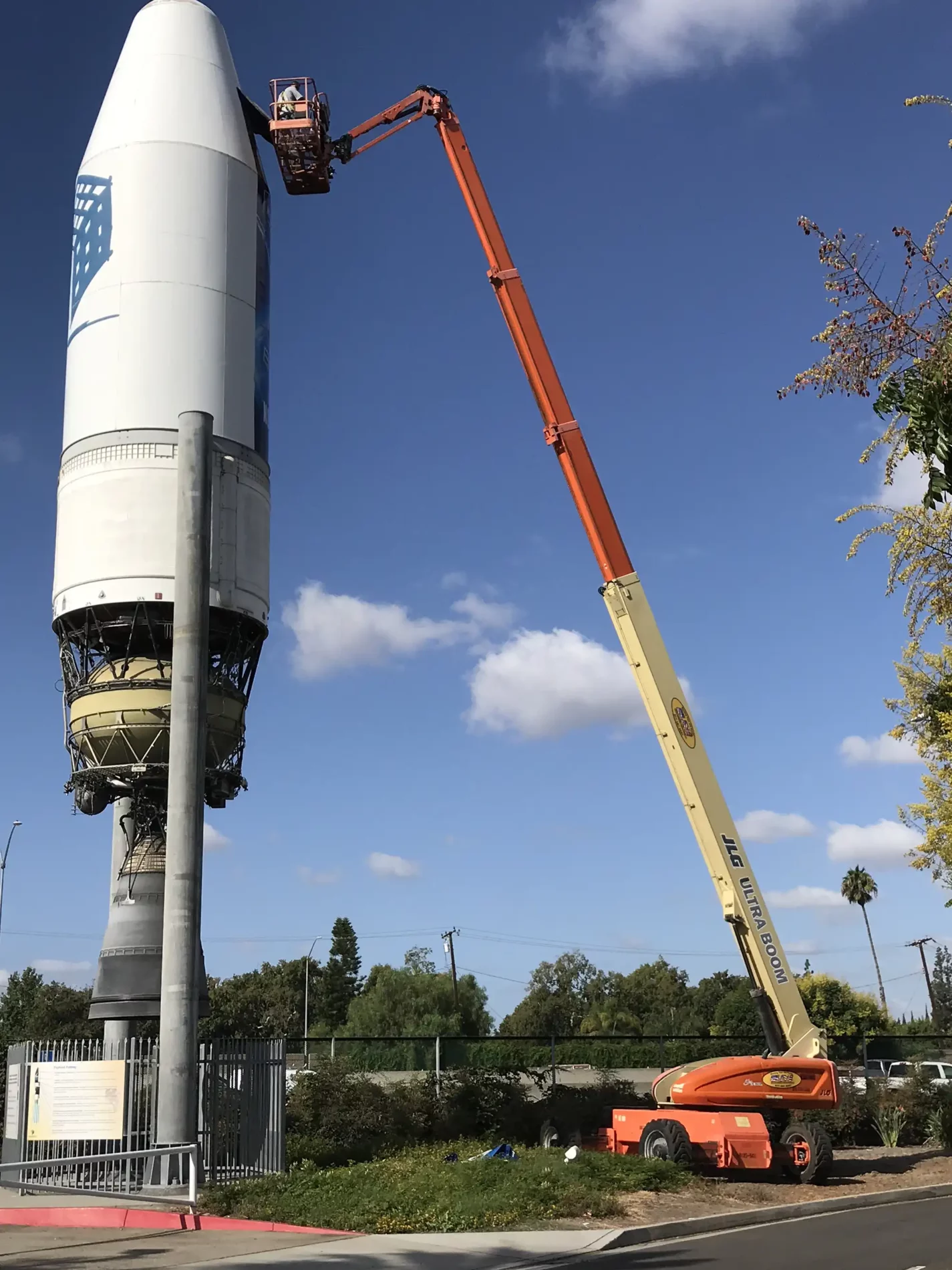
“These clients are not building and then moving on to a different project. These are companies that have operating facilities and need ongoing support, and they look to us for that support at a maintenance level, a small capital expenditure level, and a large capital expenditure level.”
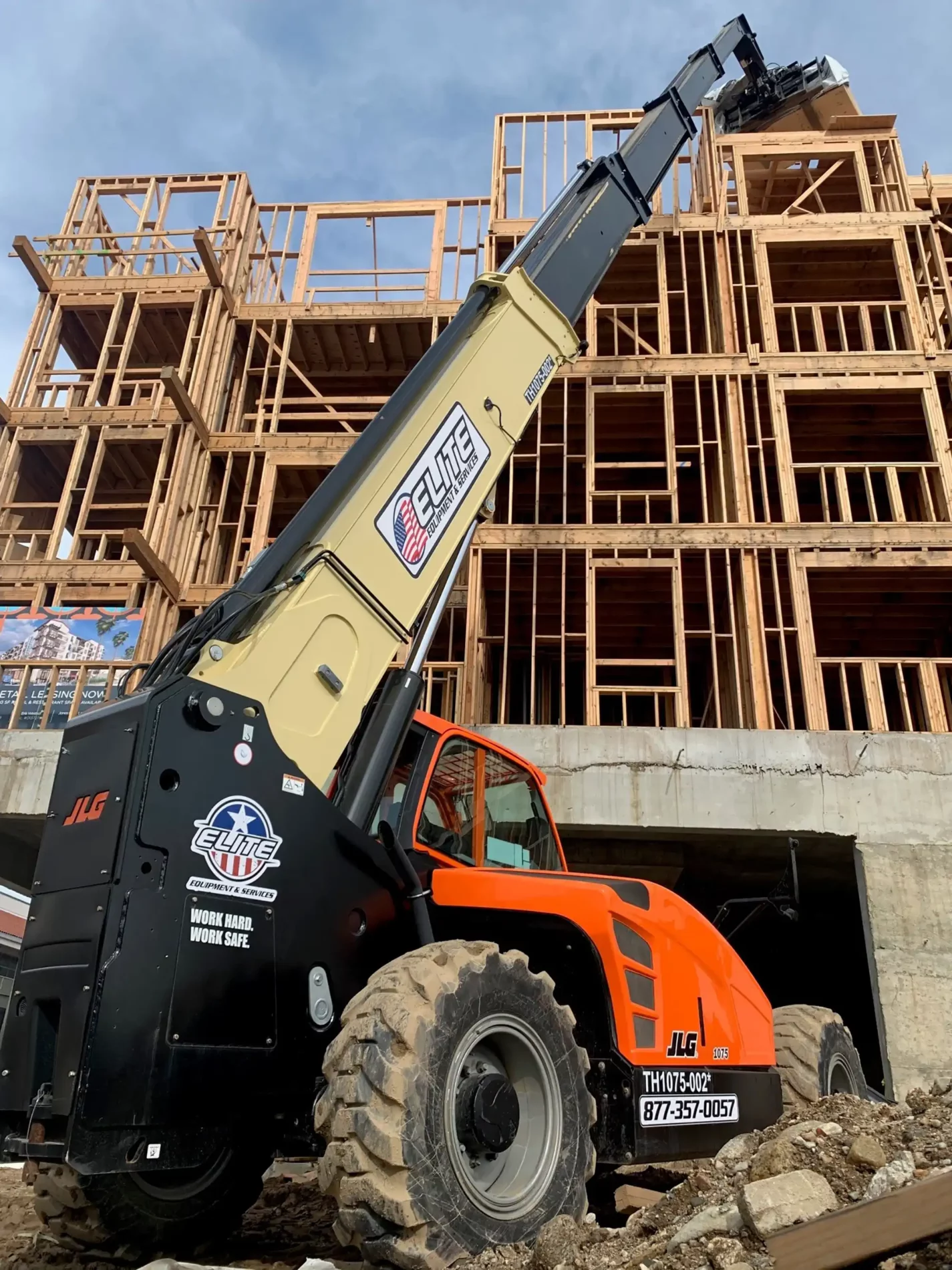
Because of the nature of the projects they work on, Sylvan is in a perpetual state of collaboration, innovation, and problem solving. “Many of the projects we work on are new, so we confront problems that have not been confronted before. This requires us to use all our resources, all our collaboration and thinking to find a solution for the client. There’s often a lot of pressure, certainly in maintenance or small cap situations where they’re not producing at the rate they want, or at all. They look to us to get them back up to speed.” 

Sylvan emphasizes collaboration across the board, both inside and outside the company. Two-way collaboration is enforced from the outset of a project and especially with new clients. “We work together with clients to learn the geography, learn the service, and build up a partnership with them.” At the helm of this collaboration is respect and transparency. “We keep our word, we tell the truth respectfully,” says Metz. “We have to make sure the client understands what’s going on in their facility and what it takes to resolve that situation. We’re very transparent about our challenges and our successes, and that works. Together we focus on the solution and not the blame—a saying we use a lot on all of our projects.” This approach allows Sylvan to anticipate realistic challenges so that when they present themselves, which they inevitably do, we can deal with them in a way that is proactive, assertive, as well as time and cost efficient. 

Repeat business does not come without customer satisfaction in the services provided. The services that Sylvan offers are diverse in range and extensive in scope, but Metz breaks them down into three categories. First there’s the process side, which covers processed piping installation and all forms of mechanical fittings, including orbital welding, MIG welding and TIG welding. “We provide electrical support and equipment setting to the machines that make the products our clients are selling,” 

Metz adds. “We have millwrights, iron workers, and rigging professionals to set that equipment and position it so it can be powered and piped. We also provide sheet metal services to those plants—so heating and cooling services, stairs, and steel supports for the equipment. That’s all on the process side.” 
Next up is the facility side of the business, which encapsulates all the services necessary for heating and cooling. This includes roof drains, plumbing, and all the industrial services that are necessary to operate the facility. “We have a service group in our Dearborn location. We’ll be replicating that group throughout the US, probably Canada as well, possibly Mexico. That group provides ongoing maintenance to commercial office buildings and industrial facilities, primarily for heating and cooling.” Last up is the material side of Sylvan’s service offering. “We have a material handling group that does all the engineering, fabrication, manufacturing and installation of material handling systems.” This service operates primarily in the automotive and food industries, as well as some airport baggage handling work. “That’s a relatively new business unit for us in the last three years that’s been very successful,” says Metz. “We recently made an add-on acquisition to support the manufacturing portion of the business.” 
Having provided insight into Sylvan’s services and the four pillars of success applied to them, Metz moves on to the company’s proven track record out on the field. That is, a small selection of Sylvan’s many standout projects from over the years. “Princeton University is going through an extensive process of heating and cooling their entire campus through a geothermal system and Sylvan performed three major projects,” Metz says. “We were part of building the Tiger Plant that pumps  hot water, chilled water, and geothermal water throughout the campus.  The Thermal Piping Project to transport hot water and chilled water to specific buildings. The Geothermal Mains Project to move the geothermal water from the well fields to the TIGER Plant.” The projects were high-profile, the deadlines were tight, and close coordination with the university and other trades was critical throughout. Despite the challenges, not least of which was a sizable application of a relatively new technology, it was a sweeping success. “It came in on time and on budget,” says Metz. “I think this project fits as an example of our client approach and how we achieve an 80% repeat business rate. This was a challenging project. I’m not sure there’s ever been a geothermal project this big. We’re very proud of it and I know Princeton is as well.” 

Stellantis, a leading global automaker with a constellation of fourteen iconic automotive brands, including Chrysler and Peugeot, is the client behind Sylvan’s next standout project. When the Stellantis facility in Windsor was gearing up for a new product launch, Sylvan was responsible for the activity in the paint shop, body shop, and general assembly. “The facility was retooling the plant and reconfiguring the systems to provide two new products, the Stellantis Minivan and New Dodge Challenger. 

It was a significant amount of planning leading up to the project, probably 10 months prior to the project on the engineering side. The pre-construction planning and the actual bulk of the construction was performed in a ten-week period where we had close to 1000 trades people performing the work. When you’re mobilizing that many trades people and there’s that much equipment coming together, there are challenges. Launch dates are very important to Stellantis and we met all of them, which allowed them to have a plant ready to build the vehicle they announced to their investors. That was another success story and one with lots of challenges along the way, lots of issues to overcome, and much needed collaboration.” 

Next up is JW Marriott, a large, multi-level hotel in Detroit. “JW Marriott is a project we’ve been working on for a number of months in the budgeting phase, the estimating phase, and now in the pre-construction phase. We’ll be starting work this fall, but the preplanning, preconstruction, and drawing of the project is very crucial. We’re doing all the HVAC and plumbing in the hotel, so there’s a lot of construction activity we have to work within. The pre-construction phase and working with the other contractors are critical to success when we actually start in the field with boots on the ground. This is a project that the city of Detroit is very excited about—the city itself, its residents, and those in the surrounding community. I believe it will sit at the former Joe Lewis Arena where the Detroit Red Wings played—a great concert hall and entertainment venue that will now be home to the hotel looking out over the river and towards Canada. I’m sure it’s going to be a great facility for the city of Detroit.” 

Looking into the future, Sylvan’s sights are set on continued growth across the company’s US footprint, as well as in Mexico where projects are on the rise. Growing its HVAC and electrical services is on the horizon too, as is expanding into the chip industry where opportunity is abundant. But such growth does not come without first taking care of existing business and maintaining the reputation Sylvan has built over the years. “We continue to work at our existing business and making it better using new technology and training our people both on the business side and the technical side,” says Metz. “We’ve opened an office in Arizona which is underway, while data centers and government work in the Southwest will be supported by our operations in Dallas-Fort Worth, which are currently in development.” Whether Sylvan is operating in prospective or existing markets, or with new or old clients, those pillars of success will remain integral to its approach. The plan, as Metz puts it, is to “find different ways to collaborate and push the boundaries, to think outside the box so we can provide better solutions for our clients, to focus on how we make our business better, and to solicit candid feedback from clients if we’re falling short. And, of course, to stay humble, because we can always be better.” 

Lightening the Load

View in E-mag
View Brochure

Bel-Con is a design-build construction company serving industrial, commercial, and institutional clients in the South-Eastern region of Ontario. Originally founded in 1973 by Bill White and Barry Brown, Bel-Con’s operations were taken over in 2006 by Tom Gunsinger and Michelle Stephens who sought to foster and grow the reputation for service and quality for which the company had become known. As such it was not just the company that was entrusted to Gunsinger and Stephens when they took over, but the legacy. “This is no easy task,” says Stephens, “and frankly it’s impossible without our amazing team”.

An image of an office room with blue features and hardwood floors.

Developing our team and helping each of them to grow individually is integral to meeting our corporate goals and to our collective success. We also encourage and participate in community service and make it a priority to provide support to many local NPO’s, charities and events that help improve & enrich our community as well as the lives of those who live here.” Bel-Con is an ‘ICI’ contractor, meaning our focus is on Industrial, Commercial and Institutional projects.  The majority of our volume, however, is comprised of industrial projects such as manufacturing and warehouse facilities”, says Gunsinger.  “We’re very open to being flexible in terms of the services we provide. Some clients basically want to settle on a design, and have us turn over the facility when we’re done, while some clients want to be very involved through the process. Either way we can accommodate them. They have their own businesses to run, and construction is often a foreign business to them, so they trust us to make the decisions for them and ultimately give them what they’re looking for.”

Bel-Con offers value-added services that go beyond those that are standard of the Design Build industry. “We often get involved with helping clients to find and select properties and to arrange financing,” says Gunsinger. “We offer value engineering ideas to help do things more economically, saving them money in capital costs, ongoing maintenance costs, and energy efficiency. Having some in-house design services, we can take 2D drawings and make renderings so people who are not used to reading drawings can more easily visualize what we are proposing.” Bel-Con’s entire business model is geared towards just that, making the design build process easier for the client through an expert, hands-on approach. Lightening the load for the client in this way and creating longstanding relationships is all part of the Bel-Con legacy. “Bel-Con had values and a reputation in the city and surrounding area, and the previous owners wanted to make sure that was carried forward with the same sort of enthusiasm,” says Gunsinger. “Our tagline is ‘Buildings that work, Relationships that last’, and we have a long history of working with clients going back several decades. In the building industry you don’t necessarily work for all clients every year, but they may need to expand every five years, or there’s little projects along the way, even something simple like installing a door or a very minor renovation. We’re not just looking for the nice new build or big addition. It’s full service and full support for our clients.”

“We’re not just looking for the nice new build or big addition. It’s full service and full support for our clients.”

Stephens and Gunsinger join me today on what is Bel-Con’s 50th year in business. For both, the award- winning SafeStart building comes to mind as a highlight as they reflect on the milestone. “That was a great project from the get-go,” Gunsinger says of the development that went on to win the Butler North American Building of the Year Award in 2014. “It was a competitive design build proposal, and we were able to sell the quality of what we were providing. We captured their vision of what they wanted the space to look like and that’s how we won the job.” Because the SafeStart project was won on quality rather than price, this fostered a relationship in which both parties valued and invested in quality throughout its duration. “SafeStart epitomized what true design-build is intended to be,” Stephens adds. “After an interview selection process, the client chose Bel-Con to work with them to design a building that met the needs of their growing, international business. Bel-Con oversaw the entire process representing their interests at every step and stage of the project, resulting in greater efficiency overall but also allowing them to continue focusing on their business. The end result was a beautiful building that we are both proud of and that provides them the functionality they need.” Gunsinger adds: “Our current building used to belong to SafeStart. When we built their new building, we bought this location from them and before we moved in, we used it as a temporary space for another client who were doing a total interior renovation.” This smart use of space and resources benefitted both parties and is characteristic of Bel-Con as a design build company.

The SafeStart project is just one example of the longstanding relationships that form the foundations upon which Bel-Con is built. “We’ve got some clients that we’ve completed thirty to forty projects for over the years, again everything from small renovations to a new plant or major addition,” Gunsinger says. “We have lots of lots of partners in our design build network, consisting of mechanical, electrical, and sitework contractors that we work with repeatedly. We have trusted subtrades who do good quality work and know what Bel-Con’s about, that we’re going to be there for our clients and if there is an issue that comes up, we find a way to solve it. It can be tough to maintain those relationships as ownership changes over the years, but we’ve been able to go from generation to generation and that’s something to be proud of.”

Perhaps one of Bel-Con’s most significant relationships is its 45-year long partnership with Butler Manufacturing, a worldwide leader in building system design and construction. “It’s a big part of a lot of our projects but we don’t just build pre-engineered buildings, we do all types of conventional construction as well. If it’s a design build, however, we often partner with Butler for a solution.” Michelle adds: “We pride ourselves in our exclusive relationship with Butler Manufacturing; the undisputed leader in the steel building industry. Our services include a wide range of construction types, contract delivery methods and project sizes including new buildings, additions, renovations, and building maintenance services. Metal roofing is also a core competency, as Butler’s proprietary MR24® Standing Seam roof system offers low maintenance protection for 40+ years.” The Butler Builder Network of which Bel-Con is a part is made up of only the highest quality contractors, ensuring superior quality control that is unmatched in the industry.

Another standout project for Stephens, for reasons that become obvious as she describes it, is the Grace Inn Shelter in Belleville. “The Grace Inn Shelter is “a ‘grass roots’ initiative by a few community members to provide Belleville with its first and only homeless shelter,” Stephens says. A long vacant building that was formerly a banquet hall, the Grace Inn Shelter was renovated into a full-service, 21 bed shelter for men and women which included a commercial kitchen, showers, and a dining hall. “Bel-Con was able to support the effort by providing our expertise and resources by overseeing construction operations and helping them open their doors before the winter. The shelter has now been operational since 2019 and to see how it has met the basic needs and provided extended support and assistance to so many vulnerable people is very fulfilling.”

To the list of memorable projects from throughout the years, Stephens adds Bel-Con’s renowned restoration of the historic Bellville City Hall in 1988 which went on to win the Ontario Association of Architect’s prestigious “Landmark” award, while Gunsinger adds the conversion of a city-owned fire hall into an office space for BCS Automation, and the high-end Bay of Quinte Country Club and restaurant, all of which capture the diversity that embodies Bel-Con’s portfolio.

In 2020 Bel-Con was awarded the Outstanding Regional Building of the Year Award at the annual Butler Building Awards & Banquet in Austin, Texas. A period of significant growth followed and continues steadily today. “That new growth has actually turned into repeat business already and that’s a good sign,” says Gunsinger. “We’re getting the confidence of new companies and new owners to expand the business further, so the future looks very bright. There’s lots of projects on the horizon with some projects going into 2026, so we’re thankful to have a solid backlog of work.” The nature of the construction industry, especially design-build, is that you can provide an initial budget for a project, but it may be five years before they “put the shovel in the ground.” This means that while Bel-Con is kept busy with repeat clients, there is always some capacity for new opportunity.

As such, Bel-Con’s approach is to maintain its existing clients while keeping a look out for new ones. “We maintain some space for repeat clients first and foremost,” says Gunsinger, but there’s always some holes to fill.” Bel-Con’s recent growth is in part a result of the construction market within which it operates, which has shifted since pre-pandemic times to the benefit of the design builder. “The area of geography that we cover in Ontario is very attractive right now to a lot of companies because the land costs are cheaper and there’s more people looking for a more relaxed lifestyle. We’re not rural by any stretch, but we’re certainly not the City of Toronto either. Lots of companies are relocating to this area and opening new facilities. That’s obviously good for business in terms of new opportunities.” Michelle says that “Bel-Con’s goal is not to be the biggest, but the best. What does it mean to be the best? To us, it’s creating a legacy that we can be proud of; founded on a superior level of service, a high-quality finished product, and long lasting, mutually beneficial relationships. When a client needs to renovate their building or increase their space by adding on or building new, it can be a daunting task as there are many decisions to be made and factors to consider. Not to mention the time it has the potential to take away from managing their business. We aim to ‘lighten their load’ by guiding and helping clients navigate the process and provide clarity so they can make educated decisions concerning their best interests, not just for today, but also keeping an eye on their potential future growth. They decide how little or much they want our involvement to be, but ultimately our goal is that in the end they get exactly what they need, are happy with not only the outcome but the efficiency of the process and the value we were able to provide. Our ideal future is one where all of our clients can attest to this level of effort and superior service.”

Teel’s Vivid Vision

View in E-mag
View Brochure

Teel Construction’s roots can be traced back to the mid-seventies when Parker Teel and Peter Gundlach started T&G Enterprises, focusing on small home and commercial construction. T&G Enterprises soon became Parker Teel Construction Company for which Parker Teel was the sole proprietor, before eventually becoming Teel Construction Inc in 1987. A family-owned business then and still to this day, Teel Construction now specializes in interior fit-outs, base building remodeling, and ground-up construction projects in Virginia and beyond. Parker Teel sits on the board as Chairman while his son, Spencer Teel, leads the company as CEO after a five-year tenure as President. “We’ve got ninety-five people on the team and a really great book of work,” Spencer says.

Distinguished names like Amazon, HSBC, Five Guys and SoulCycle all form part of this project catalogue that Spencer refers to, showcasing Teel’s status as a powerhouse within the North American construction industry. Building and maintaining long-term relationships while serving the community has always been the Teel way. It is through these long-term relationships that Teel earns most of its business, in fact ninety-three percent of it as of June, from repeat and referred clients. “We have developed a reputation within the industry based off our core principles that has allowed us to achieve success for our people and our clients. A lot of work goes into finding clients who align with our values, folks that are seeking a contractor as an extension of their team. Once we find that client, we like to try keep them for the long term, to keep them for life. Morgan Stanley, Kaplan Educational, ALDI and Lidl grocery stores; these are just some of the clients that have provided us with hundreds of projects over the years and really helped our company and our people to grow.”

Spencer recalls one Lidl project in particular that is significant as an example of a strong client relationship as well as Teel’s commitment to serving its community. “Lidl’s first store in the District of Columbia over the Skyland Town Centre was a special project because that was the first grocery store that community had. It was a meaningful job for the community that allowed us to showcase some of our base building expertise in the grocery market.”

Tysons Corner Centre is a large shopping center and mall in Virginia, currently owned by nationwide developer, Macerich, who represents another of Teel’s many long-term relationships. “That shopping center has been particularly special for us and a major source of work,” says Spencer, “not only for the landlord, but the tenants too.” One of the projects completed at the center is CAMP, a 10,300-square-foot tenant fit-out of an existing mercantile space. The project required the demolition of interior partitions to transform the area into a front-of-house sales space, and features exquisite millwork, dedicated activity and party rooms, and employee back-of-house areas. CAMP’s standout feature is the Experience Space which showcases the Disney Encanto x CAMP live immersive experience. “Tysons Corner Center a wonderful place that has afforded our team work on a consistent basis throughout our thirty-seven-year history,” Spencer says.

A project that showcases Teel Construction’s diverse skillset in building upgrades is the Westwood Country Club in Virginia. “We put a building addition on the existing clubhouse which features a new fitness facility, a private wine room, a golf simulator and a Bar & Lounge, along with a rooftop terrace that hosts weddings and various events.” As that phase of the project was wrapping up, Teel broke ground on a 45,000 square foot interior tennis building that featured three tennis courts. The building also featured a Court Tennis, or “Real Tennis” facility, which was one of only fifty in the world and twelve in the country at the time. “The Court Tennis component of that project was a highly technical and intricate construction specialty,” says Spencer. The project saw the replacement of the previous inflatable bubble tennis court enclosure with an advanced permanent pre-engineered metal building (PEMB) structure to provide a more robust and adaptable space for tennis enthusiasts. “It also included an observation mezzanine floor that overlooks both the tennis and Court Tennis courts. That was a really special project, very unique and a great opportunity to showcase some of our team’s skills.”

Spencer’s role as CEO involves strategic planning and a high-level of involvement with the leadership team to ensure they are well supported in the initiatives that they undertake. “From a recruitment and retention point of view, fostering an environment that helps our people learn and grow to their fullest potential is what we put a lot of our energy into,” Spencer says. “In 2017 we subscribed to the Entrepreneurial Operating System to help with our strategic plan and longer-term growth strategy.” The Entrepreneurial Operating System, or EOS, is a framework of tools and concepts that allows you to run your company like a well-oiled machine and keep everyone within the company on an aligned path towards achieving its goals. “That’s been foundational to a lot of the systems that we put in place and to set up the framework to really foster that growth environment,” Spencer says. “The company’s been on a slow, organic growth trajectory. We’ve got systems in place that are priming us to take on larger, more complex opportunities. We plan to grow with our current client base as well as new clients that might not have seen us as a relatable party for them in the past. They’re coming into view now as they see Teel as a viable contender to help with their project delivery.”

Speaking of his team and the workplace culture that powers it, Spencer mentions a book he read recently called Vivid Vision by Cameron Herold. It’s a book that offers tangible proof of its effectiveness in the form of Teel’s success, and inspired, I waste no time in adding it to my own to-read list. “This was really transformational for me as a leader and really helped orchestrate my thoughts in terms of how I wanted to see the company progress and grow.” The book encourages readers to do a mind map or brain dump of how you see your company in three years, therefore creating a detailed vision that acts as a point of focus as you manage your company. “That exercise helped me understand where the company was headed, where we want to go, and who we want to become” says Spencer. “There’s been a surge of positive energy injected into the company that really helps people focus on the longer-term plan for the business. You don’t have to be a president or CEO of a company. You can write your own vivid vision about where you want to go in your profession or goals in your personal life. It’s pretty remarkable, the power of writing it down and reviewing it on a consistent basis.”

“There’s been a surge of positive energy injected into the company that really helps people focus on the longer-term plan for the business.”

Sometimes success is striking the right balance between hard work and visualization. To be able to clearly visualize your goal is to take the first step in achieving it, and this continues to be the way for Teel Construction under the leadership of Spencer. As we wrap things up and reflect on the future of Teel Construction, that aligned vision and the company-wide surge of positive energy necessary for achieving it, is evident. “We’ve picked up some incredible new people while the existing folks have continued to demonstrate that thirst for personal and professional growth,” Spencer says. “We’re all probing ourselves for greatness, and there’s nothing but exciting things ahead for this company.”

Finding Your Niche

View in E-mag
View Brochure

When Dominick Camosy came to the United States in 1910, he was a carpenter by trade, kickstarting his career in the niche art of making pool cues. This marks the beginning of the Camosy Construction story, told today by Dominick’s Grandson and current Owner, John Camosy. So, how does a young pool cue maker become the legacy of a company that is now in its eleventh decade, each more successful than the last? “Relatively quickly after he arrived in the United States, my grandfather started building homes,” says John. “His first real business was in Kenosha Wisconsin as a home builder. My father was in college in the University of Wisconsin getting an engineering degree when his dad, my grandfather, fell ill. He never finished his senior year and instead came back to help him and then eventually take over the company. I think he was in his 80s when he finally went back to finish up and get his engineering degree. My dad ran the company for many years, until my brother Raymond took over as president in 1986 through 2007, and then I took over in 2007.”

exterior of a police station

Family owned since 1910 and now in its fourth generation, Camosy Construction is a mid-sized general contractor and construction management company. For most of its life, Camosy Construction has operated as a traditional general contractor, competitively bidding and working for private clients. Today, after a steady uptick decade on decade, revenue generation stands at around seventy million a year, with twenty-five employees in-office and fifty to one-hundred in the field depending on the time of year. “I like to say we are not just a paper pusher, a construction manager or general contractor,” says John. “We do our own work, so that’s concrete, masonry, carpentry and demolition, in the most traditional sense of what a construction firm does.”

Niche was always the way for Camosy Construction whose founding roots are in pool cues, and who today has found its niche in the municipal market, and more specifically police, law enforcement and fire. “In the early 2000s we made a conscious decision to try go into the construction management market and really attack the municipal sector,” says John. “And so that’s what we did. We made a big effort and we’ve been really successful, especially in the police and fire realm of that market.” Though the municipal market serves Camosy well as a niche within which to specialize, it is not the company’s only market. When Camosy Construction puts its mind to something, it goes all in. This was the case in the early 2000s when they decided to get into construction management and target the municipal sector, and it is the case today as they venture into the food manufacturing market. “We have started to target the food manufacturing market, so bread makers, chocolate makers, all those kinds of facilities, and that’s proven successful. If you haven’t done food manufacturing before, the next food manufacturer doesn’t want you. Eventually you get one big client and then it turns into two and then it turns into three. That’s how we get our niche.”

Camosy Construction’s portfolio is categorized into a Special Projects Division which covers specialized projects with values under a million, and a Major Projects Division which covers large-scale, high value projects. “We were recently rewarded for an €63 million police station in Schaumburg,” John says, encapsulating the pinnacle of the major projects division along with the growth of the police sector. Continued growth is on the horizon for Camosy Construction as it always has been, but it will come slow and steady rather than hard and fast. “We’re looking to grow but at a moderate, sustained rate. We’re not about hiring a bunch of young guys out of college and then trying to push them into running big projects quickly. That’s just not who we are. So sustained growth is what we’re targeting, and we’ve added market segments as it makes sense too. Our food manufacturing group is starting to get bigger and bigger, and we’re going to try put more resources into that, but police and fire is really where we are the industry leader in the north half of Illinois. We targeted that market early and have been very successful, completing seven major police facilities in the last decade, with two more currently in construction and another in the pre-construction phase.”

To accommodate clients who may want a one stop shop, Camosy Construction sometimes partners with local architects and carries out projects under the Design Build method. With an Architect in-house who was once on that side of the aisle, Camosy is uniquely positioned to help clients through the Design Build process which continues to grow in popularity across the field. Another popular approach, and one that also benefits from this in-house architect, is when clients request that Camosy Construction helps them to hire an architect for their projects. “We’ve been doing that too, sending out the RFP to the architects, answering their questions during the RFP process, helping the owners score the RFPs, going to the interviews, and helping the owners understand what they’re buying. The owners make the final decision, but we’re helping them along the way.” While these modern approaches grow in popularity and become new lines of work for Camosy, they do not take the place of the traditional methods that have served the company well. “We do about two thirds of our business in the construction management market and about one third in Design-Bid-Build,” says John. “We don’t really want to get out of the competitive General Contracting market. For us to be successful as a Construction Manager, we have to be successful as a General Contractor too. We want to be competitive; we want to be the low bidder when we can be.”

Another of Camosy Construction’s services is one that came about organically through operating as a Construction Manager and off the back off the trusted reputation it has built over the years. “We do cost consulting for architects who want to have some idea what a job’s going to cost before it goes out for competitive bid. They hire us as a CM and then, realizing the value of our pre-construction services, they hire us to do some initial budgeting for them. There are some clients, especially in Wisconsin, who don’t really understand the CM process. This is particularly true of municipal clients, so a lot of them go with the competitively bid route and the architects would like us to help them up front with what they can tell the owner to expect for a budget. It’s nice to have that reputation that our budgets and cost estimates are reliable.”

The team at Camosy has been through decades of industry changes, gathering valuable experience along the way and applying it to new projects. As such, the challenge when it comes to recruitment is not so much labor as it is skilled labor. “Our project managers, our estimators, myself, we all have 30 years in the industry. There’s nothing we can’t estimate or build. But the downside is a lot of people are close to retirement age, so we have to replace them. We’re a union company, so in some ways the unions help recruit people and train them through the apprenticeship program and that’s good. But we need superintendents and foremen, so we do our own recruiting for those positions. The challenge is going out, recruiting good people and training them. That’s a big part of what I do now, and that’s true of the field too.” Reflecting on this particular challenge, John circles back to the need for controlled growth, or as he puts it, “not trying to explode in growth when what you really want to do is replace your good people with more good people. Sustained, moderate, continual growth is what we’re looking for. The owner of the company is involved in all our big projects and that’s got to stay that way. When there’s growth for the sake of growth, you start to lose focus. It’s more important for us to build relationships. For example, you do a good job for a police chief, and he likes his building and the experience, then all the chief’s get together and go to each other’s new facilities. When it comes time for their upgrade, they ask who designed it, who built it? Doing a good job is important because without that, they won’t hire you again and the next chief won’t hire you in the first place. Putting people just out of college into important positions doesn’t work. Growth is great, but we need to do it smartly.”

“Sustained, moderate, continual growth is what we’re looking for.”

Between its niche segments of the municipal market and the ongoing acceleration of its food manufacturing business, Camosy Construction is busy at work with no signs of slowing down. “We have two police stations in construction right now,” says John. “Des Plaines which was competitively bid and is due to finish in December, and Lake in the Hills which was a construction management delivery method and just got started. But the big one to talk about is Schaumburg. We’re looking at a seventy-million-dollar police facility and then a fifty-million-dollar village hall for the same owner. They’re going to run consecutively, so it’s great for us that we have three to four years’ worth of work, plus we another huge police station to add to our backlog It’s fairly unusual to see them that big, but they’re getting specialized and the components are unique and specialized too. It’s a niche market. Firing ranges, Faraday Labs, unique features that most contractors don’t see, we do those kinds of things. We also have some fire facility work going on right now, including a station for Hoffman Estates which is just starting the last phase of pre-construction and will hopefully get underway this fall.”

Camosy Construction is focused on a future of industry success through sustained growth in its carefully-selected new markets, as well as safeguarding and accelerating its well-established ones. “We don’t want to do everything and we’re relatively selective about the projects we go after,” John says. “We want to continue to be the leader in the police and fire segment.” With municipal projects growing in frequency, scale, and complexity, it is Camosy Construction, backed by four generations of specialized industry experience, who leads the way.

Restoration Reinvented

View in E-mag
View Brochure

On the surface Platinum Pro-Claim Restoration is exactly what the name suggests, a restoration company. Think fire and flood restoration, environmental remediation, rebuilds and repairs. But when you pull back the curtains on this three-decade old powerhouse there is so much more to it than restoration. As Founder and CEO Tony Scott likes to put it, PPCR is restoration reinvented. Tony started his company back in 1991 when restoration was not much more than a construction job – buildings burned down and got rebuilt. “I’ve watched the industry change in an incredible number of ways,” says Tony. “I can tell stories all about how it used to be and what we used to do but let’s just say when I started there were no fans or dehumidifiers.”

Today PPCR provides most of its services in-house including cabinetry and flooring, and this is just one of the many ways it sets itself apart from the rest. Another is the speedy service for which the company has become known. “We specialize in dealing with unit owners who are in a building that’s been flooded and getting them back in faster than anybody else.” PPCR even refers to some jobs as Monday to Friday jobs, which is far from commonplace in an industry that is so often leaden with delays. “We go in and move somebody’s stuff, replace the floor, do the drywall, paint everything, put the baseboard back on, move their furniture back, and that’s a Monday to Friday job for us.” Understanding the importance of minimizing disruption to people’s lives and getting them back into buildings fast, PPCR provides this duty of speed and efficiency to jobs big and small. “We just completed a $16 million fire repair on an apartment building in 1 year and 11 months during the worst possible conditions; it was COVID, we had major climate events including a atmospheric river, polar vortex and a heat dome.  It was so unbelievably hot that we had to put in extra safety precautions to avoid dehydration.

During this time BC even had a whole town burn down in a forest fire. Then we had the worst flooding we’ve ever had. This was all in that first year of the project.” Even in such conditions, with site closures and extreme heat and bursting pipes galore, PPCR managed to complete the job in under two years. “We take it seriously when we say we’re going to get people back in faster than anybody else,” says Tony, “and that was us proving it.”

In the modern context of environmental change and sustainable thinking, the sustainably-driven customer needs to be able to differentiate between company’s who are talking the talk and walking the walk. As well as helping people through fast and efficient restoration services, PPCR is an active steward of its local environment and its processes have long been sustainably minded. Not only is this company walking the walk – it is leading the charge. “The things that people are talking about now, we were doing years ago,” says Tony. PPCR’s commitment to sustainability stemmed not from external obligation but rather from Tony’s personal belief that we need to do better for our planet.

In what he refers to as his hilltop moment, Tony recalls the event that brought the reality of the climate crisis to the forefront of his mind. “I was camping on Black Mountain which overlooks Vancouver city but also towards Howe Sound and Squamish. There are islands and there’s ocean and it’s just beautiful. I was watching the sun go down and there was this beautiful cloud over downtown Vancouver. I’m sitting there looking at it and then I think wait, there are no clouds today.” Tony realized that the grey cloud covering his beloved hometown was actually a layer of pollution in the form of smog. “And I just thought, well, I can’t leave that for my kids.”

At the time PPCR was selling repurposed lumber that was then used for flooring and had also become involved with companies in California who were selling solar powered manufactured carpet. Tony recalls an ad from that time saying, ‘making the world a better place, one floor at a time.’ Even then the company was on the cusp of sustainable technology that would later become mainstream, but it was really that hilltop moment that set-in motion PPCR’s lifelong commitment to a sustainable future. “In 2012, we grew and moved into a larger facility, it was then decided to make it as sustainable as possible. We converted our lights over to LEDs, did audits on what we were burning and all the different ways we could reduce our greenhouse emissions. Right now, we’re recycling somewhere between 70 and 80% of our debris. For many years we were the only ones talking about recycling. We were doing our own thing for our own reasons. Then at one point we said we better start talking about this, and we did. Our goal then became to elevate the industry. How do we get more restoration companies across Canada to think about what they are doing with the debris that comes out of these houses?”

A big part of PPCR’s green journey is its electric vehicle fleet. In 2016 the company identified transportation as its greatest source of greenhouse gas emissions, and in turn, as the area through which it could make the most meaningful change. “If it doesn’t plug in, it doesn’t count!” Tony says. “33% of our fleet is now electric and we’ve got 18 charging stations in our parking lot. The unique thing about that is that we open it up to the public; anyone can come in and charge their electric vehicle for free.” Because of offsetting through the Low Carbon Fuel Standard Initiative which produces Carbon Credits, this initiative has become profitable for PPCR, and though that was never in the plan, Tony says it is certainly not a bad outcome. “We’re in an industrial area where a lot of people come and go and there wasn’t a lot of charging available to them. We wanted to promote that in our business and our local community. Now, a lot of people plug in at the end of the workday, charge up for an hour and then drive home.”

Trevor, PPCR’s Senior Marketing & IT Manager, is as enthusiastic as Tony when he adds his insight into the company’s commitment to sustainability. “What makes us the greenest company is that we’ve created a culture of sustainability that is self-perpetuating. It allows our employees to come up with ideas that implement change at an organizational level, but because of the involvement that Tony and our company has across the industry, those ideas actually change our entire industry. We’re starting to see individual employees creating these rippling earthquake effects across the entire Canadian restoration industry. It’s been fascinating to watch. We have this one gentleman, Rod, who came up with the idea to transition our cabinet shop from solvent-based systems to water-based. This creates a safer environment by producing less volatile organic compounds on the stains that we spray. It’s safer for not only the employees who are breathing in those chemicals, but also the customer, because we install those cabinets in their homes. Everybody is working towards a common goal; to make the world a better place. We are all environmental advocates and we’re teaching these other restoration contractors all our trade secrets. We’re not holding any of these things tight to us. That’s how we are making the world a better place and truly elevating our industry.”

“Everybody is working towards a common goal; to make the world a better place.”

For Tony and PPCR, this commitment to sustainability comes down to a duty of care not only to the planet, but to the people that inhabit it. “We get to help people every day and that’s why I love it. When somebody is having a hard time, we get to go in and help them, to try and take that anxiety away from them and get them back to where they were before.” Emphasis on the we get to. Understanding the sensitivities involved in restoration work, Tony sees it as a privilege to be trusted with this type of work. He gives the example of a recent job the company did for a lady with dementia. “It was confusing for her to have people in the house, but we also couldn’t have her living out of the house as it would be too disturbing for her. We arranged for her to spend the whole day having tea with a lady she knew from down the hall. We did the entire job in one day and had everything back in place so that when she got back in, she didn’t even notice. Those are the things that really make us who we are, and it’s great for the staff and the team to be able to help somebody in that way. It makes a good story, but more to the point is that it inspires our team. If it doesn’t, we’d have to look at that person and think maybe this isn’t the right fit.”

Looking into the future, PPCR plan to be at the forefront of innovative technology and Artificial Intelligence in the same way it was at the forefront of sustainability all those years ago. On this, Trevor talks about a new building program called the Pro-Care Building program. “We work with developers and new builders before the building is released to the tenant homeowners, then we get all the building information and that way we’re able to mitigate it as fast as possible. We’re constantly innovating on ways that we can help reduce the cycle times for the restoration process and help insurance companies save as much money as possible.”

Tony adds, “We’re really focusing on the latest technology to help us drive faster without removing the things that are key to our purpose, like taking care of the planet, getting the homeowner back into the building, and saving the insurance company money. We’ve had some really big wins. We just saved money on one job by drying all the floors in a brand-new apartment building. There were eight floors that were damaged by water that the builder wanted to have ripped out, and we got in there and said no, we can dry all this. It made what would have been an eight-month job, a forty-five-day job, and everybody was super happy at the end of it. So that made a big splash. People are all talking about it.”

When all is said and done, Tony reflects on that hilltop moment and can now say without question that PPCR has truly made a difference. “Eight years later and guess what? We did change the industry. We’re elevating it. We’ve taught over 70 of our competitors about recycling. We’re even doing podcasts about it.” The team, led by the ever-passionate Tony, continues to play its part in reducing that grey cloud over Vancouver and beyond in the best way they know how; together. “What really made the difference was our own staff jumping in and having people there that were passionate about it for their own reasons. They were the ones that made all these things happen the way they did. It’s great to see it happen within the company and it’s a credit to them. Because it’s about personal passion, right? Some people’s passion is money, mine is people and the environment.

That’s reflected in everything we do and it’s important as the world is becoming more purpose-driven. We don’t say and then do, we do and then say. I think that speaks volumes to our sustainability journey and our initiatives. We are authentic and we are not trying to be anything else.”

From Trees to Streets

View in E-mag
View Brochure

At the foundation of every construction project is, quite literally, the earth upon which it is built. Whether it be industrial, commercial, or residential, it can be argued that preparing the land for the vertical building process is the most critical and complex step. Site development professionals mass grade and shape the raw land, build roads, install utility infrastructure, all while navigating a world of unknowns that exists below our feet.

Wynn Site Development, based in Raleigh, North Carolina, has been providing comprehensive site development services for more than 16 years. Founded in 2007 by Lee Smith and Tommy Brinley, Jr Jr., the company has established itself as a trusted partner for its long-time, repeat customer base. Forward planning and continued process improvement has led to steady growth and has made Wynn one of the largest and most dynamic site development contractors in the area. Lee joins me today alongside business development analyst, Michael Molinaro, to tell me the story of how it all began.

From its office in south Raleigh, Wynn Site’s operations currently extend about 80 miles in all directions. The company boasts an impressive roster of over two-hundred employees, alongside a robust collection of 235 pieces of heavy machinery and more than 100 vehicles in its fleet. Vice President Lee Smith highlights the company’s strong relationships and repeat business, noting, “We do a lot of repeat business and we’ve had some customers with us since day one. I think that says a lot about our company.”

Founded in 2007, Wynn Site Development quickly faced the challenges of the recession. Yet, according to Lee, the company emerged “unscathed,” a testament to its resilience and strategic prowess in navigating economic downturns. This ability to thrive under pressure underscores the essential nature of site development, a field that continues to see demand through all economic conditions.

Lee proudly acknowledges the company’s substantial revenue growth over the years, positioning Wynn Site Development among the top four site development firms in the region. This growth not only showcases the company’s excellence and leadership in the industry but also its commitment to providing top-notch services and fostering lasting relationships with clients.

President Tommy Brinley, Jr and Vice President Lee Smith bring a wealth of experience to their roles and remain actively involved in the company’s operations. Lee mentions, “Our customers can still call us directly if they need to.” Tommy, who has been part of the industry since childhood, oversees field operations, while Lee, leveraging his accounting expertise, primarily handles financial management. Over time, they’ve assembled a dependable core team responsible for the company’s daily activities. Lee points out, “Most of our key guys have been here for eight or nine years, so we have really good employee retention.” This strong retention of employees and customers enables Wynn Site Development to grow while preserving the close-knit, family-owned atmosphere foundational to its success. This commitment to collective success binds the leadership, employees, and customers in a shared vision.

“Wynn’s approach is about transforming land with precision and care, upholding their values—the Wynn way.”

Wynn has a history of delivering high-quality projects across commercial, residential, and industrial domains. Lee details the array of services Wynn Site Development brings to these sectors. Offering land clearing, grading, and comprehensive erosion control solutions are just the start. The company also expertly handles the installation of essential public utilities, including potable water lines, storm drainage, sanitary sewer and sewage pump stations, all managed in-house. Wynn also employs several specialty crews that focus on detailed roadway construction and soil stabilization.

Lee showcases several of Wynn Site Development’s successful endeavors, highlighting a diverse client base that includes both loyal and new customers. It’s clear that many newcomers become repeat clients, drawn back by exceptional service. Among the highlighted projects is Falls Village in Durham, North Carolina, described by Lee as one of their largest undertakings. This residential project, in partnership with Stanley Martin Homes, uniquely incorporates a neighborhood within a golf course layout. With a challenging timeline, Falls Village represents a significant opportunity for success for both the client and Wynn Site Development.

Another noteworthy project is High Grove Oaks, a development of 200 homes situated in the vibrant community of Fuquay-Varina, North Carolina. This project, carried out for Mattamy Homes—a repeat client over several years—exemplifies the strong, ongoing relationships Wynn Site Development maintains with its partners.

Bexford subdivision, Fuquay-Varina, NC project aerial view by Wynn Site Development
Bexford subdivision, Fuquay-Varina, NC

Additionally, the Bexford Subdivision, also in Fuquay-Varina, for the national developer Forestar, boasts 900 homesites. Kicked off in late summer, the project is progressing smoothly and is expected to complete its first phase by this summer.

Lastly, Ashby Village in Sanford, North Carolina, is a 600-lot development marking the start of a promising partnership with Matrix Construction Co. from South Carolina. Thanks to its successful progression and on-schedule performance, Matrix Construction has already proposed further collaborations, currently under negotiation.

Through these projects, Wynn Site Development not only demonstrates its capacity for handling large-scale developments but also its ability to foster lasting relationships with clients, setting a foundation for future success.

“The Skatepark in Downtown Raleigh stands out as a smaller yet equally impactful project. Initiated by the community and supported by one of our loyal clients, Stanley Martin, we proudly donated our services and time to bring this project to fruition. It demanded extensive concrete work and some demolition, culminating in a grand opening covered by local news. Our involvement was a privilege. At Wynn Site Development, every project, from large-scale residential developments to community-centric skateparks, receives our utmost professionalism and commitment to customer satisfaction. Our approach to the dynamic field of site development, marked by practicality and attention to detail, sets us apart – we call this the Wynn difference.”

Skatepark, Raleigh, NC project aerial view by Wynn Site Development
Skatepark, Raleigh, NC

Wynn Site Development is steadfastly advancing into the future, grounded in its four fundamental values encapsulated by the acronym DIRT: Dependability, Integrity, Responsiveness, and Timeliness. Lee emphasizes the importance of these values as the company eyes expansion with a strategic approach. The blueprint for growth involves attracting new clients while bolstering the workforce. Lee notes significant strides in enhancing competitive edge and diversification through the introduction of in-house erosion control, maintenance services, and the acquisition of a novel full-depth reclamation machine, or cement stabilization machine, sparking success in specialized sectors.

Moreover, Wynn is venturing into property development, taking raw land through to fully developed lots ready for builders, further illustrating the dynamic growth strategy. However, expansion is mindful, with an acknowledgment of the challenges, particularly in recruiting skilled labor. Michael underscores the ethos of “controlled growth,” prioritizing managed, sustainable expansion over rapid, unchecked growth. This philosophy ensures that Wynn Site Development can scale effectively, maintaining its commitment to excellence and delivering unparalleled service to both new and existing clients. In essence, Wynn’s approach is about transforming land with precision and care, upholding their values—the Wynn way.

Where Quality Meets Speed

View in E-mag
View Brochure

To do business in a way that is efficient, durable, and lucrative, is to respond to market trends and offer solutions to socioeconomic and industry challenges. That is, to provide a service that is useful to the market in which you operate. In Ontario, a growing market trend is to build up instead of out. One of the socioeconomic challenges is a lack of affordable housing and an increased demand for rental properties. And a major industry challenge is the post-pandemic labor shortage which continues to have a critical impact on construction practices. The answer? A company like Magest Building Systems Ltd, who specializes in delivering multi-story buildings using a system that is less labor intensive than traditional methods. Today, Magest specializes in the design, manufacturing, and assembly of cold formed steel (CFS) stud wall panels, floor joists and trusses as a complete panelized building system for framing multi-story buildings. It’s portfolio spans across Ontario and beyond, and includes Condominiums, Apartment Buildings, Hotels, Retirement Homes, and Student Residences.

Magest Group Limited was founded in 1990 as a general contracting company, which specialized in the supply and erection of pre-engineered steel building structures. “Our pre-engineered steel buildings contained a large quantity of cold-formed steel girts and purlins required to frame out the walls & roof,” says Craig Wood, Business Development Manager. “After erecting pre-engineered buildings for quite a few years, we decided to get into the cold form steel market in 2005. That’s when we decided to look into the design, supply and erection of load bearing steel stud wall panels, which would primarily compete with masonry block, poured concrete, and slower, more conventional construction materials. Supply and installing load bearing steel stud wall panels is very fast and efficient compared to conventional methods of construction which are very slow and more labor intensive.”

Nova Retirement Residence, Niagara Falls, ON

After a few years of working with cold-form steel, Magest found it’s flow and began to expand its offerings. “Magest decided to take responsibility for the structural steel supply and install as well as the floor and roof systems, basically completing the entire upper super structure utilizing our CFS system as much as possible. This method helps to alleviate the general contractors, taking some responsibility off of them with Magest coordinating the superstructure install.” One of the biggest milestones in Magest’s trajectory towards future success was the purchase of a roll former in 2010. “The roll former allowed us to manufacture our own steel studs and track material and fabricate our own cold form steel components, giving us more control over both the cost and fabrication of the wall panels. Our roll former produces stud & track material ranging from 12ga to 26ga studs with 2.5” wide to 14” wide webs. All cold form steel material is produced and fabricated in our mostly automated 95,000 square foot manufacturing facility in Stratford.”

Step by step, Magest evolved from a General Contracting company to more of a one-stop-shop when it comes to cold-form steel, taking on more of the structural design in-house. “When clients come to Magest with a conceptual floor plan, we can help them to design and value engineer their building using our system while keeping cost in mind. Engineering wise, we’ve really jumped into the design of cold form steel. We can provide a complete upper structure design for our clients if they don’t yet have a structural engineer on board. We provide a preliminary structural layout for our clients with a budget price. If that budget price meets their overall project budget, they’ll engage Magest to do the structural design, produce permit drawings, and eventually issue for construction drawings.”

The market quickly caught on to the benefits of Magest’s system, and with this came a larger volume of projects. “We’ve increased the size of our manufacturing facility throughout the years because of the increased demand for fabrication and manufacturing space,” says Craig. “We have seen an increased volume of work year after year as more and more projects are designed in cold-form steel than when we started in 2005. It was difficult in the beginning to persuade architects and engineers to design their projects using load bearing steel stud walls. But now, so many projects are coming out designed in our CFS system, which is great to see. We’re doing something right.” The architects and engineers who once had to be persuaded to design using cold-form steel are now demanding it, and as a result, Magest has experienced consistent growth year after year.

In post-pandemic North America, construction companies have been scratching their heads in search of an answer to the labor shortage that continues to sweep the industry. The old way simply does not work anymore and systems built on efficiency and innovation are carving the way forward. Luckily, Magest was in the game of efficiency and innovation long before the pandemic, and as such can offer a proven, less labor-intensive system that tackles this industry challenge. “With the speed of installation using our cfs system and the skilled trades that we are bringing to site to erect our buildings, there’s less construction labor needed. We try to prefabricate as much of the building as possible, off site. It definitely speeds up the design, erection, and install time, which helps to reduce the overall project schedule. Clients can see how fast our buildings go up, especially if we’re building a six or eight story building across the street from a conventional poured concrete structure. Our buildings are erected in half the time”.

“Now, so many projects are coming out designed in our CFS system, which is great to see.”

Arguably even more important than delivering construction projects within a given program, is delivering them within budget. Magest uses a straight-up approach by which the budget is prioritized from the outset and maintained throughout the process, instead of skirted over and increased as the project progresses. “Being able to maintain the client’s budget along the way is the one of the most important things. The worst thing that we could do is suddenly increase the price at the very end. We don’t do that. If we did, we would never get a call back from that client, and we take a lot of pride in our list of repeat clients. We have so many clients that come to us knowing right from day one that they want to use Magest for their next building. They know what works, and we try hard to keep the cost in check for them.”

As Craig talks me through some of Magest’s projects, the company’s pride in repeat business is evident. First up, the Soleil Condominium development for Mattamy Homes. “Mattamy is a big constructor in the GTA. Approximately three years ago we started the construction of four six-story buildings for Mattamy in Milton.” For these buildings Magest supplied cold formed steel wall panels, as well as structural steel. “The nice part about the Soleil Condos is that all four buildings are on the same site.” This opened up a pipeline of new projects for Mattamy Homes who continue to be one of Magest’s many repeat customers.

“We’ve also completed ten 4-story apartment buildings for Hyde Construction, who operate throughout Ontario. Each building is 64,800 sq. ft, or 16,200 per level. Magest erected each above grade structure in 8 weeks” Another repeat customer, Magest now do one to two projects a year for Hyde Construction.

“Magest’s construction background has greatly contributed to our success over the years. Knowing how to construct a building on site is just as important as precisely manufacturing the components that go into the building. We understand the details & how the building needs to come together alongside other trades and on schedule. We pride ourselves on the quality of our work and the number of repeat clients that we have.”

As the demand for high-quality retirement services grows throughout North America, Magest has tapped into that market and has completed retirement homes both in Ontario and out of province. “We erected the Rivera Retirement Home in Edmonton, Alberta,” Craig says, speaking of the 4-story 130,000 square foot building in Edmonton that was erected in sixteen weeks. “We have also completed projects in Halifax, North Bay, Sudbury, Niagara Falls and Sarnia. We kind of go all over the place.” Magest’s footprint extends out of country too, with projects in the United States forming part of its portfolio. “We completed a seven-story Harrah’s Hotel and Casino in Murphy, North Carolina, approximately ten years ago.” This project had a floor area of over 160,000 square feet and was erected in just fourteen weeks. Magest’s plan for the future is to continue to respond to market trends while offering innovative building solutions through a system that is proven, efficient, and in demand. With this comes company-wide expansion that will allow Magest to take on a larger volume of projects. “This summer we will be adding a 45,000 square foot plant addition, which will give us more fabrication space. We are also looking into expanding what Magest offers as far as building materials, and that’s part of what the expansion will be used for.”

Of the industry as a whole and Magest’s place within it, Craig sees big opportunity in the increased demand for mid-rise, multi-story residential developments. “I find that multi-story residential is going to grow in smaller communities where they don’t want to expand out with single family homes and encroach on farmland. Smaller communities are now allowing developers to build vertically, to build up as opposed to out. Building 4 Story, 6 Story, 8 Story buildings is exactly what we focus on. I only see our workflow increasing.” With a high-quality system that champions innovation while staying within budget and on program, Magest is all set for a long future in an industry which values those things above all else.

More Stories

From Concept to Completion, With Discipline at the Core

Holladay Construction Group — By Elizabeth Howell

For more than two decades, Holladay Construction Group has approached real estate development with a clear objective: to support projects from conception through completion (…)

Restoring Brownstones, Rebuilding Craft

New Wave Design & Contracting — By Emma Kilcawley Hemani

New Wave Design & Contracting’s rise within New York City’s brownstone market is rooted in a simple beginning. Founded in 2006 by Antoin O’Duibhir, (…)

A Community-Focused Builder Growing Across the Northeast

StandBack General Contractors — By Elizabeth Howell

StandBack General Contractors is a commercial construction management company based in New Windsor, New York, operating within the active commercial and municipal construction markets (…)

Construction as a Force for Good

The Crowther Group — By Emma Kilcawley Hemani

For The Crowther Group, construction is not simply a means of delivering buildings. It is a vehicle for strengthening local economies, supporting communities, and (…)

Designing the Invisible Systems That Make Buildings Work

Jordan & Skala Engineers — By Emma Kilcawley Hemani

Low voltage is no longer a secondary consideration in building design. Once treated as an optional enhancement, it has become a foundational element of (…)

Hitting the Ground Running – A Design Build Success S...

Pivotal Construction — By Aoife Chaney

Pivotal Construction is a medium-sized general contractor operating in the Puget Sound area, specializing in industrial, medical, and commercial tenant improvements, as well as (…)

Building New York Through Collaboration

AECOM Tishman — By David O'Neill

In New York City, construction at scale has always depended on more than technical execution. It requires alignment between contractors, labor, public officials, and (…)

Five Decades Shaping New York Interiors

Structure Tone — By David O'Neill

Structure Tone’s place in New York City’s interiors market has not been built on speed or spectacle, but on service and endurance. Founded in (…)

Building on Experience, Building with Integrity

JRM Construction Management — By Emma Kilcawley Hemani

In New York’s commercial interiors market, where speed is unforgiving and expectations are uncompromising, JRM Construction Management has built its reputation on execution. Joseph (…)