



Cenvar Roofing & Solar traces its present-day business to a problem that had little to do with roofing at first. Founder Chris Good had spent much of the 2000s building spec homes, but the housing crash changed the economics of that work almost overnight. Rehabbing bank-owned properties offered one route forward, and in the process Good encountered a persistent problem: finding reliable tradespeople who would show up, finish the work properly and stand behind it. Roofing became the answer.

Good launched Lynchburg Roofing in 2011, initially serving the market around the Virginia city where the business began. What started as a response to a difficult construction cycle gradually became the company’s central specialty. Cenvar’s own account of those early years credits a small group of people—including longtime roofing specialist Juan Villegas and CFO Dave Reed—with helping turn a temporary sideline into a scalable operation.
The company’s growth eventually created a problem of its own. Lynchburg Roofing was no longer confined to Lynchburg, and a geographic name that had once made perfect sense risked misrepresenting an increasingly regional contractor. A public naming competition in 2019 produced Cenvar Roofing, short for Central Virginia Regional.
At the time, Good told Lynchburg Business Magazine, “We loved how Cenvar captured that part of our history without alienating any communities we may serve in the future.”
The timing proved significant. Cenvar has continued pushing beyond its original Central Virginia footprint, developing service areas across Virginia and into West Virginia, Tennessee, Maryland and Pennsylvania. Its website now identifies locations and service markets stretching from Richmond and Northern Virginia to Beckley, Hagerstown, Johnson City, State College and Altoona.
Expansion accelerated particularly visibly in 2025. The company entered Culpeper, Virginia, and Beckley, West Virginia, before announcing a Winchester branch in June. Industry publication Roofing Contractor reported that the Winchester opening was Cenvar’s third market expansion of the year and its ninth Virginia market at that point, extending the company’s reach to more than 100,000 additional households in the surrounding area. “Since founding Cenvar in 2011, it has always been our goal to bring trusted, exceptional service to everyone who needs it,” Good said in the announcement.
“Since founding Cenvar in 2011, it has always been our goal to bring trusted, exceptional service to everyone who needs it.”
Growth has involved more than geography. Residential reroofing remains the foundation of the business, encompassing asphalt shingles, metal roofing, repairs and inspections, but Cenvar has gradually moved further across the exterior of the building and into adjacent markets. Its current offering includes siding, gutters, windows and doors, while two newer businesses—solar and commercial roofing—have broadened the company’s position considerably.
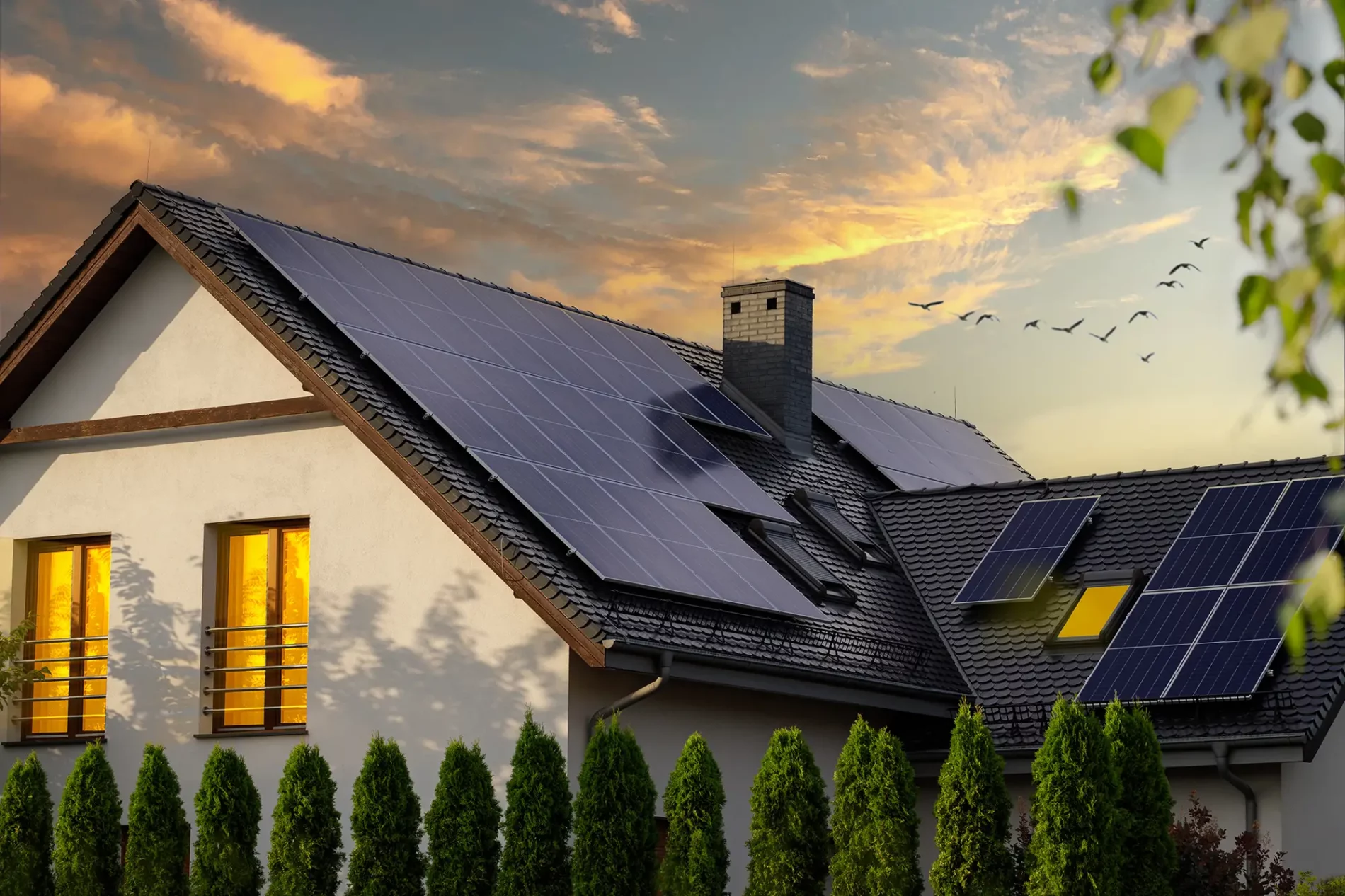
Cenvar Solar launched in 2023. The connection is practical: roofs and photovoltaic systems share both a physical surface and a long-term maintenance relationship. Installing solar on a roof approaching the end of its useful life can create avoidable cost when panels later have to be removed for reroofing, while roof work performed beneath an existing system requires coordination that becomes simpler when the disciplines are considered together. Cenvar’s own recent project material illustrates the point. On a residential proposal i Staunton, Virginia, an 18-year-old roof was still performing but its owner was considering solar. Rather than wait for a leak, the homeowner began evaluating replacement options before the panels were installed. The job is an ordinary residential example, but it captures why roofing contractors have increasingly begun looking at solar as part of the same building-envelope conversation rather than an unrelated trade.
The solar business remains centered on residential installations in Virginia, offering system design and installation alongside service and repair. For Cenvar, the addition is less a departure from roofing than an extension of the roof’s role: once a contractor is already responsible for protecting the surface, adding equipment expected to remain there for decades brings installation sequencing, flashing, waterproofing and future maintenance into the same discussion.
Commercial roofing followed in 2024. The division moved Cenvar into systems and operating conditions different from its residential base, including TPO, EPDM and PVC membranes, roof coatings and commercial metal systems. The company also markets that work to industrial facilities, where long-term maintenance, scheduling and minimizing disruption can matter as much as the initial installation.

Its commercial process places particular emphasis on inspection and planning before the work reaches the roof, followed by material selection, system design, installation and ongoing maintenance. That approach reflects a basic difference between residential replacement and larger commercial work. A roof over an occupied business, warehouse or industrial operation cannot always be treated as an isolated construction task; access, production, weather, existing equipment and the owner’s operating schedule can all affect how the work is sequenced.
Even as the scope has widened, residential reroofing remains the volume engine behind Cenvar. The company reports completing more than 15,000 jobs and serving more than 15,000 homeowners, while its current review platform records more than 10,000 customer reviews across multiple sources. Those figures come from Cenvar’s own published materials, but the broader pattern is independently visible in the number of markets it now serves and the pace at which new locations have been announced.
Scaling a trade contractor across multiple markets creates challenges that are less visible than opening another branch. Crews must install to the same standards, estimators must present comparable scopes, quality control has to survive geographic distance and a customer in a newer market has to receive an experience consistent with one near the original Lynchburg operation.
Cenvar’s organizational history shows an early recognition of that problem. Villegas, whose relationship with Good dates to the company’s beginnings, now leads quality control. Reed joined in 2013 and became responsible for finance, planning, strategy and growth. More recent additions to the leadership structure include operational roles focused on process and efficiency. The titles have changed as the company has grown, but the underlying requirement is familiar to any expanding specialty contractor: what works with one crew cannot simply be assumed to work with many.
Community work has developed alongside that expansion. Through Cenvar Gives, the company directs resources toward local projects in the markets it serves. In February 2026, Cenvar partnered with the Albemarle Housing Improvement Program to replace a severely deteriorated roof and decking for a Nelson County family after an assessment found that roof damage and limited insulation were contributing to serious winter heating problems. Earlier projects included roofing support for a veteran through Purple Heart Homes and a church project in Bedford.
Those projects sit at a different end of the spectrum from regional expansion or a new commercial division, but they return Cenvar to the uncomplicated function around which the company was built: keeping a building dry and usable.
Fifteen years after Lynchburg Roofing emerged from the aftermath of a housing downturn, Cenvar is a notably different operation. A residential reroofing specialist has developed a broader exterior business, entered solar, added commercial and industrial roofing capabilities and followed its customer base into new regions.
The evolution has not required leaving the roof behind. Instead, much of Cenvar’s growth has come from asking what else touches it—other exterior systems, energy generation, commercial maintenance, geographic reach and the quality-control structure needed to deliver the same work at a larger scale. The company changed its name once because the old one had become too small for the territory it served. Its more recent development suggests the same pressure is now shaping the business itself: growth has come not from abandoning the original specialty, but from building outward from it.